
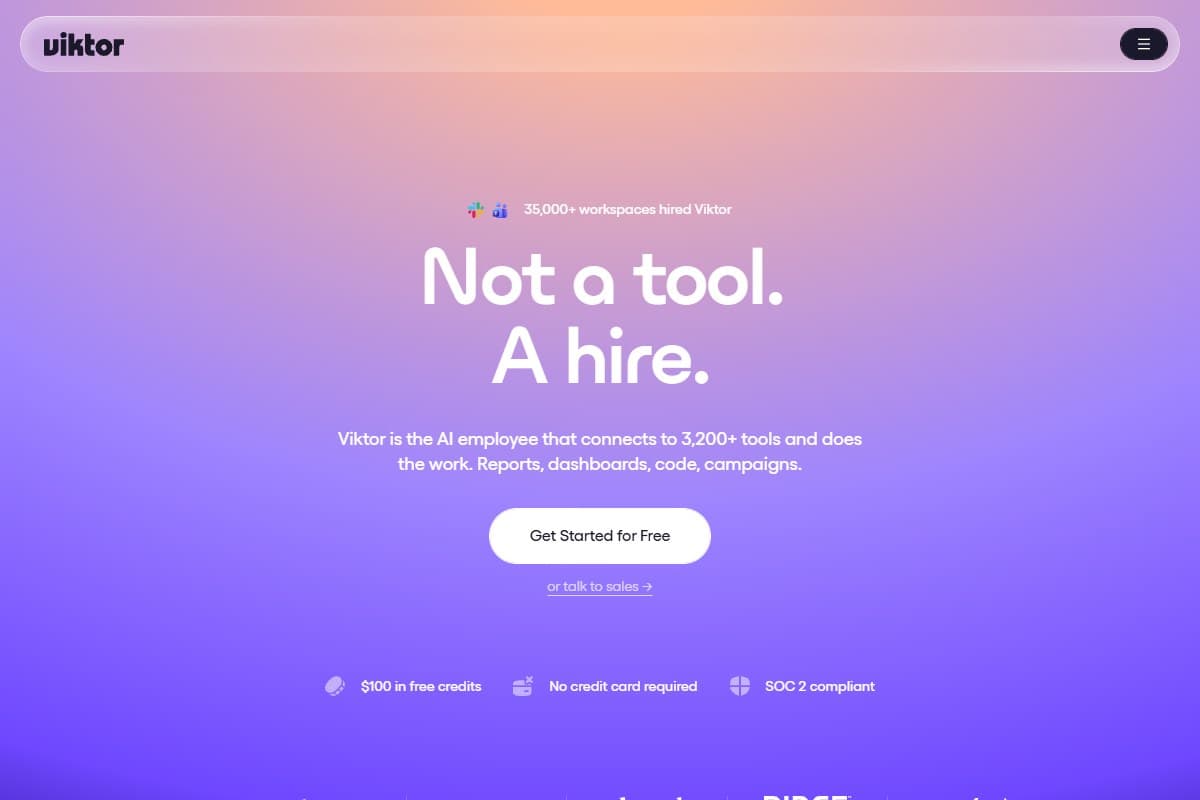
Here's the thing nobody tells you about most "AI agents" in 2026: they generate a beautiful plan and then wait for you to go do it. Viktor is the first one I've tested that doesn't. This Viktor AI review is based on running it inside a real Slack workspace, pointing it at actual tools, asking it for real deliverables, and watching the credit meter the whole time. Viktor lives where your team already works (Slack), connects to 3,000+ business tools, and the pitch on its homepage isn't subtle: "Not a tool. A hire."
Before I go further, one practical note that matters. Viktor gives $100 in free credits if you sign up direct, but signing up through this link gets you $150, an extra $50 of runway to actually test it on your own workflows before paying a cent. I'll come back to why that head start matters, because credits are the whole ballgame with this tool. Short version of my verdict: genuinely impressive, genuinely useful, and you need to understand the pricing before you commit. Worth it. With one caveat about credit burn I'll keep returning to.
What is Viktor?
Strip the marketing and Viktor is an autonomous AI agent that lives natively in Slack (Microsoft Teams is on the roadmap but not live yet, as of mid-2026). You don't open a separate app or learn a new interface. You @mention Viktor in a thread the same way you'd ping a colleague ("Viktor, pull last month's Stripe revenue, break it down by plan, and drop a PDF in #finance") and it goes and does it.
What makes it different from a chatbot is that Viktor runs in its own isolated cloud environment where it can write and execute code. It doesn't just describe what you should do; it queries your connected tools, processes the data, and produces a finished artifact. The founders (ex-Meta, with a team out of Meta, Google and Oxford) raised a $75M Series A led by Accel in May 2026, with personal investments from Slack co-founders Stewart Butterfield and Cal Henderson, Vercel's Guillermo Rauch, ElevenLabs' Mati Staniszewski, and ex-GitHub CEO Nat Friedman. When the people who built Slack put their own money into the AI that lives inside Slack, that's worth a second look.
- Slack-native: works in threads and @mentions, one-click install from the Slack App Directory.
- 3,000+ integrations: Stripe, Salesforce, HubSpot, GitHub, Jira, Linear, Notion, Google Ads, Meta Ads, and more, with real tool execution (not just reading).
- Persistent workspace memory: it remembers your team's context, tools, and past work between conversations.
The mental model that clicked for me: ChatGPT is a brilliant intern who answers questions. Viktor is the coworker you hand a messy, multi-tool task to on Friday and find finished on Monday. If you've read my Taskade AI agents review, it's the same 2026 shift (agents that act on your data), but Viktor pushes it further into "just give it to the agent and walk away" territory.
How I Tested This
Why Viktor is trending right now
Two things put Viktor in every AI-agent conversation this spring.
First, the $75M Series A from Accel in May 2026, with that founder-investor roster. Viktor reportedly hit $15M in annualised recurring revenue in roughly ten weeks, the kind of number that makes the whole category pay attention. Second, and more important for you: it's one of the few agents that has crossed from "impressive demo" to "actually does operational work." The April 2026 launch of a Skills Marketplace (ready-made automation packs, plus Viktor documenting its own learnings as reusable internal "skills") is what turned it from a clever toy into something teams run daily.
The broader context is that 2026 is the year AI agents stopped being chatbots with extra steps. The whole AI agents category is converging on the same idea (agents that read your real data and take real action), and Viktor's bet is that the best place to put that agent is inside the tool your team never leaves.
Key Features
After putting real work through it, these are the features that actually matter.
Cross-tool analytics (3,000+ integrations)
This is the headline capability and it's the real thing. Viktor can query multiple tools in a single run: pull numbers from Stripe, cross-reference Salesforce, layer in Google Ads spend, check a GitHub repo, and synthesize them into one answer. Most automation tools make you wire each connection manually. Viktor connects to 3,000+ tools and figures out the orchestration itself. When I asked for "revenue by plan with month-over-month change," it hit Stripe, did the math, and came back with the breakdown without me defining a single step.
Professional deliverables (reports, dashboards, PDFs)
Viktor doesn't hand you raw data; it hands you the finished artifact. Board-ready PDFs, dashboards your team can actually use, formatted reports. The Stripe revenue PDF it produced in my test looked like something a junior analyst would've spent an afternoon on. That "last-mile" output is what separates it from agents that dump a table in chat and call it done.
Proactive automation
You can set scheduled tasks and crons ("every Monday at 9am, post last week's metrics to #leadership"), and Viktor learns your team's patterns and starts proactively suggesting work. It's the difference between a tool you operate and a coworker who notices the weekly report is due and asks if you want it.
Viktor Spaces (app builder)
This one surprised me. Viktor Spaces lets it deploy actual web apps (backed by a Convex database, on custom subdomains), plus PowerPoint decks and even videos. I asked for a lightweight internal dashboard and got a deployed, working web app I could share by URL. It's not going to replace your engineering team for production software, but for internal tools and quick deliverables, "describe it in Slack, get a deployed app" is a genuinely new capability.
Codebase engineering
Viktor connects to your repos and can write code, open pull requests, and build/deploy. In my test it opened a clean PR for a small bug fix that I could review like any other. This puts it in the same conversation as coding agents like Devin, though Viktor's angle is "operational coworker that can also code" rather than "dedicated software engineer." For non-trivial engineering it's a helper, not a replacement, but for the small fixes and internal scripts that clog up a backlog, it's legitimately useful.
Human approval system for sensitive actions
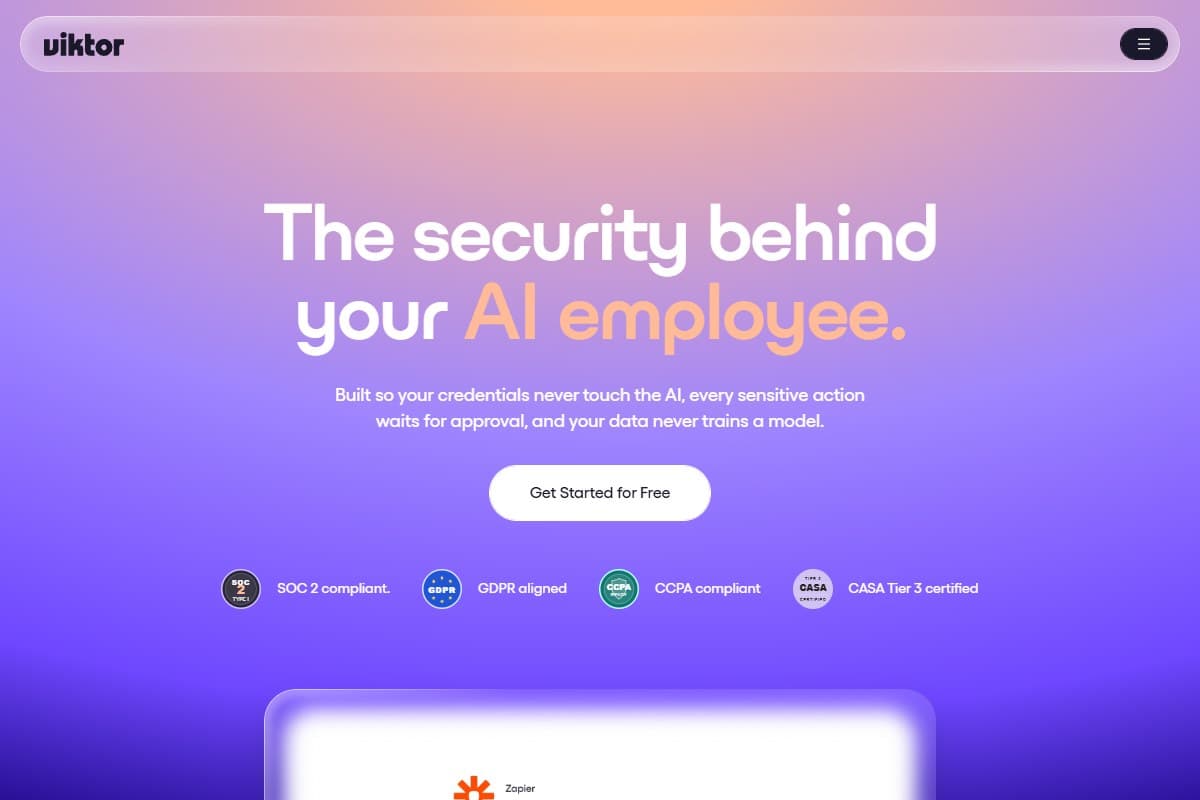
This is the feature that earned a lot of my trust, and it's worth correcting a claim I've seen floating around: Viktor is not recklessly autonomous. Human-in-the-loop is on by default. Sensitive actions (sending customer emails, deploying to production, anything that moves money) show up as approve / reject buttons right in Slack, and nothing executes until someone clicks approve. You can configure which action types require approval, and the defaults are conservative. Pair that with the security posture (credentials live in an AES-256 vault, are never exposed to the AI model, and are injected server-side at execution time; Viktor doesn't train on your data), and you have an agent you can actually point at real business systems. More on the security angle below, because for business buyers it's the whole decision.
Pricing: is it worth it?
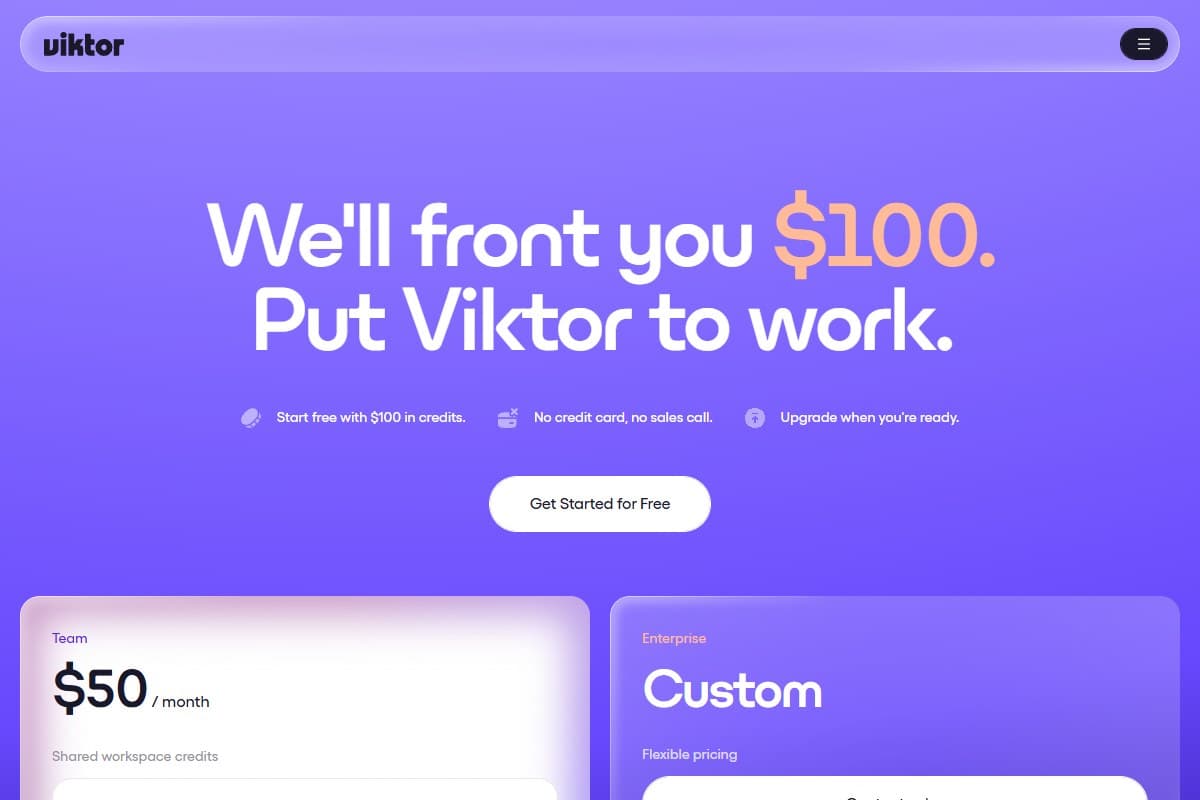
Viktor's pricing is credit-based and workspace-based, so there are no per-seat charges, which is unusual and genuinely good for teams. You pay for what the agent does, not how many people watch it work.
- $100 credits direct (no card)
- $150 via affiliate link
- Slack-native agent
- All integrations
- Best for: testing it on real work
- 20,000 credits/month (auto-refresh)
- Persistent workspace context
- Scheduled tasks & crons
- Human-approval gating
- Best for: founders + small teams
- 125,000–300,000 credits/month
- Same full feature set
- Higher autonomous volume
- Best for: growing companies running daily work
- Millions of credits/mo
- DPA, SLA, security review
- Dedicated onboarding
- Best for: large orgs
Here's the honest math, and it's the most important part of this review. The headline is "$50/month," but credits are the real unit of cost. Quick tasks run 100–300 credits, complex multi-tool workflows run 500–1,500, and full projects (a deployed app, a big report) run 2,000–5,000. The 20,000 monthly credits on the Team tier sound like plenty until you run a few complex workflows a day. Real-world reports put heavy users at $150–$400/month once you account for credit top-ups above the base plan.
That's not a knock; it's just the truth you need going in. Viktor is doing real compute-heavy work (running code, querying dozens of tools), and there's no markup on model costs with smart caching to reduce spend, so the pricing is fair for what it does. But if you're used to the flat, predictable billing of something like my Make.com review breaks down, the variable credit model is a genuine adjustment. This is exactly why the $150 free-credit head start matters: use it to measure your actual burn rate on your actual workflows before you pick a tier. Budget by workload, not by the headline price.
Who Viktor is best for
Buy it if you are:
- A founder who wants to offload the recurring "pull the numbers, make the report" work that eats your week. Viktor lives in the Slack you're already in.
- A marketing lead managing Google Ads / Meta Ads campaigns who wants performance dashboards and campaign reports without exporting CSVs by hand.
- An ops person wiring together CRM updates, ticket triage, and cross-tool reporting where the value is in finishing the task, not planning it.
- An engineering team that wants an agent to clear small PRs, build internal tools, and handle the backlog of "someone should automate this."
- Any Slack-first team that wants AI that acts inside their real systems with human-approval guardrails.
Who should avoid Viktor
Skip it (try alternatives) if you are:
- A Microsoft Teams shop. Teams support is on the roadmap but not live as of mid-2026, so today this is Slack-only with no standalone web app.
- Someone who needs flat, predictable AI costs. The credit model means heavy months cost more, and that's a real planning headache. A fixed-price automation tool fits better.
- In a HIPAA or FedRAMP environment. Viktor is SOC 2 Type 1 (Type 2 and ISO 27001 in progress) and GDPR/CCPA aligned, but it doesn't carry HIPAA or FedRAMP certifications yet.
- Just looking for a Q&A chatbot. If you only need answers over your docs, a focused tool like the one in my Chatbase review is cheaper and simpler. Viktor is overkill for pure assistant work.
Pros and cons
What I liked:
- It actually finishes tasks. Cross-tool runs that other agents only plan, Viktor completes: Stripe to PDF, Ads to dashboard, all end to end.
- Slack-native is the right call. No new interface, no context-switching. @mention it like a coworker. The adoption friction is near zero.
- Human-approval gating is excellent. Approve/reject buttons in Slack for sensitive actions, on by default and configurable. This is how you make an autonomous agent safe to trust.
- Serious security for a young company. AES-256 credential vault, credentials never exposed to the model, no training on your data, isolated per-workspace compute. SOC 2, GDPR/CCPA, CASA Tier 3.
- No per-seat pricing. Workspace-based billing means the whole team can use it without your bill scaling by headcount.
- Viktor Spaces is a real surprise. Deployed web apps with a database, from a Slack message.
What frustrated me:
- Credit burn is unpredictable and adds up. The $50 headline is honest only for light use; heavy users land at $150–$400/mo. You must watch the meter.
- Slack-only today. No Teams, no standalone web interface yet. If your team isn't in Slack, this isn't for you right now.
- Compliance gaps for regulated industries. SOC 2 Type 2 and ISO 27001 are still in progress, and there's no HIPAA/FedRAMP.
- It's a young, fast-moving product. Founded in 2023 and scaling at breakneck speed, so expect rapid changes, and the occasional rough edge that comes with it.
How Viktor compares to alternatives
Viktor sits in an interesting spot: more autonomous than a workspace tool like Taskade, more "does the whole job" than a pure automation runner like Make.com, and more operations-focused than a dedicated coding agent like Devin.
| Tool | Rating | Price | Best for | Verdict |
|---|---|---|---|---|
| Viktor | 4.3/5 | $50/mo + credits | An autonomous AI coworker inside Slack that finishes cross-tool work | Best at end-to-end execution with human approval. Watch the credit burn. |
| Taskade | 4.2/5 | $16/mo Pro | AI agents inside a real project workspace | Cheaper and great for project work, but you operate it more; it's not Slack-native. |
| Make.com | 4.4/5 | $9–$16/mo | Powerful visual automation, cheap per operation | Best for predictable, rule-based pipelines. Less 'agent', more 'wiring'. |
| Use case | Winner |
|---|---|
| Finishing a cross-tool task end to end in Slack | Viktor |
| Cheapest agent inside a project workspace | Taskade |
| Predictable, flat-cost rule-based automation | Make.com |
| Human-approval guardrails for sensitive actions | Viktor |
| Deploying a quick internal web app from a chat | Viktor |
| Complex branching/looping automation pipelines | Make.com |
The honest framing: if your work is operational and lives across many tools, and you want an agent that takes the whole task off your plate from inside Slack, Viktor wins; nothing else I've tested finishes the job as completely. If you want affordable agents in a project workspace, Taskade is the value pick. If you want predictable, deterministic automation, Make.com is cheaper and more controllable. You can line all three up side by side on our compare tool to see pricing and ratings together.
Final verdict: 4.3 out of 5
Here's the breakdown.
On capability, Viktor is a 4.7. It's the first "AI coworker" I've tested that genuinely earns the label: it lives in Slack, connects to 3,000+ tools, and finishes cross-tool work that other agents only plan. The human-approval gating is the best I've seen, Viktor Spaces deploying real web apps from a chat message is a legitimate surprise, and the security posture (AES-256 credential vault, no training on your data, isolated compute, SOC 2 / GDPR / CCPA) is serious for a company barely out of seed stage.
I'm holding back the last 0.7 of a point for three honest reasons: (1) the credit model is unpredictable, since the $50 headline becomes $150–$400/mo for real use, and that variable cost is a genuine planning burden; (2) it's Slack-only today with no Teams or standalone web app, which rules out a big chunk of teams; and (3) the compliance gaps (SOC 2 Type 2 and ISO 27001 in progress, no HIPAA/FedRAMP) keep it out of the most regulated environments for now. None of those are dealbreakers for the core audience. All of them are real.
Net: if you're a founder or a Slack-first team and you want AI that does the work instead of describing it, Viktor is the most complete agent I've used in 2026. Start with the $150 in free credits through this link, throw your messiest cross-tool task at it, and watch how fast the credits move before you pick a paid tier. That free runway is the smartest way to find out if it fits how your team actually works.
FAQ: Viktor AI review
How much does Viktor cost in 2026?
Viktor is credit-based and workspace-based with no per-seat charges. You start with $100 in free credits direct (or $150 through an affiliate link), then the Team tier is $50/month for 20,000 credits, scaling up through roughly $300–$750/month for growing companies and into custom Enterprise pricing. The thing to know going in: credits are the real cost. Quick tasks run 100–300 credits, complex workflows 500–1,500, and full projects 2,000–5,000, so heavy users typically spend $150–$400/month.
Is Viktor actually autonomous, or does it ask before doing things?
Both, by design. Viktor completes tasks end to end on its own, but human-in-the-loop is on by default for sensitive actions. Sending emails, deploying to production, or anything that moves money appears as approve/reject buttons right in Slack, and nothing executes until your team approves. You can configure which action types require approval, with conservative defaults, so it's autonomous where it's safe and gated where it counts.
Does Viktor work with Microsoft Teams?
Not yet. As of mid-2026 Viktor is Slack-only, with Microsoft Teams support listed on the roadmap but not live, and there's no standalone web interface. If your team runs on Teams rather than Slack, Viktor isn't a fit today, though it's worth watching, since Teams support is publicly planned.
Is Viktor secure enough for business data?
For most businesses, yes. Credentials are stored in an AES-256 encrypted vault, never exposed to the AI model, and injected server-side only at execution time. Viktor doesn't train on your data, runs each workspace in isolated compute, and is SOC 2 Type 1, GDPR/CCPA aligned, and CASA Tier 3 certified, with SOC 2 Type 2 and ISO 27001 in progress. The gaps to note: there's no HIPAA or FedRAMP certification yet, so the most heavily regulated industries should wait or go through Enterprise with a DPA.
Viktor vs Taskade vs Make.com: which should I pick?
Pick Viktor if you want an autonomous AI coworker inside Slack that finishes cross-tool operational work and you can budget for variable credit costs. Pick Taskade if you want affordable AI agents living in a real project workspace at $16/mo. Pick Make.com if you want predictable, flat-cost, rule-based automation pipelines. Viktor is the most "hands-off," Make is the most controllable, and Taskade is the value middle ground.
What can Viktor actually build or do?
Quite a lot. It produces board-ready PDFs and dashboards, pulls and synthesizes data across 3,000+ tools in a single run, writes code and opens pull requests, builds and deploys lightweight web apps (Viktor Spaces, backed by a Convex database on custom subdomains), runs scheduled tasks, and proactively suggests work based on your team's patterns. The core promise is finishing the whole task (data to deliverable) rather than handing you a plan.
Related reviews
- AI Agents topic hub: every AI agent and coworker review on the site in one place.
- Taskade Review 2026: AI Agents v2: affordable AI agents inside a project workspace, the value alternative to Viktor.
- Make.com Review 2026: predictable, flat-cost automation if you'd rather wire pipelines than trust an agent.
- Chatbase Review 2026: a focused AI assistant if you only need Q&A over your docs, not a full coworker.
- Compare AI tools side by side: line Viktor up against the alternatives on pricing and ratings.
Got a Viktor question I didn't cover, or a Slack workflow you want me to throw at it? Get in touch. Reader questions shape the next round of reviews.
Free interactive tool
Compare Viktor with other AI toolsSide-by-side pricing, features, and ratings — plus a recommended pick for your use case.
Independent AI tools researcher
Keep reading
Related reviews

Best AI Agents 2026: I Tested 7 Tools and Ranked Them
I tested 7 AI agents in 2026 on the same real workflows. Taskade, Chatbase, CustomGPT, Viktor and more, ranked by what they actually finish.

New Siri AI 2026: Apple Intelligence Rebuilt from Scratch (What's Actually New)
Apple rebuilt Siri at WWDC 2026 on its own Foundation Models: personal context, onscreen awareness, and the Gemini-under-the-hood question.

Claude Fable 5 Review: Anthropic's Most Powerful Public Model Ever (First Look)
Anthropic just made its most powerful model public. I spent launch day testing Claude Fable 5: benchmarks, pricing, the Opus fallback, and the catch.