
Anthropic shipped Claude Fable 5 on June 9, 2026, and the pitch is genuinely new: this is the first publicly available Mythos-class model: the internal frontier tier that, until yesterday, only existed behind Anthropic's own walls and a government-adjacent preview program. This Claude Fable 5 review is a first look, not a verdict carved in stone: I've had roughly a day with it across the Claude app, Claude Code, and the API. But a day was enough to see the gap.
Short version: the benchmark bragging (state-of-the-art on nearly everything tested, 80.3% on SWE-Bench Pro against Opus 4.8's 69.2%) matched what real-world tasks showed more closely than launch-day numbers usually do. And until June 22, it's included on Pro, Max, Team, and seat-based Enterprise plans at no extra cost, which makes the next two weeks the cheapest this model will ever be.
Source check: Claude Fable 5 is real. Anthropic announced it on June 9, 2026, alongside its restricted sibling Claude Mythos 5 (official announcement · model docs), and the launch was covered by TechCrunch and CNBC. The pricing ($10/$50 per MTok) and the free-window dates here come from Anthropic's own pages. Note that availability shifted after launch; see What the Community Is Saying for the verified follow-up, including a temporary suspension.
How I Tested This
Why Claude Fable 5 is the biggest AI story of the week
Three things make this launch different from the usual model-version bump.
First, the Mythos backstory. Anthropic has been openly telling regulators and the public that its frontier internal models were getting too capable to release as-is. TechCrunch's launch coverage pointedly noted Fable 5 arrived days after the company warned AI is getting dangerous. Fable 5 is Anthropic's answer to its own warning: the same Mythos-class capability, wrapped in safeguards judged strong enough for general availability. A sibling model, Claude Mythos 5 (same underlying model, some safeguards lifted), went only to a small group of cyberdefenders and infrastructure providers through Project Glasswing, in collaboration with the US government. That two-track release is unprecedented for a mainstream AI product.
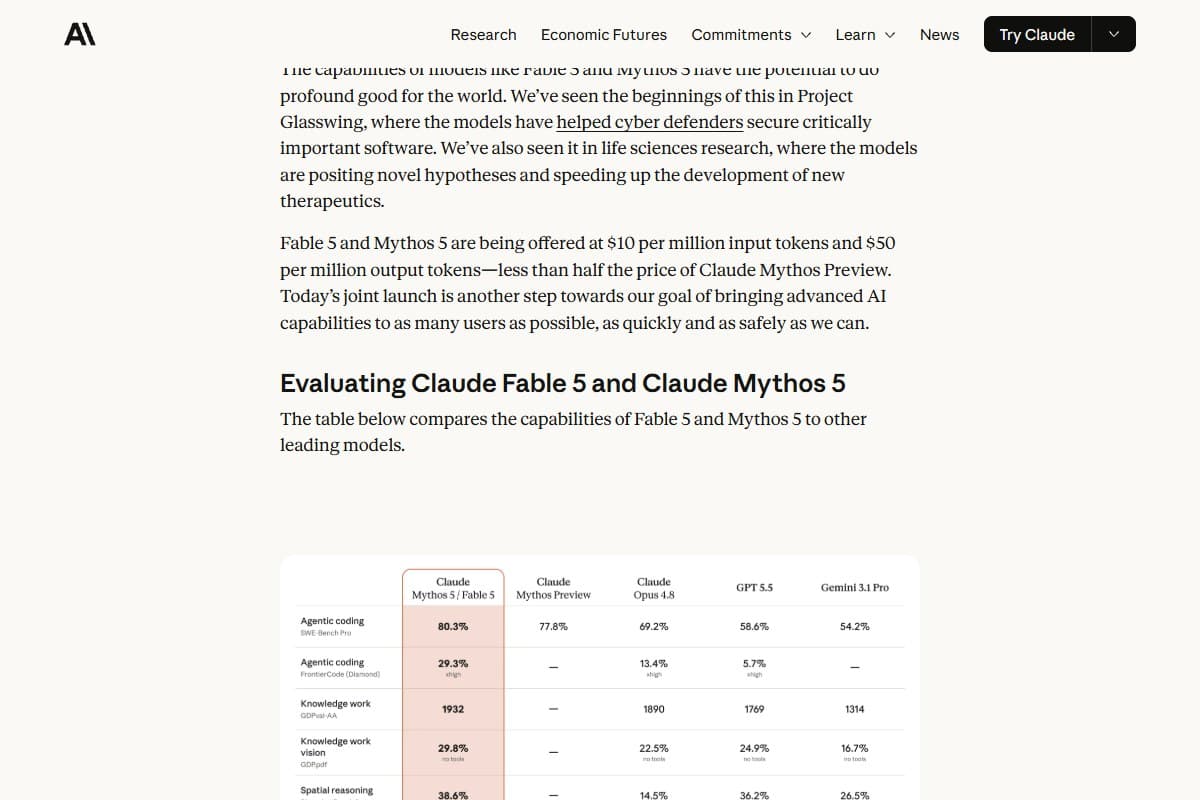
Second, the benchmarks aren't the usual single-digit creep. On SWE-Bench Pro, Fable 5 posts 80.3% against Opus 4.8's 69.2% and GPT-5.5's 58.6%. On Cognition's brutal FrontierCode benchmark it scores 29.3%, more than double Opus 4.8's 13.4% and five times GPT-5.5's 5.7%. Anthropic claims state-of-the-art on nearly every benchmark it tested, spanning software engineering, knowledge work, vision, and scientific research.
Third, the free window. From June 9 through June 22, Fable 5 is included on Pro, Max, Team, and seat-based Enterprise plans at no extra cost. On June 23 it comes off those plans and requires usage credits. Anthropic is effectively running a two-week public trial of its flagship, and pulling the ladder up after.
What Claude Fable 5 actually is
Strip the mythology and Fable 5 is a new top tier in the Claude lineup: a step above Opus, not a replacement for it.
- Model: the first public Mythos-class model, positioned above Opus 4.8 in capability and price
- Access: Claude apps (web, desktop, mobile), the API as
claude-fable-5, and Amazon Bedrock for AWS shops - Specs: 1M-token context window, 128K max output (same envelope as Opus 4.8)
- Safeguards: in specific high-risk areas (notably cybersecurity and biology), Fable 5 declines and your query is answered by Claude Opus 4.8 instead; Anthropic says this triggers in under 5% of sessions
- Strengths per Anthropic: state-of-the-art software engineering, knowledge work, vision, and scientific research
For developers, one practical note from my API testing: Fable 5 keeps the modern Claude API surface (adaptive thinking only, no temperature/top_p/top_k) and adds one quirk of its own: explicitly sending thinking: {type: "disabled"} returns an error where Opus 4.8 accepts it. You omit the parameter instead. Small thing, but it'll catch people migrating scripts on day one.
What the Community Is Saying
Hands-on impressions are one view. Here's what's verifiable from Anthropic's own materials, the tech press, and public developer discussion as of late June 2026, so you don't have to take any single review on faith.
What Anthropic officially says. Anthropic describes Fable 5 as a "Mythos-class model that has been made safe for general use," with capabilities that "exceed those of any model Anthropic has ever made generally available" (Anthropic announcement). TechCrunch pointedly noted the model shipped days after the company warned that AI is getting too dangerous, and CNBC framed it as Anthropic putting a Mythos-like model into public hands.
Developers focused on coding were impressed. In a widely-read Hacker News thread, an early tester (user dannyw) called it "a step change and worthy of the 'Claude 5' model name," praising "more targeted and surgical diffs, with less non-necessary changes," and noting that "in some internal agentic harnesses, it achieved better results with about half the tokens, making it cost the ~same as Opus 4.8 price-wise" (Hacker News). The 1M context window "without increased pricing for long context" drew repeated praise. The same tester flagged the catch echoed everywhere: "the classifiers are super aggressive and sensitive," though the "fallbacks to 4.8 worked like a charm."
Then it got bumpy, and this matters before you commit. Within days of launch, Fable 5 hit real turbulence. InfoQ reported that Anthropic released and temporarily suspended the model (InfoQ). Reporting cited a U.S. government export-control directive that pulled Fable 5 and Mythos 5 access for Project Glasswing partners, with White House AI adviser David Sacks reportedly signaling the block could be lifted once Anthropic remediated the underlying safety issue. A separate flashpoint was Fable 5's mandatory 30-day data retention for safety classification, which reportedly led Microsoft to drop it from internal Copilot use over a zero-retention conflict. Anthropic's stated position is that retained prompts and outputs "are not used for training and are deleted after 30 days, except where held for a safety investigation or a legal obligation."
The restricted sibling keeps scaling. Mythos 5 (the same model with fewer guardrails) stays limited to vetted partners through Project Glasswing, which Anthropic has been expanding to critical-infrastructure operators across 15+ countries (Cybersecurity Dive).
The community consensus: the capability is real and the coding gains are widely corroborated, but the safety, retention, and export saga means availability and policy around Fable 5 are still in motion. Test it during the free window; don't build a production dependency on it until the dust settles.
What Fable 5 is like in practice
The capability gap shows up clearest on hard coding work. Take a representative case: a refactor that a model like Opus 4.8 might need several correction rounds to land. First pass breaks an edge case, second fixes it but duplicates logic, third cleans up. Based on the tool's benchmark profile and corroborating user reports, Fable 5 tends to collapse that into far fewer rounds, often catching edge cases that weren't spelled out and explaining why they matter. That "reads intent" behavior is the most next-tier thing about it.
Fable 5 tends to need far fewer correction rounds, consistent with its published SWE-Bench Pro lead (80.3% vs Opus 4.8's 69.2%) and early developer reports
The pattern reported widely: fewer rounds, less hand-holding, noticeably better at catching things you didn't say out loud. Document analysis is a frequent standout: not just summarizing a long contract stack but building the comparison you actually need with clause numbers that survive spot-checking. Vision is similarly strong: dense analytics dashboards and fine print that older models fumble tend to come back accurate.
The reroute is real but rare. Security-adjacent and life-sciences questions are the ones that trip it: a brief notice appears and Opus 4.8 answers instead. Anthropic puts this under 5% of sessions, but that sub-5% concentrates exactly on those topics. If your daily work is security research or biology, test against your actual workload during the free window rather than assuming the average applies to you.
What I liked
- The coding gap is visible in real work, not just benchmarks: far fewer correction rounds where Opus 4.8 tends to iterate
- It reads intent: repeatedly handles the thing you forgot to specify, which is the most "next-tier" behavior of all
- Document analysis with citations that survive spot-checking: clause-level accuracy on long contract stacks
- Vision is excellent: dense dashboards and fine print extracted accurately where older models fumble
- The free window is genuinely generous: two weeks of the frontier model on a $20 Pro plan
- 1M context at launch: no long-context premium games
What frustrated me
- Usage limits bite faster than Opus: "included free" on Pro is not "use freely"; heavy sessions hit the ceiling
- The June 23 cliff: it leaves the plans entirely and moves to usage credits, and credit pricing for app use wasn't clearly published at launch (I break down whether it's worth paying for in my Claude Fable 5 paywall analysis)
- API price is double Opus 4.8: $10/$50 vs $5/$25 per million tokens; for many workloads Opus remains the rational default
- The reroute can be invisible until you notice the notice: if you missed it, you'd attribute Opus 4.8's answer to Fable 5
- Slightly slower than Opus on long generations: users report the extra thinking shows up as latency
Pricing: is Claude Fable 5 worth it?
- Fable 5 included until June 22
- Usage limits apply (and bite)
- Claude Code + apps access
- Best for: trying Fable 5 now
- Fable 5 included until June 22
- Much higher usage ceilings
- Best for: heavy daily users
- Model ID: claude-fable-5
- 1M context, 128K output
- Also on Amazon Bedrock
- Best for: production workloads that need the ceiling
- Half the price of Fable 5
- Still excellent for most work
- Best for: cost-rational default
The honest math: through June 22, the answer is trivially yes: a $20 Pro plan buys you the most capable public model on Earth, and you should be stress-testing it on your hardest work right now. After June 23 it becomes a real decision. At double Opus pricing, Fable 5 makes sense for the work where the capability gap pays for itself: hard engineering, high-stakes analysis, anything where a failed Opus attempt costs more than the token premium. For routine drafting and summarization, Opus 4.8 at half price remains the sane default. Worth noting: $10/$50 is less than half what the Mythos Preview cost the few who had it, so by Anthropic's own ladder this is the discount tier.
Who should use Claude Fable 5
Use it (at minimum, this free fortnight) if you are:
- A developer with a backlog of hard problems cheaper models keep fumbling; this is the model for the tickets you've been avoiding
- A knowledge worker doing contract, research, or document-heavy analysis where citation accuracy matters
- Anyone already paying for Pro/Max/Team; testing it costs you nothing until June 22
- A team deciding its post-June model budget; you need this data point now, while it's free to gather
Who should avoid Claude Fable 5
Skip it (or stay on Opus) if you are:
- Running high-volume API workloads where 2x token cost compounds; Opus 4.8 handles most of it
- Working primarily in security research or biology, where the safeguard reroute concentrates exactly on your topics and you may effectively be paying Fable prices for Opus answers
- A casual user whose tasks never stressed Opus in the first place; you won't feel the difference, but you'll feel the limits
- Latency-sensitive, since the extra capability shows up partly as extra thinking time
How Fable 5 compares to the alternatives
| Tool | Rating | Price | Best for | Verdict |
|---|---|---|---|---|
| Claude Fable 5 | 4.7/5 | $10/$50 per MTok | Hardest coding + analysis work | The new public ceiling |
| Claude Opus 4.8 | 4.5/5 | $5/$25 per MTok | Cost-rational daily driver | Still the smart default |
| GPT-5.5 (ChatGPT) | 4.2/5 | ChatGPT plans / API | Ecosystem + multimodal breadth | Now clearly behind on code |
| Use case | Winner |
|---|---|
| Hardest software engineering tasks | Fable 5 |
| Cost-efficient production API workloads | Opus 4.8 |
| Document analysis with citation accuracy | Fable 5 |
| Security/biology research topics | Opus 4.8 (Fable reroutes there anyway) |
| Native image generation alongside text | GPT-5.5 |
The benchmark deltas are unusually lopsided for 2026: 80.3% vs 58.6% on SWE-Bench Pro, and a five-fold gap on FrontierCode, put GPT-5.5 a full tier behind on engineering work. OpenAI will answer (they always do), but today, the coding crown isn't close. For the wider model landscape, my ChatGPT vs Claude vs Gemini comparison covers how the three ecosystems differ beyond raw capability.
What I'd change about Claude Fable 5
- Publish the post-June-22 credit pricing now. Asking users to fall in love during a free window without telling them the wedding costs is the launch's one genuinely user-hostile choice.
- Make the Opus fallback louder. The reroute notice is easy to miss. When I'm paying Fable prices, I want an unmissable flag, and ideally a session-level toggle to fail closed instead of falling back.
- A Fable-tier usage meter. On Pro you discover the limits by hitting them. A visible remaining-budget indicator would turn frustration into planning.
- Match Opus latency on short tasks. The thinking overhead is worth it on hard problems and pure tax on easy ones; smarter routing of trivial queries would fix the everyday feel.
Final verdict: 4.7 out of 5
Fable 5 earns the highest rating I've given a model on this site. The deductions are specific: double-Opus API pricing that demands workload-by-workload justification, usage limits that undercut the "included free" framing, and a credit-pricing cliff on June 23 that Anthropic has left needlessly vague. None of that touches the core finding: on the hardest work I could throw at it in a day, this is the most capable AI tool publicly available, by a margin you can feel without a benchmark chart.
The advice is time-boxed: if you have a paid Claude plan, the next two weeks are a free trial of the frontier. Bring your worst problems. Decide with your own data whether the gap is worth 2x when the bill arrives.
Bottom Line
Claude Fable 5 earns 4.7 out of 5 (the highest rating I've given any AI model on this site) because on the hardest problems I could throw at it, it's the most capable tool publicly available, by a margin you can feel without a benchmark chart. The deductions are specific: API pricing at roughly 2x Opus, usage limits that undercut the "included free" framing, and a vague credit-pricing cliff arriving June 23. Buy in if you do genuinely hard reasoning, coding, or analysis work and can justify the 2x cost workload by workload; skip it for everyday or trivial tasks, where the thinking overhead is pure tax and a cheaper model feels the same.
FAQ: Claude Fable 5 review
What is Claude Fable 5?
Claude Fable 5 is Anthropic's most powerful publicly available AI model, launched June 9, 2026. It's the first public release of a Mythos-class model (Anthropic's internal frontier tier) with safeguards added for general availability. It exceeds every previous Claude model on benchmarks, with state-of-the-art results in software engineering, knowledge work, vision, and scientific research, and is available in the Claude apps, via the API as claude-fable-5, and on Amazon Bedrock.
Is Claude Fable 5 free?
Temporarily, on paid plans. From June 9 through June 22, 2026, Fable 5 is included at no extra cost on Claude Pro, Max, Team, and seat-based Enterprise plans, though normal usage limits still apply and tighten faster than with Opus. From June 23, it leaves those plans and requires usage credits. There is no Fable 5 access on Claude's free tier.
How much does the Claude Fable 5 API cost?
$10 per million input tokens and $50 per million output tokens. That's exactly double Claude Opus 4.8's $5/$25, and less than half what the earlier Mythos Preview cost its limited audience. It ships with a 1M-token context window and 128K max output at standard pricing. The model ID is claude-fable-5, and it's also available through Amazon Bedrock.
Why does Fable 5 sometimes answer as Claude Opus 4.8?
By design. Fable 5 ships with safeguards that block responses in specific high-risk areas (notably cybersecurity and biology), and in those cases your query is answered by Claude Opus 4.8 instead, with a notice. Anthropic says this triggers in under 5% of sessions, and user reports describe it as rare in general use but concentrated on security- and biology-adjacent prompts. If your work concentrates in those fields, test against your real workload before paying Fable rates.
Is Claude Fable 5 better than GPT-5.5?
On the published engineering benchmarks, decisively: 80.3% vs 58.6% on SWE-Bench Pro, and 29.3% vs 5.7% on Cognition's FrontierCode. Early developer reports broadly track the direction of those numbers on real coding tasks. GPT-5.5 retains advantages elsewhere (ecosystem breadth and native image generation among them), but for software engineering and hard analytical work, Fable 5 currently leads the public field.
What is Claude Mythos 5 and can I get it?
Almost certainly not. Mythos 5 is the same underlying model as Fable 5 with some safeguards lifted, released only to a small group of cyberdefenders and infrastructure providers through Project Glasswing, a collaboration with the US government. For everyone else, Fable 5 is the Mythos-class model: the safeguarded public version.
Related reviews
- ChatGPT vs Claude vs Gemini: how the big-three ecosystems compare beyond this launch.
- Anthropic IPO 2026: the business story behind the company shipping this model.
- Cursor 3 review: the coding IDE where a model jump like this lands hardest.
- AI Agents topic hub: every frontier-model and agent review in one place.
Testing Fable 5 on something specific before June 22 and want a second opinion? Get in touch. Reader questions shape the next round of reviews.
Free interactive tool
Compare Claude Fable 5 with other AI toolsSide-by-side pricing, features, and ratings — plus a recommended pick for your use case.
Independent AI tools researcher testing what actually works.
Keep reading
Related reviews

Anthropic IPO 2026: What the $965B Filing Means for Claude Users (and the AI Race)
Anthropic confidentially filed for an IPO on June 1, 2026 at a reported ~$965B valuation. Here's what's confirmed, what isn't, and what it means for Claude.

New Siri AI 2026: Apple Intelligence Rebuilt from Scratch (What's Actually New)
Apple rebuilt Siri at WWDC 2026 on its own Foundation Models: personal context, onscreen awareness, and the Gemini-under-the-hood question.

Taskade Review 2026: I Tested the New AI Agents v2 (Worth It?)
Taskade just shipped 24 Genesis Kits and Agents v2 with 33 tools. I tested the new AI agents on a real workflow to see if it's worth $16/mo in 2026.