
At WWDC 2026 on June 8, 2026, Apple did the thing it has been promising, and missing, since 2024: it rebuilt Siri from the ground up. Not a new voice, not a few canned answers. A completely new assistant running on a second generation of Apple Foundation Models, with the four capabilities people have wanted for years finally bundled into one product. This is the new Siri AI 2026 story, and it doubles as the Apple Intelligence 2026 reset: the point where Apple stops shipping summaries and notification triage and starts shipping an assistant that actually understands your phone.
This is a first-look, written days after the keynote. I haven't lived with it yet, and neither has anyone outside the developer program, because the public beta isn't here until later in 2026. So treat what follows as analysis of what Apple showed and shipped to developers, with the demo-to-reality gap flagged honestly throughout. Short version: the architecture is right, the four pillars are exactly what Siri has been missing, and the privacy story is genuinely differentiated. The asterisks are the timeline (a "this fall" promise from the company that broke its last one) and the Gemini question under the hood.
How I assessed this (it's a first look, not a hands-on review)
What "rebuilt from scratch" actually means
Every WWDC says something is "all-new." This one earns it, because the change is in the foundation, not the paint.
The old Siri was a request-router: it pattern-matched your phrase to a small set of intents and either handled it or punted to web search. It had no real memory of your stuff, no awareness of what was on your screen, and no ability to chain actions across apps. That architecture is why "Siri, what was the name of that restaurant my sister texted me?" never worked: Siri couldn't read your messages, reason over them, and act.
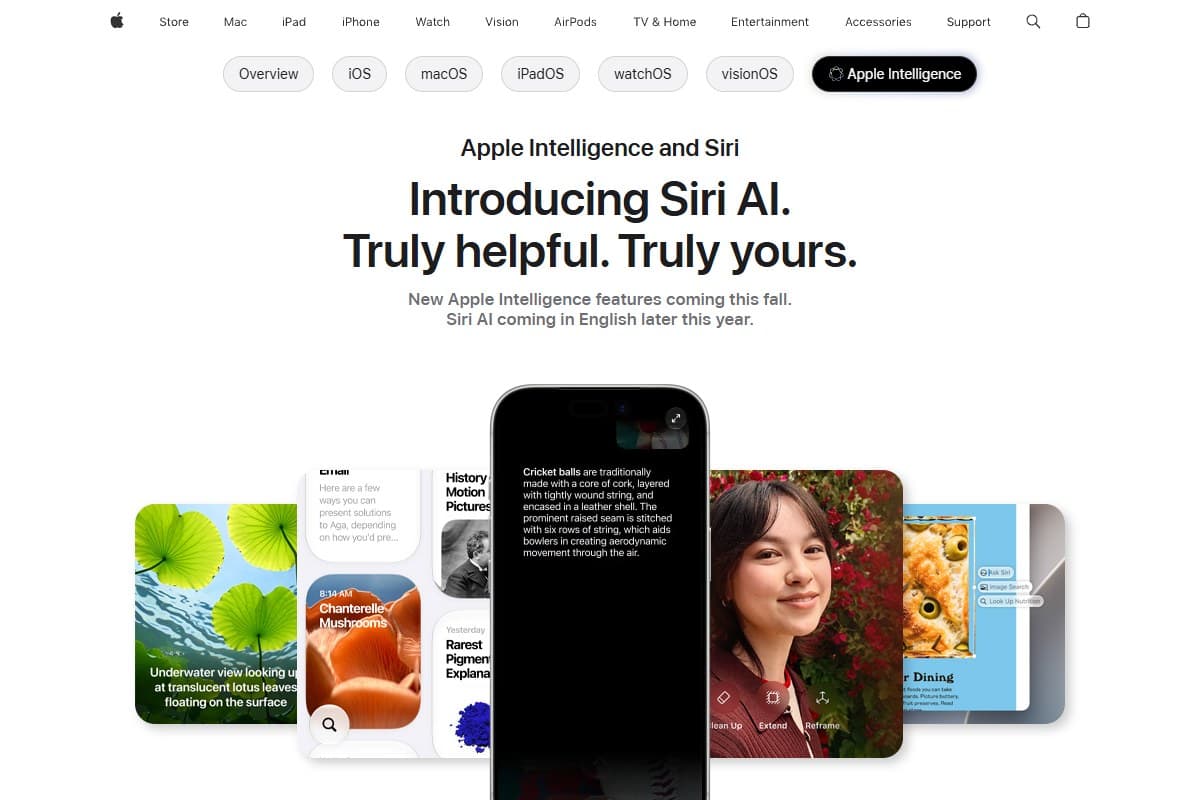
The new Siri AI is built on a new generation of Apple Foundation Models, Apple's own models that can understand speech and read both text and images, running in a hybrid setup: smaller models on-device for speed and privacy, larger models in the cloud via Private Cloud Compute for the hard requests. It's the same on-device/cloud split Apple introduced with Apple Intelligence in 2024, but pointed at a far more capable assistant. Craig Federighi's framing in the newsroom post:
"With access to broad world knowledge for up-to-date answers on virtually any topic, along with onscreen awareness and personal context understanding, Siri AI can help users take action across apps more naturally than ever."
That sentence is basically the whole product. Let's break the four pillars down.
The four things that are actually new
1. Personal context understanding
This is the headline. The new Siri can search across your messages, emails, and photos to surface what you're actually asking about, and reason over it. The "what was that restaurant my sister recommended" example finally works, because Siri can read the thread, find the name, and pull it up. It's the feature Apple demoed in 2024, then quietly delayed. In 2026 it's back, and it's the difference between an assistant that knows facts and one that knows your facts.
2. Onscreen awareness
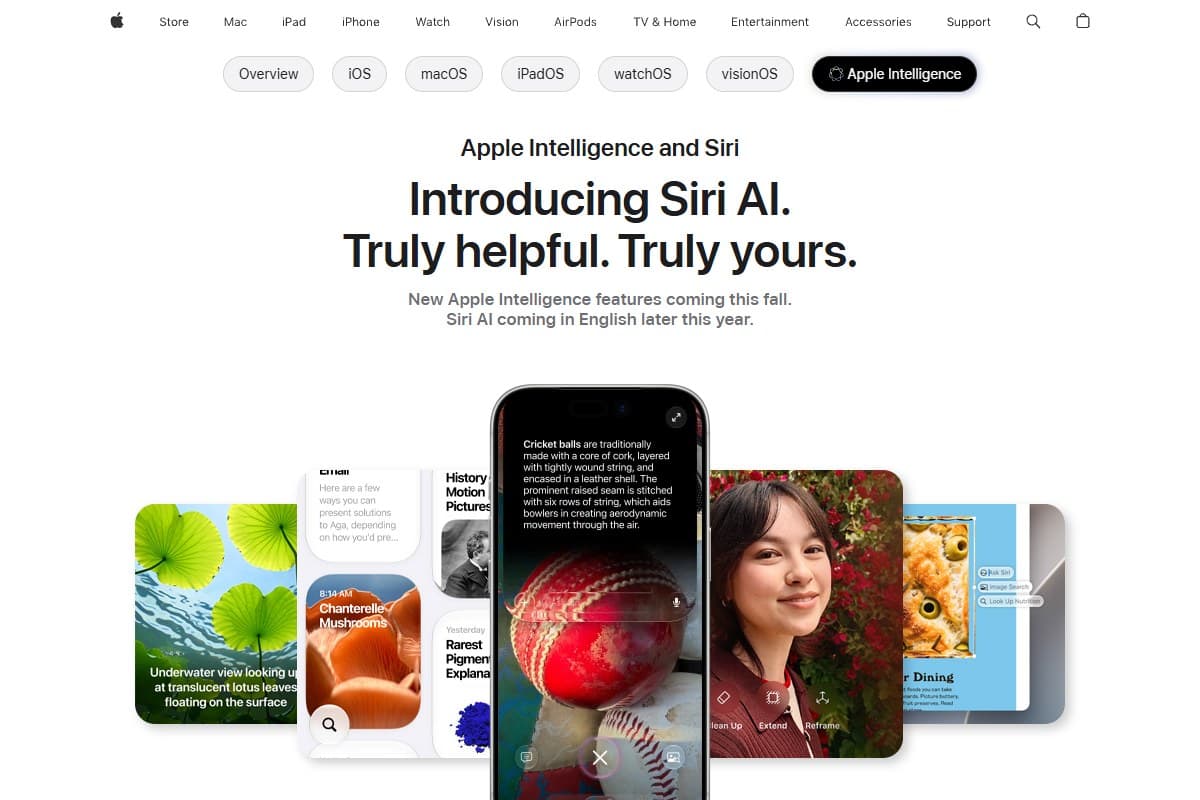
Siri AI can now answer questions about what's on your screen right now. Reading an article, reviewing a PDF, looking at a photo? You can ask about it directly ("summarize this," "who's in this picture," "what does this clause mean") without copy-pasting or describing the thing you're literally looking at. This is the capability that makes Siri feel present rather than blind.
3. Broad world knowledge
The old Siri's "here's what I found on the web" dodge is gone. Siri AI has broad world knowledge for up-to-date answers on general questions: the conversational, ask-anything competence people have been going to ChatGPT and Gemini for. Apple is, in effect, admitting that an assistant has to actually answer questions now, not just hand you links.
4. Systemwide actions across apps
Siri AI can take action across apps: draft an email, edit and share a photo, chain steps that used to require you to tap through three apps yourself. Combined with personal context, this is the "agent" part: it can find the thing and do the thing in one conversation.
Personal context + onscreen awareness + cross-app actions, the exact trio Apple demoed in 2024 and then delayed, finally shipped to developers in one rebuilt assistant
The standalone Siri app: a small change that signals a big one
Beyond the four pillars, Apple gave Siri its own app. It uses iCloud to sync your conversation history across devices, so you can start something on your iPhone and pick it up on your Mac or iPad. That sounds minor. It isn't. A dedicated app with persistent, synced history is Apple quietly conceding that Siri is now a destination you go to and converse with, like ChatGPT or Gemini, not just a voice you summon to set a timer. The mental model shifted, and the app is the proof.
Private Cloud Compute: the privacy pitch that's actually different
Here's where Apple has a genuine, hard-to-copy advantage. When a request is too big for your device, Siri AI sends it to Apple's servers, but through Private Cloud Compute (PCC), the privacy-first infrastructure Apple built for Apple Intelligence. The claims that matter:
- Requests are processed in stateless sessions: your data isn't stored after the request completes.
- Apple says your personal data is never made accessible to Apple or anyone else, including during cloud processing.
- Apple says independent experts can verify the privacy guarantees, because the PCC software is inspectable.
In a year where every assistant wants to read your screen, your mail, and your photos to be useful, "it does all that and the cloud half is built so we can't see your data" is the most defensible thing Apple said on stage. Whether the implementation holds up to outside scrutiny is the thing security researchers will poke at over the next few months, but the architecture is a real differentiator, not a slogan.
The catch nobody put on a slide: the Gemini question
Now the honest part the keynote glided past. Multiple outlets reported that Apple's new foundation layer was built with help from Google Gemini: that the model powering the cloud side was trained or distilled using Google's technology, with reporting pointing to a very large custom model running on Google Cloud hardware. Apple's position, echoed by Apple-friendly coverage, is that through distillation and training the end result is Apple's own technology and code: pure Apple Foundation Models, no Gemini riding along inside your requests.
Both things can be true: Apple used Google's tech to build its models, and the shipping models are Apple's. But it complicates the tidy "we rebuilt Siri ourselves" story, and it's the detail to watch as more technical information comes out. If you care about the supply chain behind your assistant, this is the asterisk. It doesn't change what Siri AI does, but it's relevant to how independent the new Apple Intelligence really is.
When can you actually use it?
This is the most important practical section, because the answer is "not yet."
- Developer beta: now. Available immediately through the Apple Developer Program for iOS 27, iPadOS 27, macOS 27, and visionOS 27. If you're a developer, you can build against Siri AI today.
- Public beta: later in 2026. Initially English-language users on supported devices. Apple's framing points to a public rollout this fall alongside the new OS versions and hardware.
If that timeline gives you déjà vu, it should: the personal-context Siri was announced in 2024 and slipped badly. So the single most useful thing I can tell you is wait for the public beta before you believe the demo. The architecture shipping to developers is a much stronger signal than last cycle's pre-rendered concept videos, but "shipped to developers" is not "in your pocket and working."
Which devices get Siri AI?
Siri AI rides on the same Apple Intelligence hardware bar, which means recent devices only: the on-device half needs the silicon. Reported supported devices:
- iPhone 16 and later
- iPhone 15 Pro / 15 Pro Max
- Older iPhones: not supported
- Best for: the full on-device + cloud experience
- iPad mini (A17 Pro)
- iPad models with M1 and later
- Best for: longform onscreen-awareness tasks
- Any Mac with M1 or later
- Synced Siri app history from iPhone
- Best for: cross-device conversations
- Apple Watch Series 9 and later
- Apple Vision Pro
- Best for: glanceable + spatial assistant use
The pattern is clear: if your iPhone already runs Apple Intelligence, you're in; if you're on an iPhone 14 or older, this rebuild passes you by. There's no paid tier: Siri AI is free, built into the OS. The price is the hardware you already own (or will be nudged to buy this fall).
How Siri AI compares to the assistants it's chasing
Apple is late, and the honest framing is that Siri AI is trying to reach parity with assistants people already use: while leaning on the two things Apple actually owns: deep OS integration and privacy.
| Tool | Rating | Price | Best for | Verdict |
|---|---|---|---|---|
| Siri AI (Apple Intelligence) | 4.4/5 | Free, built into iOS 27 | Personal context + onscreen actions inside Apple's ecosystem, privately | The most integrated and most private, once it ships. |
| Google Gemini (Android) | 4.5/5 | Free · Advanced w/ Google AI plans | World knowledge + deep Google Workspace + Android integration | The maturity benchmark Siri is chasing. |
| ChatGPT (app + voice) | 4.4/5 | Free · Plus $20/mo | Best raw conversational quality and reasoning | Still the assistant people switch to when Siri fails. |
| Alexa+ (Amazon) | 3.9/5 | Bundled w/ Prime / $19.99/mo | Home and smart-device control | Strong at the house, weak at the phone. |
| Use case | Winner (today) |
|---|---|
| Acting on your own messages, mail and photos | Siri AI (deepest OS hooks) |
| Answering general world-knowledge questions | Gemini / ChatGPT (proven) |
| Privacy of personal-data processing | Siri AI (PCC) |
| Available and battle-tested right now | Gemini / ChatGPT |
| Doing it all without leaving the iPhone you own | Siri AI (once it ships) |
The takeaway: on integration and privacy, Siri AI has a structural edge nobody else can match on an iPhone. On proven, today, it-just-works conversational quality, Gemini and ChatGPT are still ahead: they've been shipping and iterating in public while Siri was stuck. WWDC 2026 is Apple's credible attempt to close that gap. The public beta is where we find out if it did. For a broader assistant face-off, my ChatGPT vs Claude vs Gemini comparison covers how the non-Apple options stack up.
What I liked about the announcement
- It's a rebuild, not a patch. New foundation models, four real capabilities, a dedicated app: Apple stopped tinkering and started over, which is exactly what Siri needed.
- The four pillars are the right four. Personal context, onscreen awareness, world knowledge, cross-app actions: this is precisely the list of what Siri couldn't do, addressed head-on.
- Private Cloud Compute is a genuine moat. "Useful and we can't see your data, and outsiders can verify that" is something no rival can credibly claim on a phone today.
- It's free and built-in. No new subscription, no Siri Pro tier: it ships with the OS update on hardware you may already own.
- Developers can build now. Shipping real APIs to the developer program is a far stronger signal than the concept videos of last cycle.
What gives me pause
- The timeline is a promise, from a company that broke the last one. "Public beta later in 2026" is the same shape as the 2024 personal-Siri pledge that slipped. Until it's installable, it's a roadmap.
- The Gemini-under-the-hood reporting muddies the all-Apple story. Apple says the shipping models are its own; the build path reportedly ran through Google. Worth watching as details emerge.
- English-only at public beta. Non-English users wait longer: a real limitation if you don't operate in English.
- Recent-hardware-only. iPhone 14 and older are left out entirely; this is also, conveniently, an upgrade-cycle driver.
- Demos aren't latency. Onscreen awareness and personal context are impressive on stage; the question is whether they're fast and reliable on a real phone with a weak signal. That's a public-beta question, not a keynote one.
First-look verdict: 4.4 out of 5 (potential, not a tested score)
Let me be precise about what I'm rating: not a product I've lived with, the public beta isn't out, but the announcement and the developer release behind it. On that basis, Siri AI earns a 4.4. The architecture is right, the four capabilities are exactly what Siri has lacked for a decade, the standalone app signals Apple finally gets what an assistant is now, and Private Cloud Compute gives Apple a privacy story no competitor can match on an iPhone.
I'm holding back the rest for reasons any cautious person would: this is a beta-later-this-year promise from the company that delayed the near-identical promise last cycle, the Gemini foundation question complicates the independence narrative, and demos are not the same as a fast, reliable assistant in your hand on a bad day. None of that is a knock on the vision: it's a refusal to grade the homework before it's turned in.
The bottom line on the new Siri AI 2026: this is the most serious, most credible Siri overhaul Apple has ever shipped, and the clearest sign yet that Apple Intelligence in 2026 is a real assistant rather than a notifications feature. If it ships this fall in the shape Apple demoed, it's a genuine contender on your iPhone. Bookmark it, install the public beta the day it drops, and judge the demo against your own Tuesday. I'll update this the moment it's installable.
FAQ: New Siri AI 2026
What is the new Siri AI and when was it announced?
Siri AI is Apple's completely rebuilt voice assistant, announced at WWDC 2026 on June 8, 2026. It runs on a new generation of Apple Foundation Models and adds four core capabilities Siri previously lacked: personal context understanding (across your messages, mail, and photos), onscreen awareness, broad world knowledge for general questions, and the ability to take actions across apps. It also gets a standalone app with conversation history synced via iCloud.
When can I actually use the new Siri AI?
A developer beta is available now for iOS 27, iPadOS 27, macOS 27, and visionOS 27 through the Apple Developer Program. The public beta arrives later in 2026, initially for English-language users, with a broad rollout expected this fall alongside the new OS versions. If you're not a developer, you'll be waiting until the public beta, and given Apple delayed a similar Siri upgrade in 2024, it's worth treating the timeline as a target, not a guarantee.
Is the new Siri AI free?
Yes. Siri AI is built into iOS 27, iPadOS 27, macOS 27, and visionOS 27 at no extra cost: there's no subscription or "Siri Pro" tier. The only real requirement is supported hardware: iPhone 16 and later or iPhone 15 Pro/Pro Max, iPads and Macs with M1 or later (plus the A17 Pro iPad mini), Apple Watch Series 9 and later, and Apple Vision Pro.
How does Apple keep the new Siri private?
Through Private Cloud Compute (PCC). Simple requests run on-device. When a request needs more power, it's sent to Apple's servers and processed in stateless sessions: your data isn't stored afterward and, Apple says, is never made accessible to Apple or anyone else. Apple also says independent experts can verify these guarantees because the PCC software is inspectable. It's the strongest privacy claim of any major phone assistant in 2026.
Does the new Siri use Google Gemini?
Partly, behind the scenes, and Apple frames it carefully. Multiple reports say Apple built its new foundation models with help from Google Gemini's technology, using training and distillation, with the heavy cloud model reportedly running on Google Cloud hardware. Apple's stated position is that the shipping models are its own Apple technology and code, not Gemini answering your questions directly. Both can be true: Google tech helped build it; the result is Apple's. It's the detail to watch as more technical information comes out.
Is the new Siri AI better than Gemini or ChatGPT?
On integration and privacy, Siri AI has a structural edge on an iPhone that neither can match: deep access to your apps and data, processed via Private Cloud Compute. On proven, today, conversational quality and world knowledge, Gemini and ChatGPT are still ahead, simply because they've been shipping in public while Siri stagnated. WWDC 2026 is Apple's serious attempt to reach parity; the public beta later this year is where we'll find out whether it actually did.
Related reviews
- ChatGPT vs Claude vs Gemini: the assistants Siri AI is chasing, compared on the merits.
- Poke AI the iMessage agent review: the third-party agent that beat Apple into Messages.
- Gemini Spark Review: worth $100 a month?: Google's always-on assistant, the maturity benchmark for Siri AI.
- AI Agents topic hub: every AI assistant and agent review on the site in one place.
Want me to update this the day the public Siri AI beta is installable, or test a specific feature against ChatGPT and Gemini? Get in touch, reader questions shape the next round of coverage.
Free interactive tool
Compare Siri AI (Apple Intelligence) with other AI toolsSide-by-side pricing, features, and ratings — plus a recommended pick for your use case.
Independent AI tools researcher testing what actually works.
Keep reading
Related reviews
Claude Fable 5 Review: Anthropic's Most Powerful Public Model Ever (First Look)
Anthropic just made its most powerful model public. I spent launch day testing Claude Fable 5: benchmarks, pricing, the Opus fallback, and the catch.
Taskade Review 2026: I Tested the New AI Agents v2 (Worth It?)
Taskade just shipped 24 Genesis Kits and Agents v2 with 33 tools. I tested the new AI agents on a real workflow to see if it's worth $16/mo in 2026.
Anthropic IPO 2026: What the $965B Filing Means for Claude Users (and the AI Race)
Anthropic confidentially filed for an IPO on June 1, 2026 at a reported ~$965B valuation. Here's what's confirmed, what isn't, and what it means for Claude.