
On June 4, 2026, Apple did something it has never done before: it approved a third-party AI agent to text you inside the native Messages app. That agent is Poke, built by The Interaction Company of California, and within hours of the announcement the service was visibly straining (replies arrived late, some not at all) which is the kind of problem you only get when far too many people show up at once.
I have been poking at Poke (sorry) since the news broke. This is not a launch-day reaction typed from a press release. I actually signed up, argued with its pricing bouncer, wired up a couple of integrations, and let it text me unprompted for a few days to see whether "an AI that lives in your Messages app" is a real shift or a novelty that wears off by Thursday.
Short version: the texting-first format is the most natural assistant experience I have used, and I did not expect to feel that. The rough edges are equally real. Let me show you both.
How I Tested This
What Poke actually is
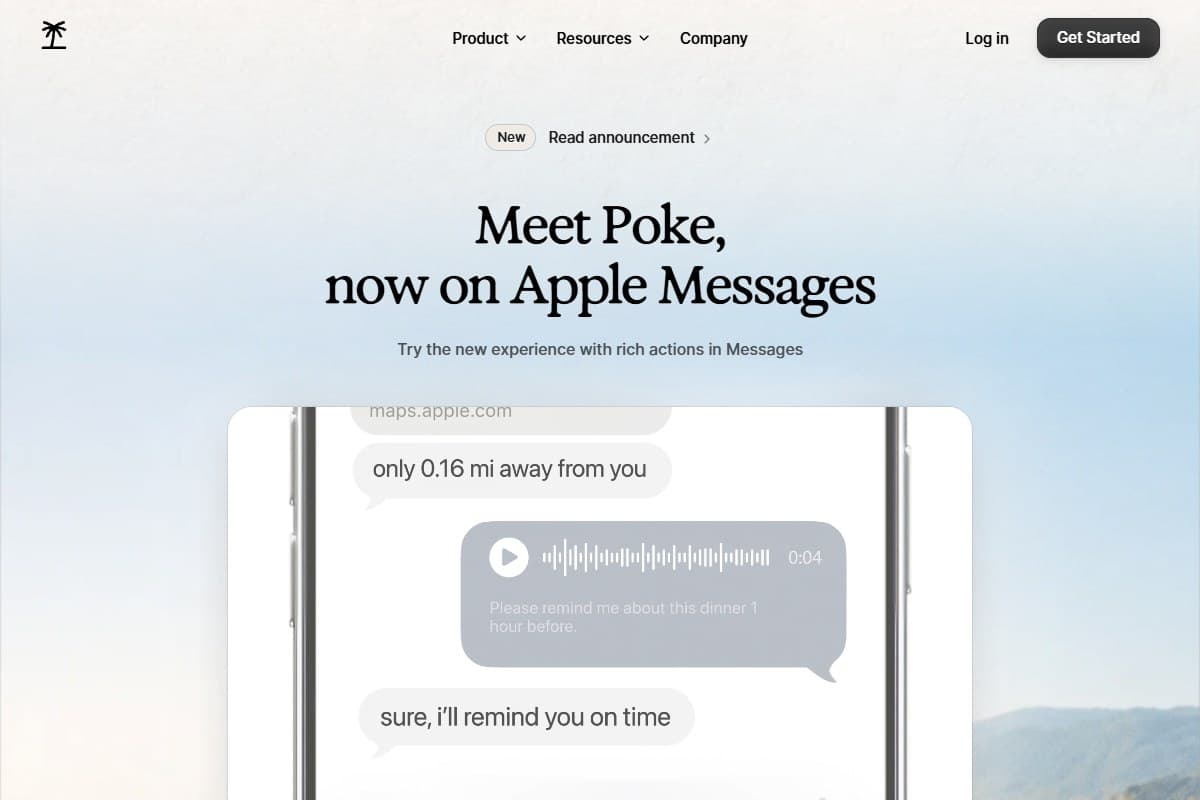
Poke is a personal AI assistant that lives entirely in your messaging app. There is no separate Poke app to open, no chat window to navigate to. You text it the way you would text a friend (over Apple Messages, WhatsApp, or Telegram) and it texts you back. It can also handle voice messages, set reminders, and, crucially, reach out to you first when something needs your attention.
The technical detail behind the June 4 news matters: Poke runs inside iMessage through Apple's Messages for Business framework: the same plumbing that lets you chat with an airline or a bank in the Messages app. Interaction is the first company Apple has approved to use that channel for a general-purpose AI agent rather than a single business's support line. In Poke's own words, it is "officially approved by Apple to text on Apple Messages. As the first and only AI agent." That is a real moat, at least for now.
The engine underneath is an integration system Poke calls recipes. You connect services: Gmail, Google Calendar, Notion, Linear, GitHub, Oura, Strava, Asana, Todoist, Sonos, and a couple dozen others, and Poke uses them plus its memory of your habits to "help out right on time." Developers can go further with the Poke Kitchen, building custom recipes and wiring in their own integrations over MCP (the same Model Context Protocol the rest of the agent world has standardized on).
So the one-line version: it is a proactive, memory-backed AI assistant whose entire interface is the text thread you already check 80 times a day.
Why Poke is trending right now
Three things collided this week.
First, the Apple approval is genuinely a first. Apple has guarded the Messages app obsessively. Letting an outside AI agent text users natively is a notable crack in that wall, and the whole industry noticed within hours.
Second, the signup is going viral for being weird. Poke does not have a pricing page. Instead, it "sets pricing through negotiation with you": you literally haggle with an AI persona until you agree on a number. People have been screenshotting their negotiations all over X, comparing how low they got the price (anchors in the hundreds talked down to single digits). It is the most shareable onboarding flow I have seen since the early Clubhouse invite scramble.
Third, demand outran the servers. The day of the iMessage news, Poke was visibly overloaded: slow replies, errors, the works. That is a bad first impression and a strong demand signal at the same time, and it kept the conversation going.
Put those together and "Poke AI review" is suddenly one of the most-searched assistant queries of the week.
My honest hands-on experience
I want to start with the negotiation, because it is the first thing everyone hits and the thing I have the most mixed feelings about.
The price haggling is clever, and also a chore. You don't pick a plan. You talk to what is effectively a bouncer, and you keep talking until you both agree on a monthly number. The first quote it floated me was absurd; a few rounds of "that's way too high, here's what I'd actually pay" brought it down dramatically. Reports I have seen put the typical landing spot somewhere between roughly $2 and $29 a month depending on how hard you push and how much you say you'll use it. As a growth gimmick it is brilliant: it makes you feel like you won, and it turns onboarding into content people share. As an actual experience, it took me longer to settle the price than it did to connect Gmail and Calendar afterward. I can see this being delightful once and irritating if you ever have to redo it.
The texting format is the real story, and it surprised me. I went in assuming "assistant in your Messages app" was a thin wrapper around a chatbot. It is not. The friction difference between opening an app, waiting for it to load, typing into a box and firing off a text from the thread that's already open is bigger than it sounds. By day two I was offloading little things to it reflexively: "remind me to call the dentist at 9," "what's on my calendar tomorrow afternoon," "summarize the last email from Sam": because it cost me nothing to ask.
The proactive nudges are a double-edged sword. When Poke texted me unprompted to say a meeting had moved and asked if I wanted it to draft a reply, that felt like magic. When it pinged me with a low-value "here's your day!" summary during a focus block, it felt like a notification I didn't sign up for. The proactivity is the most differentiated thing about Poke and also the thing most likely to annoy you before you tune it. Give it a couple of days of "not now" and "yes, more of this" and it settles down.
Launch-day reliability was poor. I want to be fair: this is the busiest week in the product's life. But I sent messages that sat unanswered for ten-plus minutes, and a couple that seemed to vanish entirely. For an assistant whose whole pitch is "it's right there in your texts," latency is not a cosmetic problem: a slow assistant in a fast medium feels broken. I expect this improves as the capacity catches up, but I can only review what I experienced.
What the integrations actually unlock
The assistant is only as good as what it can reach. Here is where Poke earned its keep for me:
- Gmail + Calendar is the core loop. "What needs a reply today?" plus "move my 2pm to Thursday" covers most of why I open those apps at all.
- Notion as a memory backend is the sleeper feature. Asking Poke to drop a thought into the right Notion database from a text message removes the "open Notion, find the page, type" tax entirely.
- Linear / GitHub / Asana make it a lightweight standup buddy: "what's assigned to me this week?" answered without opening a single tab.
- Oura / Strava are the quietly personal ones. A morning "you slept 5h40, want me to keep the morning light?" is the kind of context a generic chatbot can't offer.
The recipe system is the right abstraction. The ceiling is high (custom recipes via the Kitchen, MCP integrations for anything else), and the floor is low enough that connecting Gmail took me under a minute.
Pricing: there isn't a price (and that's the point)
This is the strangest pricing section I have written, because Poke genuinely has no published plans. Pricing is negotiated per person. The table below is not official tiers: it's the rough shape of where people report landing after haggling, so you walk in with an anchor.
- The bouncer's first number is high
- Treat it as an anchor, not a price
- Pushing back is expected
- Best for: nobody, always negotiate
- Where most reasonable haggling ends up
- Full integrations + proactive features
- Reported, not guaranteed
- Best for: daily users
- What heavy negotiators report
- Same features, lower commitment signal
- Your mileage will vary
- Best for: light users willing to argue
A few honest caveats. The negotiated model means two people can pay wildly different amounts for the same product, which some will find clever and others will find off-putting. There is no public free tier documented, and there is no referral or affiliate program yet: Interaction's own FAQ says "Not yet… keep an eye out in case we launch one." If you're comparing the spend to a fixed-price assistant, factor in that you're trading price certainty for a one-time game you might enjoy.
On privacy, Poke's FAQ is refreshingly direct: when you connect integrations, "no human will be able to see any of your chats or personal data," and "we do not train on user data." Given the assistant is reading your email and calendar, that policy is the thing I'd actually read in full before connecting Gmail.
Pros and cons (after a few days of real use)
- Texting-first UX is genuinely lower-friction than any app-based assistant
- First and only AI agent approved to run natively inside iMessage
- Proactive nudges are a real differentiator once tuned
- Strong integration roster: Gmail, Calendar, Notion, Linear, Oura and ~20 more
- Recipes + Poke Kitchen + MCP give it a high ceiling for power users
- Clear privacy stance: no human chat access, no training on your data
- Negotiated pricing is a chore and means no two people pay the same
- Launch-day reliability was poor: slow and sometimes dropped replies
- Proactive pings can be noisy before you train them
- No referral or affiliate program, and no published free tier
- iMessage access depends on Apple's Messages for Business goodwill
- Multi-channel number switching (it may text from different numbers) is mildly confusing
Poke vs the alternatives
Poke isn't really competing with chatbots: it's competing with every other "assistant that does things for you" play. Here's how I'd place it against the agents I've tested.
| Tool | Rating | Price | Best for | Verdict |
|---|---|---|---|---|
| Poke | 4.1/5 | Negotiated (~$2–$29/mo) | Texting-first personal assistant | Most natural UX, roughest reliability |
| Gemini Spark | 4.0/5 | $100/mo | Heavy Google-ecosystem agent work | Powerful but priced for power users |
| ChatGPT Agent | 4.2/5 | $20/mo (bundled) | Web tasks inside ChatGPT | Best value if you already pay OpenAI |
| Mina | 4.0/5 | Freemium | Meeting capture & follow-ups | Narrower, but excellent at its one job |
| Use case | Winner |
|---|---|
| Assistant you text like a friend | Poke |
| Lives natively in iMessage | Poke |
| Deep Google Workspace automation | Gemini Spark |
| Cheapest if you already pay for ChatGPT | ChatGPT Agent |
| Meeting notes and follow-ups specifically | Mina |
If you're weighing the big consumer agents against each other more broadly, my Gemini Spark review is the post that anchors what's actually worth paying for, and the ChatGPT vs Claude vs Gemini breakdown covers which underlying model to trust for the reasoning Poke leans on.
Who should use Poke, and who shouldn't
Try Poke if you are:
- Someone who lives in iMessage, WhatsApp, or Telegram and resents opening yet another app
- Already using Notion, Gmail, Calendar, Linear, or Oura and want one assistant across them
- Curious about proactive AI and willing to spend two days tuning the nudges
- The kind of person who'll enjoy haggling a price down for sport
Hold off on Poke if you are:
- Reliant on instant responses today: give the post-launch overload a few weeks to settle
- Allergic to variable, negotiated pricing and want a published number
- Looking for a free tier (there isn't a documented one)
- Uncomfortable connecting email and calendar to a young startup, even with a strong privacy policy
Use the best AI meeting assistant roundup instead if your real need is meeting capture and follow-ups rather than a general life assistant.
Final honest verdict
Poke is the most interesting consumer AI launch of the week, and not only because Apple blessed it. The texting-first format genuinely changed how often I reached for an assistant: friction is destiny, and Poke removes more of it than anything I've used. The integrations are real, the proactivity is a true differentiator, and the privacy stance is better than I expected.
But I can't pretend the rough edges aren't there. The negotiated pricing is a brilliant growth hack wrapped around a slightly tedious experience. The launch-day reliability undercut the entire premise on the days I tested it. And the lack of a referral program or published free tier makes it harder to recommend casually.
So: 4.1. Poke is worth trying this week if the novelty and the iMessage angle excite you. It is not yet worth depending on for anything time-critical until the servers calm down and the pricing model matures. I'll be revisiting this one in a few weeks: it has the best shot of any agent I've tested at becoming the assistant I actually keep.
Related reviews
If this Poke review was useful, these are the natural next stops:
- AI Agents topic hub: every consumer and developer agent we've reviewed in one place.
- Gemini Spark review: is a $100/month agent worth it, and what covers 80% for less.
- ChatGPT vs Claude vs Gemini, which model to trust for the reasoning these agents run on.
- Best AI meeting assistant roundup: where Mina and the other dedicated meeting tools stack up.
What I'd change about Poke
I like Poke enough to be picky about it. If I ran product there, here's what I'd ship next, in order.
-
Fix latency before anything else. An assistant in a text thread is judged on speed. A ten-minute reply in iMessage doesn't read as "busy," it reads as "broken." Capacity and response time are the whole product right now: everything else is secondary until a text gets answered in seconds, reliably.
-
Make the negotiation optional. The haggle is great content and a fun first impression. It should not be the only path. Offer a "just give me a fair number" button for the large group of people who find negotiating a price for software exhausting rather than delightful.
-
Ship a real referral program. The FAQ says "not yet." For a product whose entire growth engine is people screenshotting it to friends, leaving signups unrewarded is money on the floor. Even the creator-recipe payout model hinted at elsewhere should be front and center.
-
Give me a proactivity dial I can see. Tuning the nudges by replying "not now" works, but it's invisible: I never know how aggressive Poke currently is. A simple visible setting (quiet hours, nudge frequency, what it's allowed to interrupt me for) would turn the scariest feature into the most trusted one.
-
Clarify the multi-number behavior. Being told Poke "might text you from different numbers depending on which platform you choose" is the kind of small confusion that makes people second-guess a message's legitimacy. One consistent identity per channel would help.
Fix the latency and make the price negotiation optional, and most of my reservations disappear.
FAQ: Poke AI review
What is Poke and who makes it?
Poke is a personal AI assistant built by The Interaction Company of California. Instead of a standalone app, it lives inside your messaging apps (Apple Messages, WhatsApp, and Telegram) so you interact with it by texting. It connects to services like Gmail, Calendar, and Notion through "recipes," remembers your habits, and can message you proactively when something needs attention.
Is Poke really inside iMessage?
Yes. On June 4, 2026, Apple approved Poke to operate inside the native Messages app via Apple's Messages for Business framework, making it the first and only general-purpose AI agent allowed to text users that way. Practically, you text Poke from the Messages app like you'd text any contact, and it replies in the same thread.
How much does Poke cost?
There's no published price. Poke sets pricing through a negotiation: you effectively haggle with an AI persona until you agree on a monthly number. Reported outcomes generally land somewhere between roughly $2 and $29 a month depending on how hard you push and how much usage you signal. Treat the opening quote as an anchor, not a real price, and push back.
Does Poke have a free trial or free plan?
There's no clearly documented free tier as of June 2026: pricing runs through the negotiation flow instead. If a free option exists, it isn't published, so plan to settle on a paid number during signup.
Is Poke safe with my email and calendar?
Poke's FAQ states that when you connect integrations, no human can see your chats or personal data, and that the company does not train on user data. Given the assistant reads sensitive data like email and calendar, I'd read the current privacy policy in full before connecting Gmail, but the stated stance is stronger than many competitors'.
Does Poke have an affiliate or referral program?
Not yet. Interaction's FAQ explicitly says there's no referral program at the moment but to "keep an eye out in case we launch one." For now, signups aren't rewarded, which, for a product that spreads through word of mouth, is the most obvious gap in its strategy.
Have a question I didn't cover, or a screenshot of the lowest Poke price you managed to negotiate? Get in touch: I read everything, and the questions readers send shape the next round of reviews.
Free interactive tool
Compare Poke with other AI toolsSide-by-side pricing, features, and ratings — plus a recommended pick for your use case.
Independent AI tools researcher. Testing and reviewing the tools that matter for creators and businesses.
Keep reading
Related reviews

Gemini Spark Review: Is Google's $100 AI Agent Actually Worth It?
Google's Gemini Spark runs 24/7 across Gmail, Calendar and Drive, but you need the new $100 Ultra plan. Here's my honest verdict after a week of access.

Best AI Agents 2026: I Tested 7 Tools and Ranked Them
I tested 7 AI agents in 2026 on the same real workflows. Taskade, Chatbase, CustomGPT, Viktor and more, ranked by what they actually finish.

Viktor Review 2026: The AI Coworker That Lives in Slack (Tested)
Viktor is an AI coworker that lives in Slack and connects to 3,000+ tools. I tested it for reports, dashboards, automation, and more. Here's my honest verdict.