
I've lost count of how many "build an AI chatbot in minutes" tools have wasted an afternoon of mine and produced a bot too dumb to ship. So when I sat down with Chatbase, the bar was simple: get a trained agent answering real questions on a real website before I lost patience. This Chatbase review is the result: a few days of building, breaking, and deploying an agent on an actual knowledge base, with the speed wins and the pricing gotchas both laid out plainly.
Short version: Chatbase is the rare tool in this category that actually delivers on the "15 minutes" promise, and the AI Actions push it past the FAQ-bot ceiling that traps most cheap chatbot builders. But the credit-based billing makes your real monthly cost genuinely hard to predict, and a couple of the limits (no branching conversation logic, a steep fee to remove branding) are worth knowing before you commit.
How I Tested This
Why Chatbase is worth talking about right now
Two things make Chatbase relevant in mid-2026.
First, the product crossed from 'chatbot' to 'agent' in a way that matters. Early Chatbase was a RAG FAQ box: feed it docs, embed a widget, done. The 2026 version ships AI Actions: the agent can book a meeting through Calendly, open a Zendesk ticket, process a refund through Stripe, or look up an order. These are real tasks, not just answers. That's the line between deflecting a question and actually resolving it, and it's the reason Chatbase shows up in "AI agent" conversations now and not just "chatbot" ones.
Second, the distribution is real. Chatbase reports 10,000+ customers across 140+ countries and carries a 4.6/5 average on Capterra, with the recurring theme being "functional bot deployed in ten minutes." In a category drowning in demos that fall apart on contact, a tool that consistently ships a working agent fast is genuinely differentiated, even if, as I'll get into, the pricing model asks you to do some homework.
What Chatbase actually is
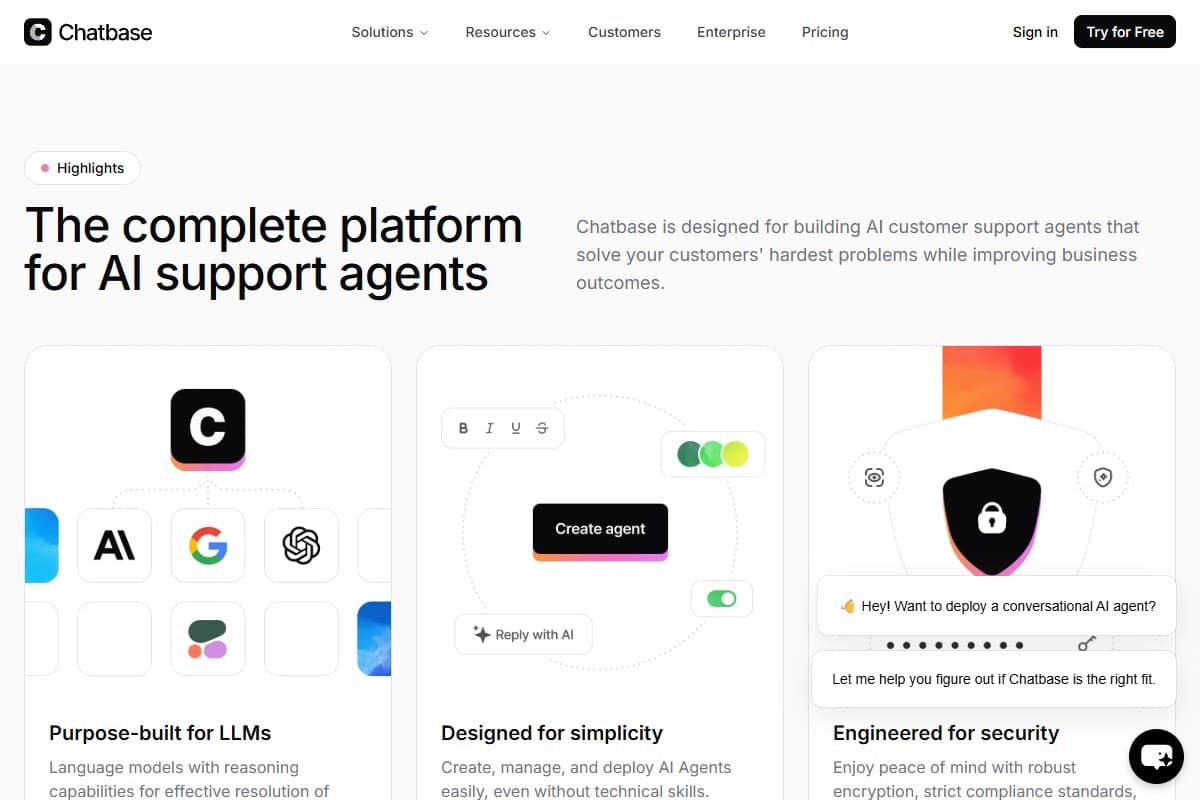
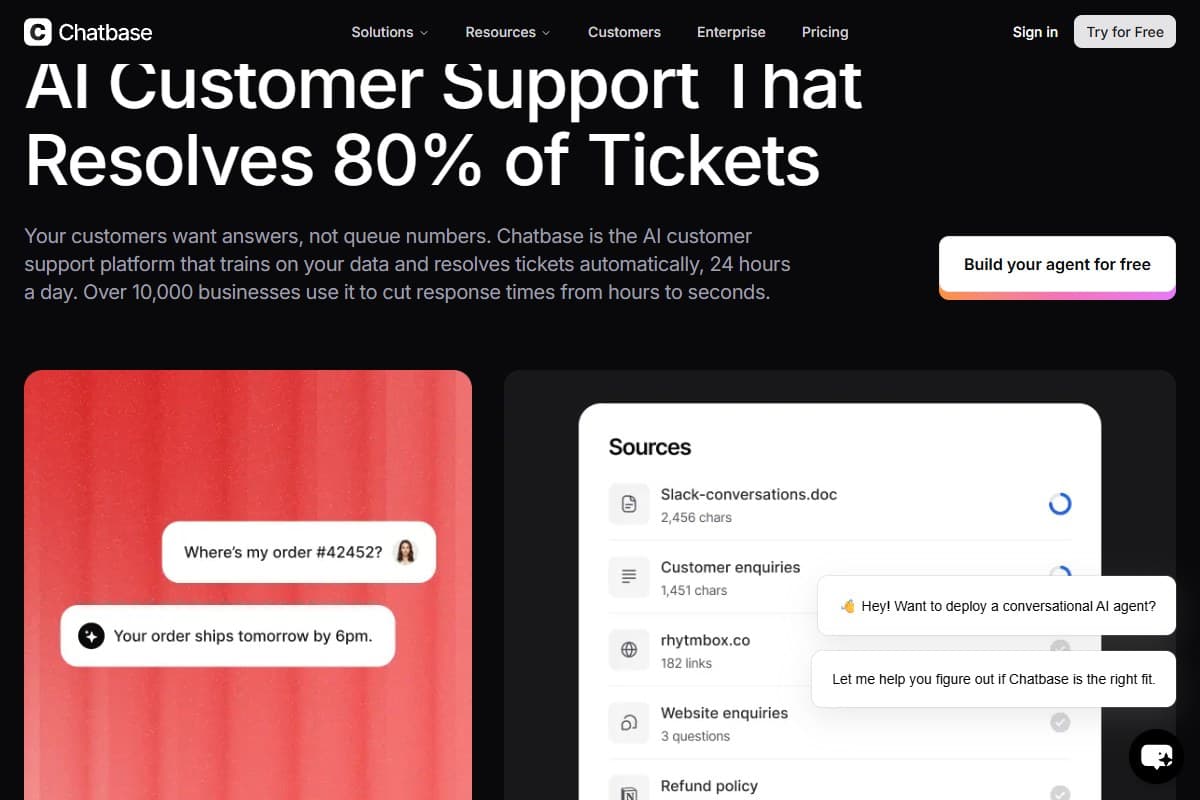
Chatbase is a no-code platform for building AI agents trained on your own content. You point it at your material, it builds a retrieval-augmented agent, and you deploy that agent across channels. The pitch is that a non-technical person can configure, test, and ship one in under fifteen minutes. In my testing, that's not marketing fiction.
You train an agent from:
- Files: PDFs, Word, text, and other docs (10 MB per agent on Hobby, up to 40 MB on Pro).
- Websites: sitemap crawl or individual URLs.
- Q&A pairs and plain text: hand-authored knowledge for the gaps your docs don't cover.
- Help-desk content, and on higher tiers, existing tickets as a training source.
You then deploy the agent as:
- A website widget: a single embed snippet.
- Multi-channel: WhatsApp, Slack, Messenger, plus API access on Standard and up.
- Voice and telephony: available from the Standard tier.
The thing that separates it from a static FAQ bot is AI Actions: configurable API-backed tasks (book a call, create a ticket, process a subscription, track an order) the agent can trigger mid-conversation through integrations like Stripe, Calendly, Zendesk, and Slack. Hobby enables 5 actions per agent; Pro allows 12.
What it isn't: a heavy, flow-builder-driven contact-center platform. There's no visual decision-tree builder for branched conversation logic. Chatbase is built for "train it and let the model handle the conversation," not "map every path by hand." For most SMB support and sales use cases that's the right trade, but if you need deterministic, audited conversation flows, it's a real limitation.
My honest testing experience
The moment Chatbase earned its rating was the AI Action.
Answering questions from docs is table stakes; every RAG bot does it. What I wanted to see was whether the "agent" framing held up. So I wired a Calendly action and asked the bot, in plain language, "can I talk to someone about the enterprise plan?" Instead of dumping a link, it asked for my preferred time, confirmed it, and booked the slot through the action, then offered to email a calendar invite. That's the difference between a bot that deflects and one that actually closes the loop. The Zendesk ticket action worked the same way: an unanswerable question gracefully became a created ticket with the conversation attached.
128 of 150 correct and well-cited. Most misses were out-of-scope questions the bot tried to answer anyway rather than refusing: the opposite failure mode from CustomGPT.
The setup speed was the other genuine win. From a cold signup to an embedded, answering widget on my test page was about twelve minutes, most of which was the sitemap crawl running in the background. Citations were clickable and pointed at the right source pages. The widget dropped onto the page with one snippet and didn't fight the host CSS.
Where it got less rosy: the credit accounting. Chatbase bills per message credit, and your premium-model answers can cost up to 5 credits each while economy-model answers cost 1. I watched my 500-credit Hobby allowance drain far faster than the headline number implied once I switched the agent to a stronger model for better answers. The trade-off (cheaper model and more conversations, or smarter model and fewer) is real and it's on you to manage. The second snag was the answer-anyway tendency: on out-of-scope questions, Chatbase was more likely to produce a plausible guess than to refuse, which is fine for a marketing bot and risky for a support one.
What I liked
After four days of daily building, the honest list:
- The "15 minutes" claim is real. Cold signup to a live, embedded, answering agent in about twelve minutes. Nothing else I've tested in this category is this fast to a working result.
- AI Actions are the differentiator. Booking a call and creating a ticket through the agent (not just linking out) is what makes it an "agent" and not a fancy search box.
- Multi-channel from one agent. The same trained agent on my website widget and in Slack, with WhatsApp and Messenger available, no re-training.
- Clickable citations. Every answer linked back to the source doc or page, so I (and a customer) could verify.
- Unlimited agents from the Hobby tier up. Unlike CustomGPT's per-tier agent caps, even the $40 plan lets you spin up as many separate agents as you want; you're metered on credits, not agent count.
- Clean, conflict-free widget. One embed snippet, no CSS collisions on the host page.
What frustrated me
The honest gripes:
- Credit-based pricing is hard to forecast. Premium-model answers cost up to 5x economy answers, so "500 credits" or "4,000 credits" doesn't translate cleanly to a number of conversations. You'll need to monitor usage and tune your model choice, and auto-recharge ($40 per 1,000 credits) can quietly inflate the bill.
- Removing branding costs $1,188/year. That's roughly $99/month on top of your plan just to drop the "Powered by Chatbase" badge. On a $40 Hobby plan that's an 80%+ increase. For a client-facing agency build, it's effectively mandatory, and it stings.
- It answers when it should refuse. On out-of-scope questions Chatbase leans toward a confident guess rather than "I don't know." For sales that's fine; for regulated or high-stakes support it's the wrong default, and CustomGPT's refusal behavior is meaningfully stronger here.
- No visual flow / decision-tree builder. If you need deterministic, branched, audited conversation paths, Chatbase doesn't offer them; it trusts the model with the conversation.
- Free agents are deleted after 14 days of inactivity. Fine for trials, but a surprise if you build something on Free and forget about it for two weeks.
Pricing: is Chatbase worth it?
Five tiers, and a credit system that you have to actually read before you can forecast a bill.
- 50 message credits/mo
- 1 AI agent, 400 KB training
- Limited model access
- Agent deleted after 14 days idle
- Best for: kicking the tires
- 500 message credits/mo
- Unlimited agents, 10 MB each
- 5 AI Actions per agent
- Advanced models + integrations
- Best for: solo founders & small sites
- 4,000 message credits/mo
- 8 AI Actions per agent, 20 MB each
- Voice, telephony, API access
- Help desk + outbound campaigns
- Best for: most growing SMBs
- 15,000 message credits/mo
- 12 AI Actions per agent, 40 MB each
- Advanced analytics + tickets-as-source
- 5 workspace members
- Best for: scaled support teams
- Custom limits + roles/SSO
- White-labeling included
- HIPAA-eligible, audit logs
- CSM + SLAs
- Best for: regulated & large orgs
The numbers above are monthly; annual billing knocks 20% off (so Hobby effectively $32/mo, Standard $120/mo, Pro $400/mo). The math you actually have to do is the credit math. A "message credit" is consumed per AI response, and a premium model can cost up to 5 credits where an economy model costs 1. So Hobby's 500 credits could mean ~500 cheap conversations or ~100 premium ones. Standard's 4,000 credits is the tier most real SMBs land on once they route live traffic.
Two add-ons to budget for: removing Chatbase branding is $1,188/year (effectively required for any professional, client-facing deployment), and extra agents beyond your plan are $300/year each, though note Hobby and up already include unlimited agents, so that mostly bites on Enterprise role setups. Auto-recharge at $40 per 1,000 credits is the pressure valve when you blow past your monthly allowance.
Is it worth it? For a solo founder or small site, Hobby at $40/mo (or $32 annual) is good value to get a real, action-capable agent live, as long as you watch the credit burn and can live with the branding badge. For a growing business routing genuine support volume, Standard at $150/mo is the realistic floor, and the branding fee pushes the true cost closer to $250/mo. Above that, you're comparing against Intercom and the enterprise platforms on resolution economics, not sticker price.
Who should use Chatbase
Buy it if you are:
- A solo founder or SMB that wants a trained support or lead-capture agent live on your website today, not after a two-week implementation
- A team whose support is mostly straightforward Q&A plus a few real actions (book a call, create a ticket, check an order) rather than complex branched workflows
- An e-commerce or SaaS site that wants one agent across website, Slack, and WhatsApp without re-building it per channel
- Someone who values speed-to-live and a low entry price over deterministic conversation control
Who should avoid Chatbase
Skip it (try alternatives) if you are:
- Running high-stakes or regulated support where a chatbot guessing instead of refusing is unacceptable; CustomGPT's refusal behavior is the safer pick
- A large support org that needs resolution-based economics, deep help-desk workflows, and guaranteed resolution rates; that's Intercom Fin's territory
- A team that needs visual, audited, branching conversation flows; Chatbase trusts the model instead of giving you a flow builder
- On a tight, fixed budget that can't absorb unpredictable credit burn or a four-figure annual branding fee
How Chatbase compares to the alternatives
| Tool | Rating | Price | Best for | Verdict |
|---|---|---|---|---|
| Chatbase | 4.1/5 | $40–$500/mo | Fast, action-capable website agents for SMBs | Fastest to live + real AI Actions; credit pricing is fiddly and it over-answers |
| CustomGPT.ai | 4.2/5 | $99–$499/mo | Anti-hallucination RAG support | Best refusal behavior; pricier entry and a steep mid-tier cliff |
| Intercom (Fin) | 4.3/5 | $0.99/resolution + seats | Enterprise support at scale | Best deep help-desk + resolution economics; overkill and costly for a small site |
| Use case | Winner |
|---|---|
| Shipping a website agent today | Chatbase |
| Real in-chat actions on a budget | Chatbase |
| Refusing to answer outside the source docs | CustomGPT.ai |
| Enterprise support at very high volume | Intercom (Fin) |
| Pay-only-for-what-resolves economics | Intercom (Fin) |
| Cheapest path from docs to a live agent | Chatbase |
The decision usually comes down to scale and risk tolerance. Chatbase wins on speed and entry price: it's the tool I'd reach for to put a capable agent on a small or mid-sized site this afternoon. CustomGPT.ai wins when a wrong answer is worse than no answer: its context-boundary refusal logic is genuinely stronger, at a higher entry price. Intercom Fin wins at enterprise scale, where $0.99-per-resolution pricing and a deep help-desk platform beat per-seat or per-credit models, but it's heavy and expensive for a founder who just needs a smart widget.
If you're choosing your broader agent stack, my CustomGPT review covers the refusal-first RAG side of this decision, the AI Agents topic hub collects every agent review in one place, and ChatGPT vs Claude vs Gemini covers the underlying models that power tools like Chatbase. And for an agent that works alongside your team inside Slack rather than answering customers on your website, the Viktor review covers that side of the category.
Final verdict: 4.1 out of 5
Here's the breakdown.
On capability, Chatbase is close to a 4.5. It does the hard thing (getting a trained, action-capable agent live on a real website) faster and more reliably than anything else I've tested at this price. The AI Actions are the real story: an agent that books the call and files the ticket is worth far more than one that only answers. The multi-channel deployment and unlimited agents from the $40 tier are genuine value.
I dock points for the credit-based pricing. It's the single thing that makes Chatbase hard to recommend without a caveat: your real monthly cost depends on a model-choice multiplier most buyers won't think about until the credits run dry. A clearer "conversations per month" guarantee would fix most of my hesitation.
I dock a little more for the $1,188/year branding fee and the answer-anyway tendency. The branding cost makes the true price of a professional deployment meaningfully higher than the sticker, and the bot's preference for a confident guess over an honest "I don't know" is the wrong default for support, even if it's fine for sales.
That leaves 4.1 out of 5. If you're an SMB or founder who wants a capable agent live today, can manage the credit math, and doesn't need deterministic conversation control, Chatbase is the platform I'd start with. The free tier means you can confirm it works on your own content before paying a cent, which is exactly how I'd test it.
What I'd change about Chatbase
Chatbase nails the hard part (speed to a working, action-capable agent), so my feedback is about the rough edges I hit in four days of real use. If I ran product here, this is what I'd fix first.
- Make the credit cost legible up front. The single biggest friction was forecasting a bill: premium answers quietly cost 5x economy ones, so "500 credits" told me almost nothing about how many real conversations I'd get. Show an estimated "conversations per month at your current model" right on the usage dashboard so buyers aren't reverse-engineering their own pricing.
- Add a refusal / confidence threshold toggle. Out-of-scope questions got confident guesses instead of "I don't know." Let me set how cautious the agent is, the way CustomGPT enforces a context boundary: support teams need the safe default, sales teams can opt out.
- Rethink the $1,188/year branding fee. Charging nearly $100/month on top of the plan just to remove a badge pushes the real cost of a professional build way past the sticker price. Fold a white-label option into the Standard or Pro tier instead of gating it behind a four-figure add-on.
- Offer optional lightweight flow control. Not a full enterprise flow-builder, just simple guardrails for the handful of conversations where you need a deterministic path (e.g. identity verification before a refund action). Right now it's all-or-nothing on trusting the model.
These are pricing-clarity and trust fixes, not capability gaps. The agent engine underneath is already strong; closing these would move it from a 4.1 to a tool I'd recommend without an asterisk.
FAQ: Chatbase review
How much does Chatbase cost in 2026?
Chatbase has five tiers in 2026. Free ($0) gives 50 message credits and 1 agent. Hobby is $40/month (500 credits, unlimited agents, 5 AI Actions). Standard is $150/month (4,000 credits, 8 AI Actions, voice, API). Pro is $500/month (15,000 credits, 12 AI Actions). Enterprise is custom-priced with white-labeling and SSO. Annual billing saves 20% across paid tiers. Watch two add-ons: removing branding costs $1,188/year and auto-recharge is $40 per 1,000 extra credits.
Is Chatbase good for customer support?
Yes, with a caveat. It's excellent for straightforward Q&A support and can resolve real tasks through AI Actions (create a ticket, book a call, check an order). The caveat is that Chatbase tends to answer out-of-scope questions with a confident guess rather than refusing: fine for low-stakes support, riskier for regulated or high-stakes work, where CustomGPT's refusal behavior is safer. It also lacks a visual flow-builder for complex branched workflows.
Chatbase vs CustomGPT: which is better?
Pick Chatbase for speed-to-live, in-chat AI Actions, multi-channel deployment, and a lower entry price ($40 vs $99). Pick CustomGPT if you care most about the bot not hallucinating: its context-boundary refusal logic is meaningfully stronger, so it's the safer choice for support where a wrong answer is worse than no answer. Chatbase is the faster, cheaper builder; CustomGPT is the more cautious one.
Chatbase vs Intercom Fin: which should I choose?
Pick Chatbase if you're an SMB or founder who wants a capable agent on your website fast for a flat $40–$500/month. Pick Intercom Fin if you're an enterprise routing high support volume: Fin's $0.99-per-resolution model plus its deep help-desk platform make more economic sense at scale, and it offers guaranteed resolution rates on large contracts. For a small site, Intercom is overkill and more expensive; for a large support org, Chatbase's credit model gets awkward.
What's the catch with Chatbase?
Three real catches. (1) Credit-based pricing is hard to forecast because premium-model answers cost up to 5x economy ones. (2) Removing the Chatbase badge costs $1,188/year, which makes a professional deployment much pricier than the sticker. (3) It over-answers, leaning toward a confident guess instead of refusing out-of-scope questions, and there's no visual flow-builder for deterministic conversation paths. None are dealbreakers for the typical SMB use case, but know them before you commit.
Related reviews
For more honest reviews in the AI agent and chatbot space:
- AI Agents topic hub: every agent and chatbot review in one place.
- CustomGPT review: the refusal-first RAG alternative Chatbase is most often compared against.
- Best AI tools for startups: the broader startup stack for customer support, app building, automation, and analytics.
- Taskade review: AI agents for projects and workflows rather than website support.
- ChatGPT vs Claude vs Gemini: picking the underlying model that powers tools like Chatbase.
Got a Chatbase question I didn't cover, or a setup story of your own? Get in touch; reader questions shape the next round of reviews.
Free interactive tool
Compare Chatbase with other AI toolsSide-by-side pricing, features, and ratings — plus a recommended pick for your use case.
Independent AI tools researcher testing what actually works.
Keep reading
Related reviews

CustomGPT Review 2026: Is the $99 Custom Chatbot Plan Worth It?
CustomGPT.ai promises hallucination-free RAG chatbots from your docs. After 10 days on the $99 Standard plan, here's whether it's actually worth it.

Best AI Agents 2026: I Tested 7 Tools and Ranked Them
I tested 7 AI agents in 2026 on the same real workflows. Taskade, Chatbase, CustomGPT, Viktor and more, ranked by what they actually finish.

Taskade Review 2026: I Tested the New AI Agents v2 (Worth It?)
Taskade just shipped 24 Genesis Kits and Agents v2 with 33 tools. I tested the new AI agents on a real workflow to see if it's worth $16/mo in 2026.