
Most roundups of the best AI agents in 2026 make the same mistake: they rank a chatbot, a browser assistant, and a deployable support agent as if those are the same product competing for the same money. They are not, and it is why people keep buying the wrong one. So I split this list along the line that actually matters. The first four are agents you configure and hand a job to, ones that keep running when you close the tab. The last three are assistants you talk to, which are extraordinary at thinking and mostly useless at owning a recurring task.
I ran all seven against the same real work over eight weeks: a weekly content pipeline, a support inbox trained on 50 real docs, and a recurring Monday reporting job. Short version before you scroll: Taskade is the best value for most people, Chatbase is the one to put on your website, CustomGPT is the one to buy when a wrong answer costs you more than no answer, and Viktor is the one if your company already lives in Slack.
Best AI agents 2026: quick picks
Four deployable agents, one per job. The three consumer assistants further down are ranked separately because they are a different kind of product.
Taskade
Free tier · Pro $10/mo
The cheapest way to run real agents. 33 built-in tools, 15+ frontier models selectable per task, and unlimited agents on the $16 Pro plan. Agents live inside the project workspace instead of a detached chat box, which is why work actually lands somewhere.
Chatbase
Free tier · Hobby $40/mo
The fastest path from a pile of docs to a working chat widget on your site. It answers quickly and takes actions like booking a call or filing a ticket. Lowest entry price of the customer-facing options.
CustomGPT
From $99/mo
It refuses to guess outside your documents, and that single behavior is the reason to pay 2.5x Chatbase's entry price. Buy it when a confidently wrong answer is worse than an honest 'I do not know'.
Viktor
Free credits · Team $50/mo
An AI coworker that lives in Slack and connects to 3,000+ tools, with scheduled tasks and human-approval gating. If your company already runs on Slack, this is the agent with the least adoption friction.
The Taskade, Chatbase, CustomGPT and Viktor links above are affiliate links, so I may earn a commission if you subscribe. It costs you nothing extra, and the rankings come from the testing described below.
Full affiliate disclosure here. The Gemini Spark, Claude and ChatGPT links in this post are plain vendor links and earn nothing.
How I Tested This
The test that separated these tools was the six unanswerable questions. Every agent here can answer something covered by its documents. What decides whether you can put one in front of customers is what it does when the answer is not there. Two of the four deployable agents refused cleanly. The others produced confident, plausible, wrong answers, which is the single most expensive failure mode in this category.
CustomGPT refused all 6. Chatbase refused 4 and invented 2. The general-purpose assistants invented answers to nearly all of them unless explicitly told not to.
Quick comparison: best AI agents in 2026
| Tool | Rating | Price | Best for | Verdict |
|---|---|---|---|---|
| Taskade | 4.2/5 | $10/mo | Agents inside a real project workspace | Best overall value. Watch the credit meter. |
| Viktor | 4.3/5 | $50/mo | Slack-native autonomous work | Best if you live in Slack. Priciest per seat. |
| CustomGPT | 4.2/5 | $99/mo | Business knowledge that must not guess | Refuses to hallucinate. Steep entry price. |
| Chatbase | 4.1/5 | $40/mo | Customer-facing website widget | Fastest to ship. Costs jump past Hobby. |
| Claude Fable 5 | 4.7/5 | $20/mo | Hardest reasoning and coding | Most capable model here. Not a deployable agent. |
| Gemini Spark | 4.3/5 | $100/mo | Gmail, Calendar and Drive power users | Real agent, real paywall. Google-only. |
| ChatGPT | 4.4/5 | $20/mo | General assistant with the widest tooling | Best known, best default. Weakest at owning a job. |
1. Taskade: best AI agent overall
What it is
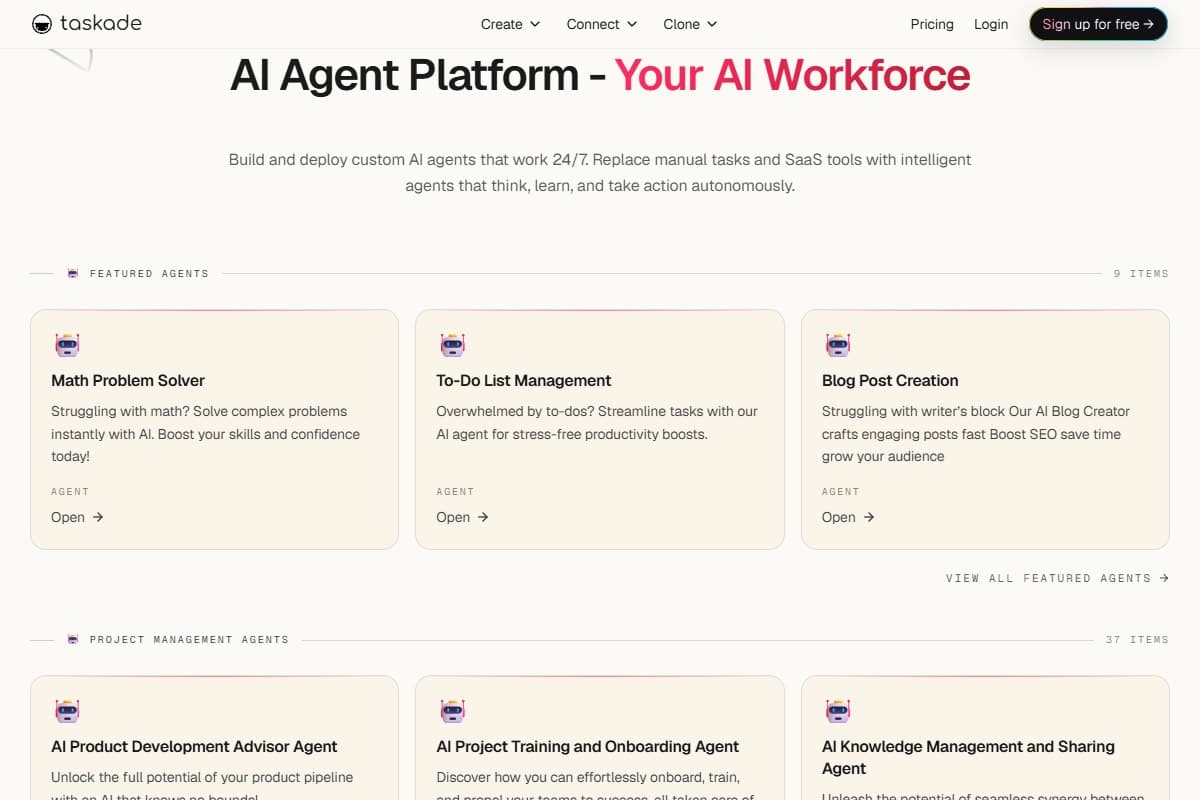
Taskade stopped being a to-do list and became one of the cheapest ways to run genuine AI agents. In May 2026 it shipped 24 pre-built Genesis Kits (cloneable, working AI app workspaces) and Agents v2, where each agent carries 33 built-in tools and can switch between 15 or more frontier models depending on the task. The agents live inside projects, docs, and boards rather than in a separate chat window.
What it did in testing
It was the only tool here where the three-step content pipeline ran end to end without me rebuilding the plumbing. That is mostly an architecture win rather than a model win: because the agent already sits in the workspace where the output belongs, there is no final step where a human copies text out of a chat and pastes it somewhere useful. That copy-paste step is where most agent workflows quietly die.
Cloning a working Genesis Kit and having something running in about 30 seconds is a genuinely better starting point than a blank agent builder. The honest catch is credits. Pro gives you 50,000 a month and a busy pipeline eats them faster than you expect, so the effective cost is higher than the sticker for heavy users. My full Taskade review 2026 has the credit math.
Pricing
- 1 user, 3 apps
- 3,000 credits (one-time)
- 500+ community templates
- Best for: trying the full flow
- 10 users, unlimited AI agents
- 50,000 credits/month
- Train agents on your data
- Best for: founders and small teams
- Unlimited users, AI teams
- 150,000 credits/month
- White-label, API, 100+ integrations
- Best for: agencies and scaling teams
- Cheapest genuine agent platform here: unlimited agents on a $10 plan against $40 to $99 elsewhere
- Agents live inside the project workspace, so output lands where the work already is
- 33 built-in tools and 15+ selectable frontier models per task, so you are not locked to one vendor's model
- 24 Genesis Kits clone a working setup in about 30 seconds instead of starting from an empty builder
- Free tier includes 3,000 credits and needs no card, which is enough to test the real flow
- Doubles as the project workspace, so it can replace a separate task tool rather than adding to the stack
- Credit limits are the real ceiling, and a busy pipeline burns 50,000 faster than the plan implies
- Lifetime-deal holders have publicly complained that credit caps arrived after purchase
- Mobile interface got noticeably more complex after the AI expansion
- Not customer-facing: there is no polished website widget to put in front of your users
- Model switching is powerful but adds a configuration decision to every agent you build
- Weaker at refusing to answer outside its knowledge than a purpose-built business agent
2. Chatbase: best AI agent for websites
What it is
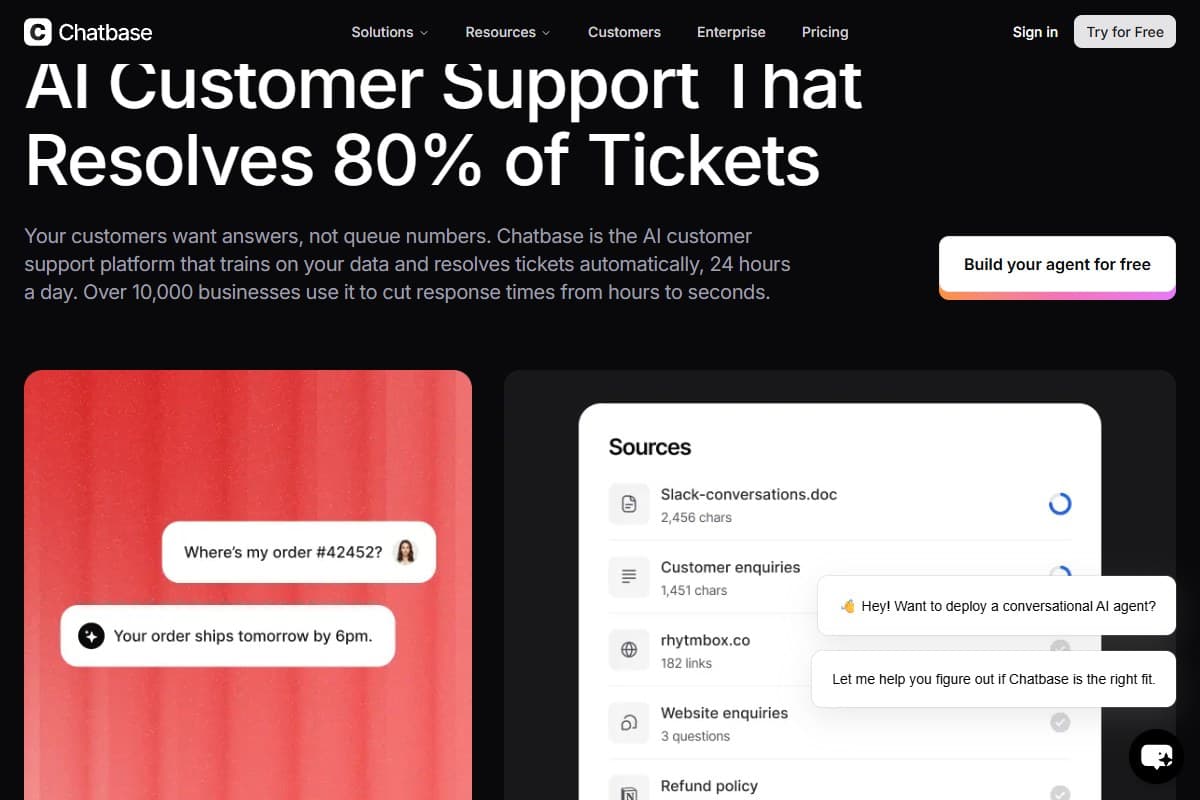
Chatbase turns a pile of your documents into a chat widget sitting on your website, usually inside an afternoon. It is customer-facing by design, and in 2026 it does more than answer: AI Actions let it book a call, file a ticket, or hand off to a human, and higher tiers add voice and telephony.
What it did in testing
Fastest tool here from raw documents to something a customer could actually use. The setup genuinely took under an hour for a working widget on a real site, and the action handling worked as advertised for booking and ticket creation.
The weakness showed on the unanswerable questions. Chatbase refused four of six and confidently invented answers to two. For a marketing site that is an acceptable trade for speed and polish. For a support desk where a wrong answer creates a refund or a compliance problem, those two are the reason CustomGPT exists. The pricing ladder is the other thing to plan for: Hobby at $40 is genuinely cheap, and the jump to Standard at $150 arrives sooner than most people budget for. Full detail in my Chatbase review 2026.
Pricing
- 50 message credits/mo
- 1 AI agent, 400 KB training
- Agent deleted after 14 days idle
- Best for: kicking the tires
- 700 message credits/mo
- Unlimited agents, 10 MB each
- 5 AI Actions per agent
- Best for: solo founders and small sites
- 4,000 message credits/mo
- 8 AI Actions per agent, 20 MB each
- Voice, telephony, API access
- Best for: most growing SMBs
- 15,000 message credits/mo
- 12 AI Actions per agent, 40 MB each
- Advanced analytics, 5 workspace members
- Best for: scaled support teams
- Fastest path from documents to a working customer-facing widget, comfortably under an hour
- AI Actions genuinely work: booking, ticket creation, and human handoff all fired correctly in testing
- Cheapest customer-facing entry point at $40/mo against CustomGPT's $99
- Holds 4.8 out of 5 on G2, the highest third-party rating of any tool in this roundup
- Voice and telephony available without leaving the platform on Standard and above
- Free tier is enough to build and test one agent end to end
- Invented answers to 2 of 6 unanswerable questions, which rules it out for high-stakes support
- Price jumps hard from $40 to $150 once you outgrow 700 message credits
- G2 reviewers repeatedly flag limited customization and rising cost past the basic plan
- Message-credit pricing makes a traffic spike an unpredictable bill
- Only 19 G2 reviews, so the 4.8 rating rests on a small sample
- Not built to own an internal recurring job, only to answer visitors
3. CustomGPT: best AI agent for business knowledge
What it is
CustomGPT builds an agent from your own documents and, unlike almost everything else here, is engineered to refuse rather than guess. It ingests 1,400+ source formats, works across 92 languages, and exposes a RAG API so the same knowledge base can power search inside your own product.
What it did in testing
It refused all six unanswerable questions. That is the entire buying case and it is worth more than any feature list. Loading 50 documents was straightforward, answers stayed inside the source material, and it consistently said it did not know rather than producing something plausible.
The price is the problem. At $99 a month the entry tier is 2.5 times Chatbase's, and the 1,000 monthly query cap is modest for anything customer-facing at volume. The honest read: this is an internal-knowledge and regulated-industry tool, not a general website chatbot. My CustomGPT review 2026 works through whether the refusal behavior justifies the bill, and Chatbase vs CustomGPT puts them side by side on identical documents.
Pricing
- 1,000 queries/month
- 60M words storage, 10 agents
- RAG API access
- 1,400+ source formats, 92 languages
- Best for: small businesses, single product
- 5,000 queries/month
- 300M words storage, 25 agents
- White-label with no CustomGPT branding
- SharePoint integration, website auto-sync
- Best for: scaled businesses and agencies
- Custom query volume
- Azure OpenAI API option
- Custom SSO and DPA
- Dedicated account manager
- Best for: regulated industries
- Refused all 6 unanswerable questions, the only tool here with a clean sheet on hallucination
- 1,400+ supported source formats and 92 languages, the widest ingestion range in this roundup
- RAG API means the same knowledge base can power search inside your own product
- Anti-hallucination behavior is the right default for regulated, legal, and medical-adjacent use
- Reviewers consistently praise setup simplicity, documentation, and security posture
- White-label available on Premium for agencies reselling the capability
- $99/mo entry is the steepest here, 2.5x Chatbase for a narrower job
- 1,000 queries a month is thin for anything customer-facing at real volume
- Very thin third-party review footprint: 3 Capterra reviews and none on G2
- Capterra reviewers rate it 3.3 out of 5, the lowest score of any tool in this roundup
- Price relative to competing agents is the single most common complaint in those reviews
- Refusal-first behavior feels unhelpful for marketing or top-of-funnel use
4. Viktor: best AI agent for Slack
What it is
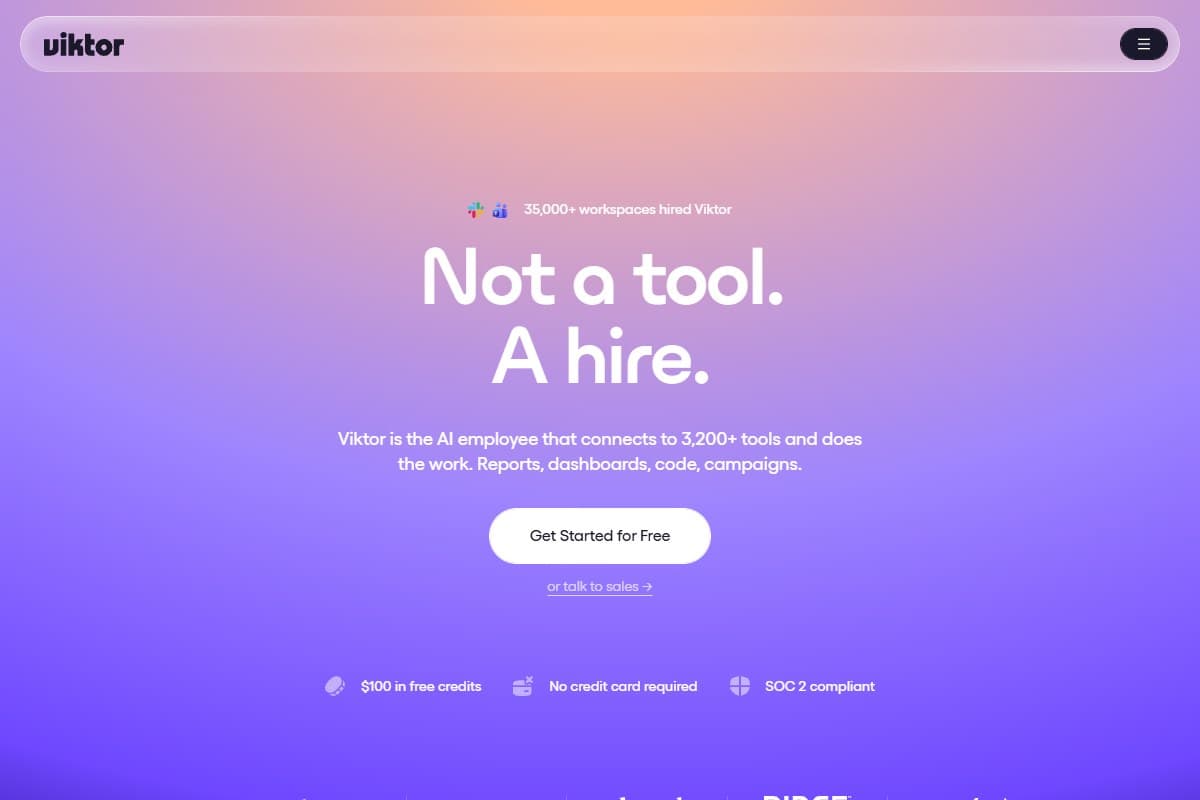
Viktor is an AI coworker that lives inside Slack and connects to more than 3,000 tools. You give it work the way you would give a colleague work, in a channel or a DM, and it runs scheduled tasks, builds reports, and pushes updates into the systems you already use. Human-approval gating means it can be allowed to act without being allowed to act unsupervised.
What it did in testing
The recurring Monday report was still running correctly four weeks later, which only two tools here managed. Adoption friction is the real story: nobody had to learn a new interface, because the interface was the Slack they already had open. For a team that genuinely runs on Slack, that matters more than any feature comparison.
The cost is the catch. Team is $50 a month for 20,000 credits, and Scale runs $300 to $750. That is the priciest tier structure of the four deployable agents. One genuinely useful detail: signing up through an affiliate link starts you with $150 in credits rather than the $100 you get going direct, so use the link below even if you only intend to test it. Full write-up in my Viktor review 2026.
Pricing
- $100 credits going direct, no card
- $150 credits via affiliate link
- Slack-native agent, all integrations
- Best for: testing it on real work
- 20,000 credits/month, auto-refresh
- Persistent workspace context
- Scheduled tasks and crons
- Human-approval gating
- Best for: founders and small teams
- 125,000 to 300,000 credits/month
- Same full feature set
- Higher autonomous volume
- Best for: companies running daily work
- Millions of credits/month
- DPA, SLA, security review
- Dedicated onboarding
- Best for: large orgs
- Zero adoption friction for Slack teams: the interface is one your colleagues already have open
- Connects to 3,000+ tools, the widest integration surface of any agent here
- Scheduled tasks and crons survived four weeks unattended in testing
- Human-approval gating lets you grant autonomy incrementally rather than all at once
- Free tier gives $150 in credits through an affiliate link, enough for genuine testing
- Persistent workspace context means it remembers the account it is working on
- Most expensive per-team pricing of the four deployable agents at $50/mo entry
- Useless if your company does not run on Slack, and there is no meaningful fallback
- Scale tier at $300 to $750 is a steep next step from $50
- Credit-based billing again, so heavy autonomous use is hard to forecast
- Almost no third-party review footprint yet, so there is little independent signal
- Newer product than the rest of this list, which carries the usual continuity risk
5. Gemini Spark: best for Google Workspace
Gemini Spark is the first consumer assistant that genuinely feels like it lives inside your accounts rather than beside them. It reads Gmail, Calendar, and Drive with real context and does multi-step work while you are not watching, which is more than most things calling themselves agents can claim.
It costs $100 a month, on the Google AI Ultra tier that exists largely to gate it. When Google cut its top plan from $250 to $200, most coverage read that as a price drop. It was a new tier, and Spark is what sits behind it. For someone buried in Gmail and Calendar all day it is arguably the best $100 in AI right now. For everyone else it is a beautiful product solving a problem they do not have, and the Google-only scope means it cannot help with work that lives anywhere else. My Gemini Spark review covers whether the paywall is worth crossing.
- Genuinely agentic inside Gmail, Calendar and Drive rather than a chat box bolted onto them
- Real multi-step work completed unattended, which most consumer assistants still cannot do
- Context across your actual accounts, so it knows who people are and what the meeting is about
- Best-in-class for anyone whose working day is mostly email and scheduling
- $100/mo puts it far above every deployable agent in this roundup
- Locked to Google Workspace, so it cannot touch work living anywhere else
- No affiliate program, and no free tier that meaningfully demonstrates the agent
- Solves a narrow problem very well rather than a general one adequately
6. Claude Fable 5: best for complex tasks
Claude Fable 5 is the most capable model I have pointed at real work, and the gap over the previous generation shows within an hour on hard coding and long-context reasoning. It is the tool I reach for when a task is genuinely difficult rather than merely long.
It is not a deployable agent, which is why it sits here rather than in the top four. It will not own your support inbox or run your Monday report unattended without you building that scaffolding yourself. Treat it as the best reasoning engine available and pair it with one of the platforms above when you need something to actually run. The practical catches are real: API pricing is double the previous tier at $10 and $50 per million tokens, the safety classifiers are aggressive enough to occasionally hand your conversation to an older model, and the launch period was genuinely bumpy. Detail in my Claude Fable 5 review.
- The most capable publicly available model tested, with a visible gap on hard coding tasks
- 1M context window without long-context price penalties, which changes what is practical
- More surgical, targeted edits than any competing model in agentic coding harnesses
- Included on paid Claude plans from $20/mo rather than requiring a separate agent subscription
- Not a deployable agent: it will not own a recurring job without scaffolding you build
- API pricing at $10/$50 per million tokens is double the previous generation
- Aggressive safety classifiers sometimes route conversations to an older model mid-task
- Launch period included a temporary suspension and a data-retention controversy
7. ChatGPT: the best known agent
ChatGPT is the default, and defaults matter more than reviewers like to admit. It has the widest tooling, the largest ecosystem, and the shallowest learning curve of anything here, and ChatGPT Agent comes bundled at the $20 tier rather than behind a $100 gate like Gemini Spark.
It is also the weakest tool in this roundup at owning a job. In testing it needed a human in the loop on essentially every run of the recurring report, not because it could not do the steps but because nothing kept it accountable to the schedule. It is the best general assistant on this page and the one I would recommend last if your actual problem is "something needs to happen every Monday without me." For how it stacks up against the other frontier assistants, see ChatGPT vs Claude vs Gemini.
- Widest tooling and largest ecosystem of anything in this roundup
- ChatGPT Agent is bundled at the $20 tier rather than gated behind a $100 plan
- Shallowest learning curve here, and most of your team already knows it
- Genuinely capable free tier, which nothing else on this page matches
- Weakest at owning a recurring job unattended despite the agent branding
- Needed a human in the loop on nearly every scheduled run in testing
- No affiliate program, and no business-grade refusal behavior out of the box
- Being the default means it is rarely the best tool for a specific job
How to pick, by the job you actually have
| Your situation | Buy this | Why |
|---|---|---|
| You want agents doing real work on a budget | Taskade | Unlimited agents at $10/mo, and output lands in the workspace |
| You need a chat widget on your website this week | Chatbase | Documents to live widget in under an hour, $40 entry |
| A wrong answer creates a refund or a compliance problem | CustomGPT | Only tool that refused all 6 unanswerable questions |
| Your company already runs on Slack | Viktor | Zero adoption friction, and scheduled tasks that survive |
| Your working day is Gmail and Calendar | Gemini Spark | Real agentic behavior inside Google, if you can pay $100 |
| The task is genuinely hard rather than just long | Claude Fable 5 | Most capable reasoning available, from $20/mo |
| You want one assistant your whole team will actually use | ChatGPT | Widest tooling, shallowest learning curve, bundled agent |
| Total budget under $60/month | Taskade plus Chatbase | Internal agents and a customer-facing widget for about $50 |
That last row is the pairing I recommend most often. Taskade at $10 handles internal work and Chatbase at $40 handles the website, which covers both sides of the job for about $50 a month. That is less than Viktor's entry tier alone and well under CustomGPT's. Move up only when you hit a specific ceiling you can name.
Who should skip AI agents for now
Skip all of this if you cannot yet describe the recurring task in one sentence. Agents are automation, and automation applied to a process you have not defined produces faster mess rather than less work. Skip it if the job runs less than weekly, because the setup and credit cost will exceed the time saved. And skip the paid tiers entirely until you have run the same job manually enough times to know what "done correctly" looks like, because you cannot evaluate an agent's output against a standard you have not set.
The free tiers on Taskade, Chatbase, and Viktor are genuinely enough to answer the question for your own situation. Start there.
There is also a whole class of job that does not want an agent at all. If the task is deterministic, meaning the same trigger should always produce the same steps in the same order, a visual automation platform is cheaper, more predictable, and far easier to debug than any agent on this list. Make.com is the one I reach for: you watch the data move between apps as the scenario runs, and the free plan's 1,000 credits a month is enough to run something real. The Make.com review covers the learning curve, and the Pictory and Make video workflow is a worked example of the shape.
What the Community Is Saying
Paraphrased community sentiment rather than direct quotes, drawn from public reviews and developer discussion.
- Taskade is the best-reviewed tool on this page. It holds 4.5 out of 5 across 83 verified reviews on G2, with 80% of reviewers giving five stars. Ease of use, the AI features, and consolidating tasks, docs, and AI in one place are the recurring praise. On Product Hunt reviewers describe a genuine shift from manually building workflows to prompting an outcome and letting agents handle the scaffolding, with the main complaint being a mobile interface that grew more complex after the AI expansion.
- Taskade's credit change is a real grievance worth knowing about. On AppSumo, longtime lifetime-deal holders have raised concerns about AI credit limits being introduced after purchase, with some feeling the terms changed without clear communication. If you are evaluating long-term cost rather than this month's bill, read those first.
- Chatbase scores highest but on a small sample. It carries 4.8 out of 5 on G2, the top rating in this roundup, though across only 19 verified reviews. Reviewers consistently praise the speed of setup and describe support as responsive. The two recurring criticisms line up with my testing: limited customization options, and costs climbing quickly once you need features above the basic plan.
- CustomGPT has the thinnest independent footprint here, and that is a finding in itself. It has no reviews at all on G2 and just three on Capterra, where it averages 3.3 out of 5. Reviewers there praise easy setup, documentation, and security, and the criticism is almost entirely about price relative to competing chatbot and agent tools, plus inflexible customer service policies. A three-review sample proves very little, but the absence of independent signal is worth weighing against a $99 entry price.
- Developers rate Fable 5 on capability and worry about the guardrails. In a widely read Hacker News thread, an early tester called it "a step change and worthy of the 'Claude 5' model name," praising "more targeted and surgical diffs" and noting it hit better results with roughly half the tokens in some agentic harnesses. The same tester flagged the catch repeated everywhere: "the classifiers are super aggressive and sensitive," though the fallbacks to the older model "worked like a charm."
- Fable 5's launch was genuinely turbulent, which matters if you are committing a workflow to it. InfoQ reported that Anthropic released and then temporarily suspended the model, and Anthropic's own announcement describes it as a Mythos-class model made safe for general use. Coverage in TechCrunch noted it shipped days after the company warned that AI is getting too dangerous.
- The category-wide complaint is credits, not capability. Across every platform here, the loudest recurring theme in user reviews is not that the agents fail. It is that the advertised monthly allowance runs out sooner than the pricing page implies, and that heavy autonomous use makes the bill hard to forecast. Budget for roughly double the tier you think you need.
Bottom Line
Taskade is the best AI agent for most people in 2026, and it earns the 4.2 rating on value rather than raw capability. Unlimited agents at $10 a month, with output landing inside the workspace where the work already lives, beats paying $40 to $99 for a narrower job. It is also the best-reviewed tool here at 4.5 across 83 G2 reviews. The catch is credits, and 50,000 a month disappears faster than you expect.
Buy Chatbase at $40 if the job is a website widget and you want it live this week. Buy CustomGPT at $99 only when a confidently wrong answer costs you more than the extra $59, because refusing all six unanswerable questions is the one thing it does that nothing else here matched. Buy Viktor if your company runs on Slack, and use the link for $150 in starting credits instead of $100. Gemini Spark, Claude Fable 5, and ChatGPT are excellent assistants and poor agents: reach for them to think, not to own a recurring job. And skip all of it if you cannot describe the task in one sentence yet.
FAQ: best AI agents in 2026
What is the best AI agent in 2026?
Taskade, for most people. It runs unlimited agents on a $10 a month plan with 33 built-in tools and 15 or more selectable frontier models, and the agents live inside the project workspace rather than in a detached chat window. That last detail is why work actually gets finished. If you need a customer-facing agent instead of an internal one, Chatbase at $40 is the better buy.
What is the difference between an AI agent and a chatbot?
An agent owns a task and keeps working after you close the tab, including on a schedule. A chatbot answers when spoken to. The distinction sounds academic until you try to make one do the other's job. In my testing only four of these seven could run a recurring task unattended for four weeks, and the three that could not are the three best-known consumer assistants.
What is the cheapest AI agent worth paying for?
Taskade at $10 a month on Pro, with unlimited agents and 50,000 credits. Nothing else here does genuine agent work below $40. If you need a customer-facing widget rather than internal automation, Chatbase's $40 Hobby tier is the cheapest real option, and both have free tiers substantial enough to test the actual workflow first.
Do AI agents hallucinate?
Yes, and it is the single most important thing to test before you put one in front of customers. I asked every tool six questions its documents could not answer. CustomGPT refused all six. Chatbase refused four and invented two. The general-purpose assistants invented answers to nearly all of them unless explicitly instructed otherwise. If a wrong answer creates a refund or a compliance problem, buy the tool that refuses.
Which AI agent is best for customer support?
CustomGPT if accuracy matters more than cost, because it declines to answer outside its source documents rather than guessing. Chatbase if speed and price matter more, because it ships a working widget in under an hour at $40 a month and handles actions like booking and ticket creation. The honest split is that Chatbase is the better marketing-site agent and CustomGPT is the better support and internal-knowledge agent.
Is ChatGPT an AI agent?
Partly. ChatGPT Agent is bundled at the $20 tier and can carry out multi-step tasks, which is more than most assistants offer at that price. But in testing it needed a human in the loop on nearly every run of a scheduled job. It is the best general assistant on this list and the one I would pick last if the actual requirement is something happening every Monday without you.
Is Gemini Spark worth $100 a month?
Only if your working day genuinely lives in Gmail, Calendar, and Drive. For that person it is arguably the best $100 in AI right now, because it does real multi-step work with context across accounts rather than answering questions about them. For everyone else it is a narrow product at a wide price, and every deployable agent in this roundup costs less and does more outside Google.
How much do AI agents cost in 2026?
The real range is $10 to $100 a month depending on where the agent runs. Taskade starts at $10, Chatbase at $40, Viktor at $50, CustomGPT at $99, and Gemini Spark at $100. The number that matters more than the tier price is the credit allowance, because every platform here bills usage against a monthly pool and the loudest complaint across all of them is that the pool runs out before the month does. Budget for roughly double the tier you think you need.
Can I run AI agents for free?
For testing, yes. Taskade gives 3,000 one-time credits, Chatbase gives 50 message credits a month with one agent, and Viktor starts you with $150 in credits through an affiliate link or $100 going direct. That is genuinely enough to build one real workflow and find out whether it holds up. None of the free tiers sustain production use, but all three answer the only question that matters before you pay.
Related reviews
- Cluster hub: AI agents
- Taskade review 2026: the full deep dive on the winner, including the credit math
- Chatbase review 2026: the website-facing pick, tested on a real site
- CustomGPT review 2026: whether refusal-first behavior justifies $99 a month
- Chatbase vs CustomGPT 2026: the two knowledge agents on identical documents
- Viktor review 2026: the Slack-native coworker, tested for four weeks
- Gemini Spark review: is Google's $100 agent worth the paywall
- Claude Fable 5 review: the most capable model here, and its caveats
Got an AI agent question I did not cover here? Get in touch: reader questions shape the next round of testing.
Free interactive tool
Compare Taskade with other AI toolsSide-by-side pricing, features, and ratings — plus a recommended pick for your use case.
Independent AI tools researcher testing what actually works.
Keep reading
Related reviews
Best AI Chatbot Builders 2026: I Tested 6 Tools and Ranked Them
I tested 6 AI chatbot builders on the same knowledge base. Chatbase, CustomGPT, Taskade, Viktor, Botpress and Tidio, ranked by what shipped.

Chatbase Review 2026: The Best AI Chatbot Builder for Your Website?
Chatbase claims a trained AI support agent for your site in 15 minutes. I built one on a real knowledge base; here's where the pricing bites.

Taskade Review 2026: I Tested the New AI Agents v2 (Worth It?)
Taskade just shipped 24 Genesis Kits and Agents v2 with 33 tools. I tested the new AI agents on a real workflow to see if it's worth $10/mo in 2026.