
I'm writing this three days into the AI World Cup 2026: the tournament kicked off on June 11, the group stage is in full swing across Canada, Mexico and the USA, and I cannot stop thinking about the part nobody's chanting about in the stands. The football is the football. But underneath every match is the single largest live deployment of artificial intelligence the world has ever switched on at once.
Here's the thing that actually got me to drop what I was doing and write this. This isn't AI bolted onto the broadcast as a gimmick. The ball has a chip in it. Every player has been scanned into a 3D avatar. All 48 nations were handed the same AI analyst. Sixteen stadiums each have a living digital twin. Google's models are sitting on the bench with the defending champions. The 2026 World Cup is, functionally, an AI stress test with a billion people watching, and most of them have no idea how much of what they're seeing is being decided, drawn, or routed by a model.
I spend my days testing AI tools for regular businesses and creators, so I went looking for what's real here versus what's marketing. Short version: it's more real, and more far-reaching, than the press releases let on. Let me walk you through the six pieces that matter, and then the part the glossy launch videos skip, which is what happens when this stuff goes wrong on the biggest stage in sport.
How I reported this
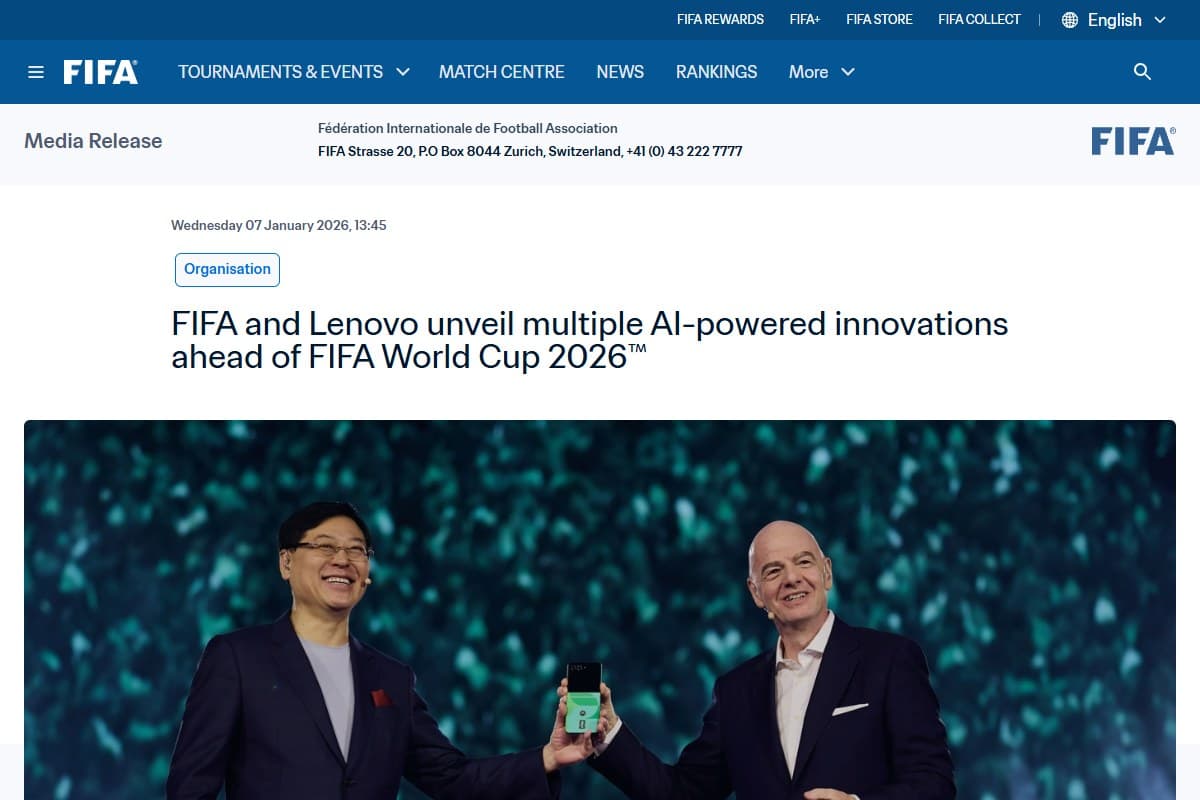
1. Football AI Pro: every nation gets the same elite analyst
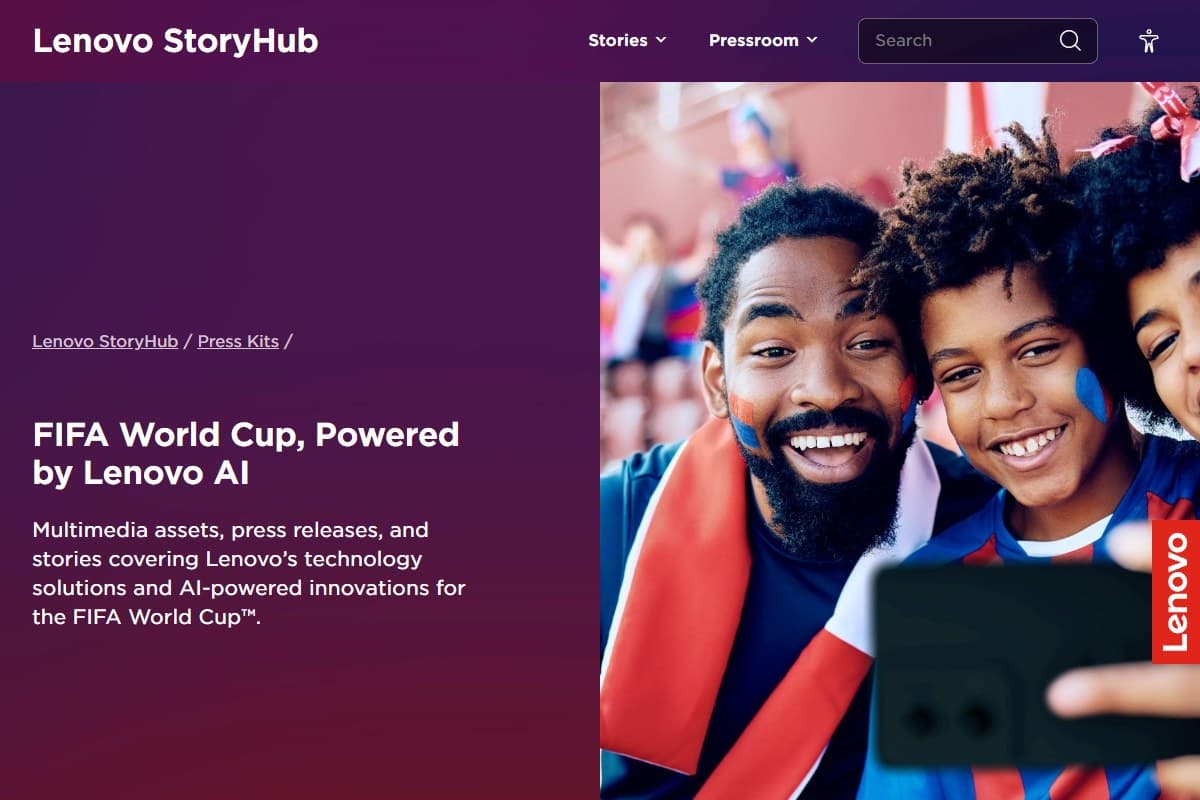
Start with the one that quietly changes the sport. Football AI Pro is a FIFA-certified generative AI knowledge assistant, built on FIFA's own Football Language model and Lenovo's AI infrastructure. And here's the detail that matters more than any spec: it was given, equally, to all 48 competing nations.
Think about what that does. Historically, the federations with the deepest pockets bought the best analysts, the most video crews, the fanciest data ops. A smaller nation simply couldn't match the analytical horsepower of a footballing superpower. Football AI Pro hands every team the same engine, and that engine is genuinely serious. It chews through hundreds of millions of data points per match across more than 2,000 performance metrics, then spits out answers as text, video clips, graphs and 3D visualizations.
Coaches query it in plain language. "Compare our set-piece conversion to the quarterfinalists." "Break down their high-press triggers." "Build me a scouting report on their substitute striker." Post-match analysis that used to eat two full days of manual video review now lands in roughly two hours. That's not a faster spreadsheet: that's a different job.
The one guardrail I respect: it cannot be used during live play. Pre-match and post-match only. FIFA drew a deliberate line to preserve human tactical integrity in the moment: the manager on the touchline still has to be a manager, not a prompt operator. It's a small decision that signals someone thought about where the human has to stay in the loop. More on that tension later.
2. 3D player avatars and the new offside system
This is the one that'll change what you see on your screen during a tight call.
Every player at the tournament was digitally scanned, and the scan takes about one second. That quick capture pulls precise body-part dimensions, so the system knows exactly where each player's shoulder, knee and toe sit in space. Those measurements feed AI-enabled 3D avatars that look and move like the real player, scaled to their actual physical dimensions.
Where it bites is offside. The semi-automated offside system now combines the player tracking with the ball data (more on the ball in a second) to draw the offside line automatically. The upgrade for 2026: clear-cut offside calls are sent directly to the on-field referees, into the assistant referee's earpiece, rather than waiting on a separate VAR-room review. Faster, cleaner, fewer of those agonizing two-minute pauses where everyone stares at a screen. And when the decision is made, a 3D animation plays on the stadium screens so 80,000 people (and everyone at home) can actually see why the flag went up.
Routed straight to the on-field official with an auto-generated 3D replay, instead of a manual VAR-room redraw
I'll be honest: the part of me that loves the human chaos of football has mixed feelings. But the part of me that's watched a season ruined by a blurry, hand-drawn offside line is relieved.
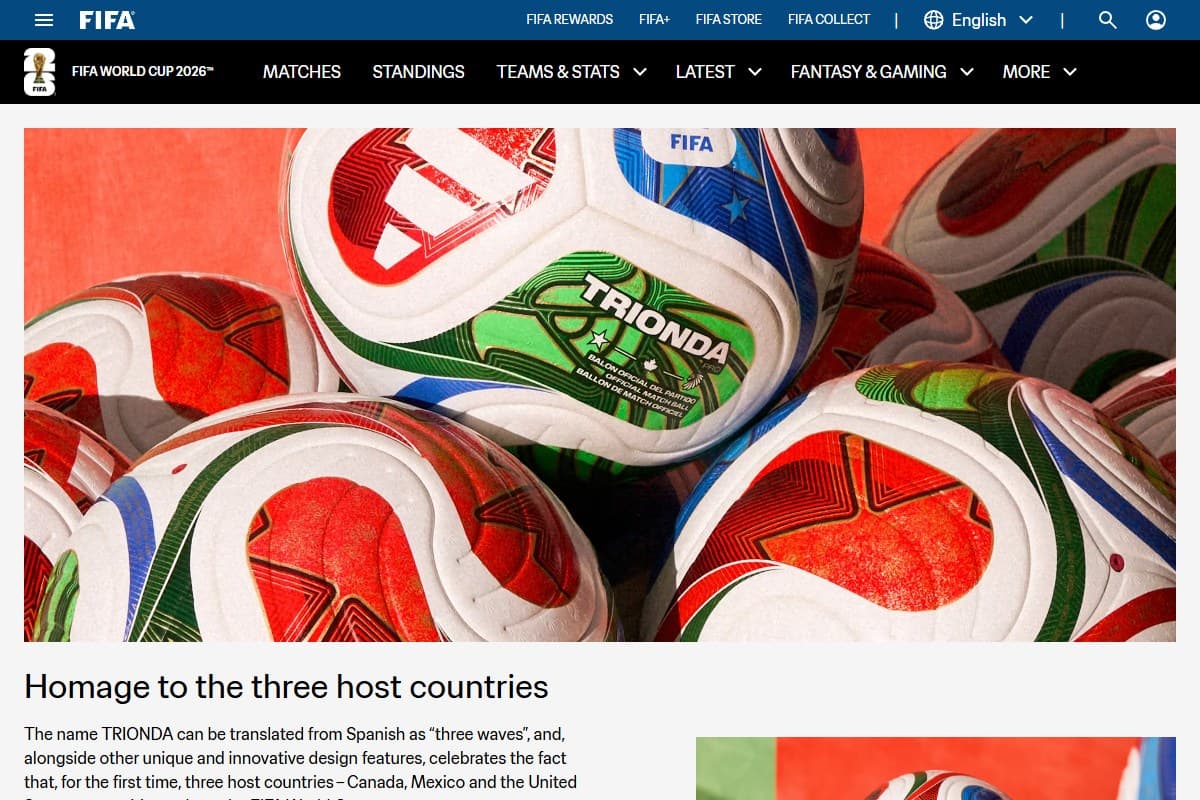
3. The smart ball: Trionda has a chip in it
The ball is now part of the data system. Let that sink in.
Trionda, the official 2026 match ball, has a 500Hz motion-sensor chip embedded inside it. Five hundred readings per second. Every touch, every spin, every acceleration is logged and streamed in real time to the VAR system. Its job is to pin down the exact moment of contact, the single hardest thing for a camera to judge, which is precisely what you need for offside timing, handball, and penalty-box decisions.
Pair that with the player avatars and you get something football has never had: the system knows where every player was and when the ball was struck, to the hundredth of a second, from inside the ball itself. (Yes: it has a battery, and yes, they have to charge the match balls before kickoff. A genuinely funny sentence to type about a World Cup.)
This is the quiet revolution. We've spent a decade adding cameras to capture the game from the outside. Trionda makes the game instrument itself from the inside. The object of play is now a sensor.
4. Google Gemini is on the bench with the champions
Here's where the consumer AI giants enter the chat. Argentina, the defending champions, are using Google Gemini to analyze opponent data. Gemini branding is on their training kit, and the staff use it to break down plays and pull apart formation data, on both their own performances and their opponents'.
And it's not just Argentina. France, Morocco, the USA and Brazil have all struck deals with Google too: France runs Pixel as its official squad phone and uses Gemini for team communications. Coaching staffs across the tournament are leaning on Gemini to dissect plays and formation patterns the way they'd once lean on a roomful of analysts. If you've read my Gemini Spark review, you already know how capable Google's assistant has gotten: this is that same engine, pointed at winning a World Cup.
Google's also pushing AI to the fans. It's baking AI-generated answers into football searches: ask a tactical question and AI Mode in Search builds interactive diagrams for that specific query, alongside live scores pinned to your lock screen and match-day routing in Maps and Waze. The broader pattern, Google quietly threading its models through every consumer touchpoint, is the same one I dug into in my Google Antigravity 2 review. The World Cup is just the most-watched showcase of it yet.
What strikes me is the workflow underneath. A coach asking Gemini to summarize an opponent's last five matches is doing the exact thing a marketer does asking an AI to summarize five competitor campaigns, and the exact thing automation platforms like the ones in my Make.com review do when they chain "fetch data → analyze → report" without a human touching the middle. The World Cup version just has better lighting.
5. The stadiums are thinking too
Step outside the white lines and the AI gets even denser.
At the center sits the FIFA Intelligence Command Centre: a hub that connects data across all venues, monitors the entire tournament's operations in real time, and produces AI-generated daily summaries so officials can spot and respond to trends across the whole footprint. It's an air-traffic-control room for a tournament spread across a continent.
Feeding it: digital twins of all 16 stadiums. Hyper-accurate virtual replicas that track crowd flow, security deployments and technical systems live. If a concourse is getting dangerously dense, the twin sees it before a human in a control room would. Layered on top is a Smart Wayfinding platform that guides fans to their seats, the nearest food, the right exit, and onward transport: from their phones, before they even reach the gate.
The part that genuinely impressed me is the safety angle. During an emergency, evacuation routes get pushed directly to fans' phones: personalized to where you're standing, not a generic "please proceed to the nearest exit." That's AI doing something unambiguously good with crowd-scale data.
And for everyone watching at home: referee body-cam footage is AI-stabilized for broadcast (so you get the ref's-eye view without the nausea), and there's a 3D immersive viewing angle that lets you reposition yourself around a moment of play. The tournament is being rendered, not just filmed.
6. The risks nobody puts in the launch video
This is the section that makes this a real article instead of a press release, so let me be straight with you. Every system above has a shadow.
- Tactical homogenisation. If all 48 teams are fed analysis by the same engine trained on the same data, do they all start converging on the same "optimal" game plan? The thing that makes football beautiful is the weird, irrational, locally-invented idea. Hand everyone the same oracle and you risk sanding off exactly that. This is the AI-everywhere problem in miniature: when everyone uses the same model, everyone's output drifts toward the same mean.
- Deepfake ticketing scams. This one's not hypothetical: fraudsters are already deploying AI-generated fakes around the tournament to sell tickets that don't exist. The same generative tools powering the fan experience are powering the people trying to rob the fans.
- Over-reliance on automation in high-stakes calls. Sending offside decisions straight to the on-field ref is faster: until the day the system is confidently wrong and the human has been trained to trust it. Automation bias is well-documented: the more reliable a system usually is, the less likely a person is to overrule it on the one occasion they should.
- Surveillance at scale. Digital twins watching crowd behavior, biometric gates, facial-recognition entry in some venues: that's a lot of monitoring of a lot of people who showed up to watch football. The line between "crowd safety" and "crowd surveillance" is a policy choice, and it's being drawn fast and quietly.
- And the big one: what happens when the AI gets it wrong in a final? Every system here has a margin of error. Most of the time it's invisible. But a 500Hz ball reading or a 3D avatar's shoulder placement deciding a goal in the 89th minute of a World Cup final: that's a moment where "the model was 99.7% accurate" is no comfort to the team that just lost. The technology has removed the human scapegoat without removing the possibility of being wrong.
None of this means the tech shouldn't be here. It means the people deploying it owe us honesty about the trade-offs, and most of the launch material is allergic to that conversation.
What this means for AI in 2026
Here's why I think this matters far beyond football, and why I'm writing about it on a blog about AI tools.
Every single capability on display at the World Cup is a scaled-up version of something a regular business or creator can already use. Football AI Pro analyzing millions of data points and returning a plain-language briefing? That's an AI research assistant: you can point one at your market, your competitors, your own analytics today. Gemini breaking down formations for Argentina? That's the same assistant breaking down a spreadsheet for a solo founder. The Intelligence Command Centre summarizing operations across 16 venues? That's an automation that watches your systems and pings you when something's off.
The World Cup didn't invent these capabilities. It concentrated them: took tools that are already in your reach and ran them at planetary scale with the world watching. The democratization point FIFA made about Football AI Pro (every nation gets the elite analyst) is the exact thing happening in business right now: the small team gets the same AI leverage that used to require a budget only the giants had.
That's the real headline. Not "AI is at the World Cup." It's "the gap between what a billion-dollar tournament can do and what you can do shrank to almost nothing, and 2026 is the year it became impossible to ignore." The risks scale down to you too, by the way: the homogenisation, the over-reliance, the temptation to trust the output you didn't check. Same trade-offs, smaller stage.
If watching the most advanced AI deployment in history makes you want to put a fraction of that leverage to work yourself, that's the right instinct. Start small, stay skeptical, and verify the output: same as I'd tell a World Cup referee.
FAQ: AI at the 2026 World Cup
What is Football AI Pro and which teams get it?
Football AI Pro is a FIFA-certified generative AI knowledge assistant, built on FIFA's Football Language model and Lenovo's AI infrastructure. It analyzes hundreds of millions of data points per match across 2,000+ metrics and answers coaches in natural language with text, video, graphs and 3D visualizations. Crucially, it was given equally to all 48 competing nations to level the analytical playing field, and it can only be used before and after matches, never during live play.
Does the 2026 World Cup ball really have a chip in it?
Yes. The official ball, Trionda, has a 500Hz motion-sensor chip embedded inside it that streams precise ball-contact data to the VAR system in real time. It pinpoints the exact moment of touch, which is what makes faster, more accurate offside, handball and penalty decisions possible. It runs on a battery, so the match balls genuinely have to be charged before kickoff.
How does the new semi-automated offside system work?
Every player was scanned into a 3D avatar (the scan takes about a second) capturing their precise body dimensions. The system combines that player tracking with the smart ball's contact data to draw the offside line automatically. For 2026, clear-cut offsides are sent straight to the on-field officials' earpieces instead of waiting on a separate VAR review, and a 3D animation of the decision plays on the stadium screens.
Which teams are using Google Gemini at the World Cup?
Argentina, the defending champions, are using Gemini to analyze opponent and formation data, with Gemini branding on their training kit. France, Morocco, the USA and Brazil have also signed deals with Google, with France using Pixel as its official squad phone. Google is also weaving AI-generated answers into football searches and live features across Search, Maps and Waze for fans.
What are the biggest risks of all this AI at the World Cup?
The main ones: tactical homogenisation (every team converging on the same AI-suggested game plans), AI-generated deepfake ticketing scams already targeting fans, over-reliance on automated decisions in high-stakes calls, privacy and surveillance concerns from crowd-scale monitoring and biometric gates, and the unresolved question of what happens when an automated system gets a match-deciding call wrong in a final.
Can regular businesses use the same AI that's powering the World Cup?
Largely, yes: at smaller scale. The World Cup's AI is built from the same primitives available to anyone now: AI research assistants that summarize huge datasets, assistants like Gemini that break down documents and data, and automation platforms that chain "fetch → analyze → report" without a human in the middle. The tournament concentrated and scaled these tools; the underlying capabilities are already within reach of solo creators and small teams.
Related reading
- AI Agents topic hub: every AI assistant and agent we've reviewed in one place.
- Gemini Spark Review: worth $100 a month?: Google's assistant, the same engine the champions are using.
- Google Antigravity 2 Review: how deep Google's AI push really goes.
- Make.com Review: build the "analyze and report" automations the World Cup runs at scale.
Spotted an AI system at the 2026 World Cup I didn't cover, or want me to test one of these capabilities for your own work? Get in touch, reader questions shape the next round of coverage.
Free interactive tool
Compare AI tools side-by-sideSide-by-side pricing, features, and ratings — plus a recommended pick for your use case.
Independent AI tools researcher
Keep reading
Related reviews
SpaceX Just Bought Cursor for $60B: What This Means for AI Coding Tools
SpaceX acquired Cursor for $60 billion. The AI coding tool used by 7.5 million developers is now owned by Elon Musk's space company. Here's what actually changes.
Claude Fable 5 Just Went Behind a Paywall: Is It Worth Paying For?
Claude Fable 5 is no longer free: from June 23 it needs paid credits. Users got just 4-5 days free instead of the promised 13. The full story.

Claude Is Now on Your iPhone: Apple's Multi-AI Siri Changes Everything
Apple just made Claude a selectable iPhone assistant in iOS 27. Here's what the multi-AI Siri means for you and the future of AI assistants.