
I spent a week building three real applications inside Lovable: a SaaS landing page with a working waitlist, an internal team dashboard with auth and a Postgres backend, and an MVP I'd genuinely been planning to commission from a freelance developer for around $3,500. This Lovable review is built on those three builds: not a press kit summary, not a launch-day reaction post, and not yet another "I prompted it once and was amazed" Twitter thread.
The short version: Lovable's pitch is real. You can describe an application in plain English and have a working version running on the public internet inside an hour. For the landing page, this was magic. For the dashboard, it was workable with patience. For the MVP, it was a budget-burning fight that ended at maybe 70% completion. That's the pattern that earned the rating, and it tracks with what I'm reading across Reddit threads and HN discussions all month.
If you're a solo founder and your job this quarter is to ship a demo that gets the next meeting, install it today. If you're trying to ship the real product you'll bill customers for, read the next section before you give up your developer.
How I Tested This
Why Lovable is trending right now
Three signals turned Lovable into the most-searched AI app builder of May 2026.
First, the numbers. Lovable closed a $330M Series B at a $6.6B valuation in December 2025, led by CapitalG and Menlo Ventures with NVentures, Salesforce Ventures, Databricks Ventures, Atlassian Ventures, and HubSpot Ventures all participating. The company crossed $400M ARR in February 2026, up from $100M in July 2025. That's roughly 4x revenue growth in seven months. It's the fastest European startup ever to hit $20M ARR: under two months from launch.
Second, the founder narrative. A non-technical user posting "I just built and launched my SaaS in a weekend" on X is the dominant Lovable content type right now. Some of those posts are real. Some are clearly the founder's third attempt with a lot of unshared trial and error. Either way, the social proof keeps stacking.
Third, and this is the honest one, the credit drain complaints. Every Reddit thread about Lovable has at least one person saying they burned $50 of credits in an afternoon trying to fix a single bug. That controversy is, perversely, driving more search volume. People want to know whether the magic is worth the risk.
What Lovable actually is
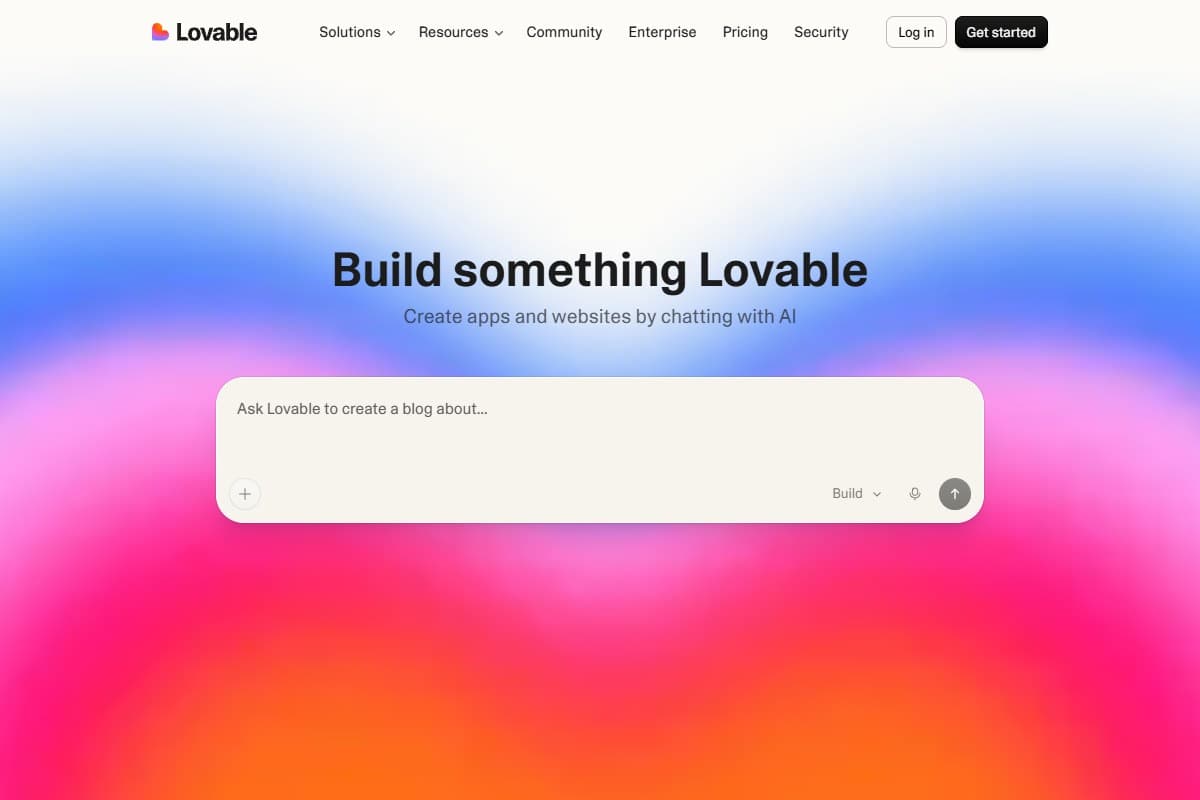
Lovable is a browser-based AI app builder that turns plain-English prompts into working full-stack web applications. You describe what you want. The agent writes the code, provisions the infrastructure, deploys it, and hands you back a live URL.
- Chat panel: describe the app, the change, or the fix you want in natural language
- Visual preview: a live, interactive preview of your app updates as the agent works
- Code view: full access to the React/Next.js source, exportable as a real GitHub repo
- Supabase integration: auth, Postgres, storage, edge functions all wired automatically when you ask for them
- Built-in deployment: every project has a public
*.lovable.appURL the moment it compiles - Credits: every prompt to the agent costs credits; complex features and fix-loops cost more
The headline change versus the 2025 generation of "AI app builders" is that Lovable handles the full stack. Frontend, backend, database schema, auth, deployment, and a working URL. Bolt.new is comparable on the front-end side but leans on you for more of the infra; v0 by Vercel is purely a UI component generator. Lovable is the closest thing to "describe an app and get an app" that exists in May 2026.
My honest testing experience
The moment that earned this review's rating came at minute 38 of day one.
I'd typed a single paragraph describing a SaaS waitlist page: what the product was, who it was for, three feature bullets, a hero CTA, an email-capture form that writes to a database, and a thank-you screen. Lovable thought for about ninety seconds, then it built every piece of it. Live URL. Working form. Database row inserting on submit. Styling that wasn't embarrassing. The CSS was tighter than what I would've written myself.
For a non-technical founder, that's not a productivity improvement. That's a category shift. The one bit of friction on day one was tiny: the live preview pane didn't refresh the form change on its own, and I had to reload it twice before the new email field actually appeared.
38 minutes end-to-end. Page deployed to a public URL, form writes to Supabase, no manual config required.
Day three changed the tone. The dashboard build needed real schema design: three tables, a join between users and projects, role-based access. Lovable got the first cut right. Then I asked it to add a billing page that pulled subscription status from a Stripe webhook. It built it, though the build errored out the first time and I had to re-run the same prompt before it completed. It half-broke the auth flow in the process. Three prompts later, the auth was back but the billing page was now showing the wrong user's data. Two more prompts. Fixed. But I'd burned about a quarter of my monthly Pro credits in one afternoon.
The MVP day was where the wheels got wobbly. Anything that crossed about 15 distinct features started producing the pattern other reviewers have described: the agent fixes the thing you asked about and breaks the thing next to it. Then you prompt to fix the second thing, and the first thing breaks again. After two hours, I had a project-tracking app that worked for the happy path and broke quietly when users did anything unusual. It was demo-ready. It was not customer-ready.
What I liked
- Prompt-to-live-URL is genuinely fast. Under 40 minutes for a real, deployable landing page on day one is a category shift, not an improvement.
- Supabase integration is clean. Auth, Postgres, and storage wire themselves up correctly when you ask for them. No env-var rabbit hole.
- The visual preview updates as the agent works. You watch the app being built in real time, not as a static screenshot at the end.
- Code export is real. You can leave Lovable at any point with a working Next.js repo on GitHub. No vendor lock-in at the code level.
- The free tier is actually usable. Enough credits to build a real first prototype, unlike most "free tier" products in this space.
- Plain-English schema design works surprisingly well. "Users should have many projects, projects should have many tasks, tasks should belong to a user" produced the right SQL.
What frustrated me
- Credit drain in fix loops. When the agent gets a complex feature 80% right, the remaining 20% can cost more credits than the original build. This is the #1 complaint across Reddit, and it is real.
- Adjacent-feature breakage. Crossing about 15 features in a single project starts producing the "fix one thing, break the next thing" loop that ends in frustration.
- Not production-ready beyond demos. Security defaults, error handling, and edge-case behavior are noticeably weaker than what a competent developer would ship. Fine for prototypes. Risky for paying customers.
- Debugging is mostly through the chat. When something breaks subtly, you're back to natural-language guessing rather than reading a stack trace. That's faster when it works and infuriating when it doesn't.
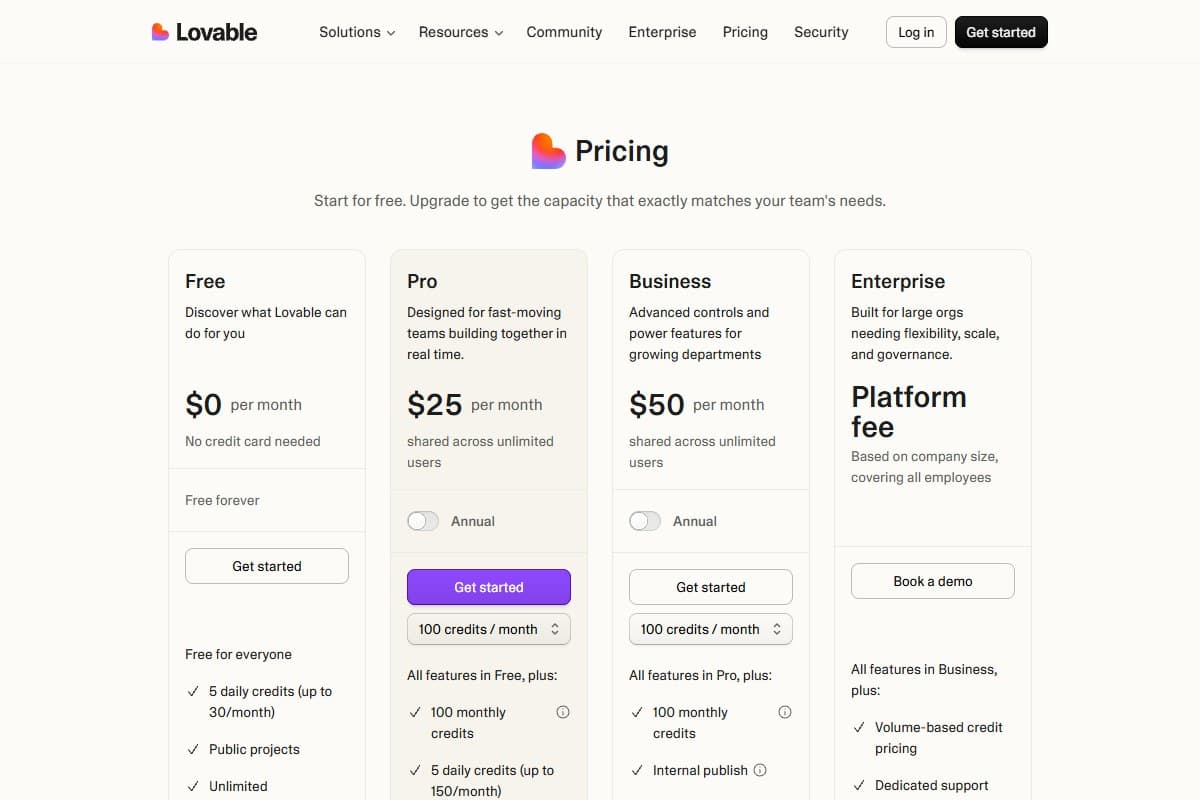
Pricing: is it worth it?
- Daily credit limit
- Public projects only
- Best for: trying it
- 100 monthly credits
- Private projects
- Custom domains
- Best for: indie founders
- 250 monthly credits
- Team workspaces
- Priority queue
- Best for: small teams shipping MVPs
- Unlimited credits available
- SSO and audit logs
- Dedicated support
- Best for: bigger orgs piloting AI app dev
Pricing math here is genuinely tricky, so the honest version: Pro at $25/mo is the right starting tier for a solo founder, but only if you treat the 100 monthly credits as a hard budget. The trap in Lovable's pricing model isn't the monthly fee: it's that complex apps can eat half of your monthly credits in a single afternoon of debugging. I hit roughly 30% of my Pro credits on the dashboard build alone, and that was a fairly simple internal tool.
Business at $50/mo with 250 credits is the saner pick if you're doing this seriously. The marginal cost over Pro is small and the credit headroom gets you through the worst fix loops without rationing prompts.
Enterprise is for organizations who've already decided AI app building is part of their workflow. If you're still evaluating, you're not the Enterprise customer.
The real comparison point: Bolt.new at $25/mo gives you 10M tokens, which roughly matches Lovable Pro for typical workloads. v0 by Vercel is cheaper but only generates UI components: not comparable for full-stack work.
Who should use Lovable
Buy it if you are:
- A non-technical founder validating an idea and you need a clickable demo this week
- A solo indie hacker shipping landing pages, waitlists, and internal tools at speed
- A product designer who wants to see your mocks running as real code
- A small team using Lovable to ship demos for fundraising, sales, or user testing
Who should avoid Lovable
Skip it (try alternatives) if you are:
- Building a production SaaS that will handle real customer data and payments from day one
- A senior developer who wants fine-grained control of architecture: Cursor 3 or Google Antigravity 2.0 are better fits
- Working in a regulated industry where security defaults and audit trails matter from line one
- Trying to ship anything where a 70% solution is worse than no solution
How Lovable compares to the alternatives
| Tool | Rating | Price | Best for | Verdict |
|---|---|---|---|---|
| Lovable | 4.0/5 | $25/mo Pro | Full-stack app generation from plain English | Best for non-technical founders shipping MVPs and demos. |
| Bolt.new | 4.1/5 | $25/mo Pro (10M tokens) | Developers wanting code visibility plus AI pair programmer | More transparent token model, lower magic, more control. |
| v0 by Vercel | 3.9/5 | $20/mo Premium | Production-quality React components in the Next.js ecosystem | Best for component generation, not full-stack apps. |
| Use case | Winner |
|---|---|
| Non-technical founder shipping a clickable MVP | Lovable |
| Developer wanting code visibility + AI pairing | Bolt.new |
| Production-quality UI components in Next.js | v0 by Vercel |
| Full-stack auth + database in one prompt | Lovable |
| Transparent token billing | Bolt.new |
Final verdict: 4.0 out of 5
Lovable is the most impressive prompt-to-working-app experience I've used in 2026, and the speed for landing pages and simple full-stack apps is genuinely a category shift. The Series B valuation isn't crazy: the underlying product is real.
I deduct one star for the credit drain in fix loops, which is the most consistent complaint across users and which I experienced firsthand. I deduct half a star for the 70% ceiling on production-grade complexity. The remaining 4.0 reflects what Lovable is best at: getting a non-technical founder to a working, deployable, shareable product in hours instead of weeks.
If your job this quarter is to ship demos, install it today. If your job is to ship the next production SaaS, use it for the prototype and bring in a developer for the real build. For the latest on Lovable's parallel-agent architecture, see the Lovable AI subagents launch post.
What I'd change about Lovable
If the Lovable team handed me a feedback form after this week, here's what I'd write: grounded in the three builds I actually shipped.
- Make fix loops free, or at least cheap. The single thing that cost me a star is paying full credits to fix breakage the agent introduced. When I asked for a Stripe billing page and it half-broke my auth flow, I burned five prompts cleaning up its own mess. Charging me to repair the agent's regressions feels backwards: discount or comp the fix prompts that follow a failed build.
- Stop breaking adjacent features. Past about 15 features, fixing one thing broke the thing next to it, then back again. Snapshot the working state before each change and let me roll back without re-prompting.
- Give me a real stack trace, not just chat. Debugging subtle breakage through natural-language guessing is the slowest part of the loop. Surface the actual error alongside the chat so I'm not blind.
- Fix the preview refresh. On day one my new email field didn't appear until I reloaded the preview twice. Small, but it undercuts the "watch it build live" promise.
- Warn me before a credit-heavy prompt. A "this looks complex, ~X credits" estimate would have saved the 30% I spent on the dashboard alone.
FAQ: Lovable review
Is Lovable worth $25 a month?
For solo founders and indie hackers shipping prototypes, yes: provided you treat the 100 monthly credits as a hard budget and don't get pulled into long fix loops. If you regularly build past about 15 features per project, jump straight to the $50 Business tier; the credit headroom pays for itself the first time you avoid a credit-out mid-debug.
What's the difference between Lovable and Bolt.new?
Lovable optimizes for full-stack apps from plain English: it handles auth, database, deployment, and the live URL in one flow. Bolt.new optimizes for transparency and code visibility, with a clearer token model and more developer-pair-programmer ergonomics. Choose Lovable if you think in products. Choose Bolt.new if you think in code.
Can I ship a real SaaS on Lovable?
For an MVP or paid beta with manual oversight, yes. For production at scale with paying customers and regulatory exposure, not yet. Lovable gets you to roughly 70% of a real product; the remaining 30% (security hardening, edge-case handling, performance tuning) still needs a developer.
Why do people complain about Lovable burning credits?
The credit drain happens in fix loops. When the agent gets a complex feature mostly right but breaks something adjacent, fixing the break can cost more credits than the original build. The pattern is consistent enough across user reports that you should plan for it: budget your credits in two halves, one for building and one for fixing.
What happens to my code if I leave Lovable?
You own it. Lovable exports any project to a real GitHub repo as a working Next.js codebase, so you can leave at any point without losing the work. That's not true of every AI app builder, and it's one of the strongest reasons to start a project here rather than a more closed platform.
Related reviews
- AI Coding Tools cluster
- AI Agents cluster
- Best AI tools for developers: the wider developer stack for coding, automation, agents, and app building.
- Cursor 3 Review: Are Parallel Agents Worth It?
- Google Antigravity 2.0 Review: Is the I/O 2026 Cursor Killer Worth It?
Got a Lovable question I didn't cover? Get in touch: reader questions shape the next round of reviews.
Free interactive tool
Compare Lovable with other AI toolsSide-by-side pricing, features, and ratings — plus a recommended pick for your use case.
Independent AI tools researcher. Testing and reviewing the tools shipping engineers and indie founders actually rely on.
Keep reading
Related reviews
Lovable Just Launched AI Subagents: Here's Why It Could Change Vibe Coding Forever (May 2026)
Lovable shipped AI subagents: the main build agent now spawns parallel workers to research, review, and synthesize. My honest first-look.
Best AI Coding Assistants 2026: I Tested 7 Tools and Ranked Them
I tested 7 of the best AI coding assistants in 2026 on the same three jobs: build, refactor, debug. Here is what each one costs and which one wins.

7 GitHub Copilot Alternatives 2026 That Actually Work
GitHub Copilot hitting its limits? I tested 7 alternatives that are faster, cheaper, or just better. Here's the honest comparison.