
Lovable announced AI subagents on May 27, 2026, and if you've used Lovable for anything past a landing page, you'll understand immediately why this is the most important update the platform has shipped since the Series B. The headline change: the primary build agent can now spawn specialized worker subagents that run in parallel to research the codebase, review code as it's written, and synthesize data: while the main agent keeps building. Every subagent shows up in the activity log with its own thread, so you can trace what each one decided. This is a real Lovable subagents post written 48 hours after the launch, based on rerunning a complex build that gave me trouble in the original review.
The short version: this is the architectural upgrade vibe coding needed. My biggest gripe with Lovable in May was the "fix one thing, break the next thing" loop that ate credits the moment a project crossed about 15 features. Subagents directly attack that: a Reviewer agent reads the change before it lands, and a Researcher agent answers the main agent's questions about how the codebase already works before it patches. In 48 hours I'm not yet ready to say the credit drain is solved. I'm ready to say it's been meaningfully reduced.
How I Tested This
Why Lovable subagents are trending right now
Three reasons the launch hit the front of every AI-dev feed within a day.
First, the timing. Lovable's $330M Series B at a $6.6B valuation in late 2025 raised the bar on what every subsequent shipment had to look like. The first major product launch after a round like that gets graded against the valuation. Subagents are exactly the kind of architectural upgrade that justifies the number: not a feature, not a model swap, but a redesign of how the agent itself does work. It's the most consequential update to Lovable since the $400M-ARR February 2026 milestone.
Second, the "subagents" moment is broader than Lovable. Claude Code subagents have been one of the most-discussed agent-platform features of 2026, and the term has its own search momentum. For a broader look at where AI coding tools are heading, the AI coding tools hub tracks every major release. Lovable shipping subagents into a vibe-coding product means the concept crosses the developer/non-developer line. A non-technical founder doesn't need to understand how Claude Code subagents work to immediately get why "the agent can split up work across specialist agents" is a better way to build a complex app.
Third, and this is the honest reason the launch matters, it directly attacks the single biggest complaint in every Lovable review (including mine). The "credit drain in fix loops" pattern, where the agent fixes the thing you asked about and silently breaks the thing next to it, has been the #1 user gripe across Reddit, Hacker News, and every long-form review since the platform got popular. Founder Anton Osika's LinkedIn announcement explicitly positioned subagents as the answer to that problem, with the Reviewer subagent running before changes land. That's a direct response to user feedback, and it's the right one.
What Lovable subagents actually do
The architecture, after walking through the activity log on a real build:
- Main build agent: the planner you've always had. It now treats specialist subagents as tools it can call mid-build.
- Researcher subagent: reads the existing codebase to answer the main agent's questions before it patches. ("How does the auth flow work today? What schemas exist? Where does this state live?")
- Reviewer subagent: reads proposed changes before they're committed and flags breakages adjacent to the change site. This is the one that directly attacks the fix-loop problem.
- Synthesizer subagent: handles data-shaped subtasks (summarizing a spec, condensing a long error log, comparing two approaches) that used to consume the main agent's context.
- Activity-log visibility: every subagent gets its own visible thread in the activity log, so you can trace why a change was made and what the Reviewer flagged before approving.
The framing in the launch post: "specialized worker agents that run in parallel" so the main agent isn't context-thrashing between research, review, and writing. Architecturally this is the same shift Claude Code made earlier in 2026, and it works for the same reason. Smaller, focused agents with bounded context beat one mega-agent trying to hold everything in head at once.
My honest 48 hours with Lovable subagents
The moment that earned the new rating was a small one and I almost missed it.
I'd asked Lovable to add a Stripe webhook receiver to the dashboard build: exactly the prompt that broke the build in my original review. In the activity log I saw a Researcher subagent spin up, read the existing auth middleware, and surface what it found before the main agent generated the webhook code. I almost missed it because the new subagent threads showed up collapsed and a beat behind the main agent's log, so I had to scroll back up once to catch what had already happened. Then a Reviewer subagent flagged that the proposed handler was about to bypass the user-role check, and the main agent fixed it before the change landed.
In my original review, that exact prompt is where I lost 25% of my monthly Pro credits to a fix loop. This time, no fix loop. The Reviewer caught it once, the main agent corrected it, and the build moved on.
Reviewer subagent caught an auth bypass *before* the change landed. No fix loop, no credit-burning regression. Same prompt that destroyed my original-review build.
It's not magic. The Researcher subagent occasionally re-asks questions the main agent could have answered itself, which costs credits. The Reviewer sometimes flags non-issues. On one prompt I watched a Synthesizer condense a perfectly readable error log into a marginally-different summary that didn't really help anyone. Subagents aren't free: they're new things calling the model, which means new credits drawn. The reason the net economics still work is that catching a fix loop before it starts saves more credits than the subagent overhead costs.
Where I'm being cautious: 48 hours is not enough to verify the credit math at scale. Anton Osika's announcement frames this as a meaningful win on cost-per-completed-feature, and my first-impressions math agrees. But I want to run a month of real builds before I'm willing to say the Lovable credit drain problem is solved. What I am willing to say after 48 hours: it's no longer the dominant pattern. The Reviewer subagent is the most important shipment in vibe coding this year.
What I liked
After 48 hours of real building, the honest list:
- The Reviewer subagent directly attacks the fix-loop problem. Catching breakages before a change lands is the single most valuable thing an AI app builder can do. Lovable got there first among the major vibe-coding tools.
- Parallel execution is visible. The activity log shows subagent threads running concurrently, so you can actually see the work being split: not just trust marketing copy.
- Researcher subagents reduce context thrash. The main agent doesn't have to re-derive how the existing codebase works on every prompt: a specialist does it once and hands over the answer.
- No new tier, no new bill. Subagents are included on the existing Pro and Business tiers at the same price. That's an aggressive launch choice and the right one: you don't want to gate the feature that fixes your platform's biggest complaint behind a paywall.
- Code export still works. Subagents don't change the export-to-GitHub workflow. You still own a real Next.js repo. Vendor lock-in didn't get worse.
- The launch is honest. Osika's announcement specifically frames subagents as a response to user-reported pain: not as a "10x improvement" gimmick. That's rare for a Series-B-backed launch in 2026.
What frustrated me
Three honest gripes inside the first 48 hours:
- Subagent overhead is a real cost. Researcher and Synthesizer calls cost credits. The break-even versus avoided fix loops is real but isn't free: expect a learning curve before you read the cost dashboard cleanly.
- Some subagent calls feel low-value. I watched the Synthesizer condense an already-readable error log into a marginally-different summary. The platform should add a setting to turn off marginal-value subagent invocations once usage patterns stabilize.
- Documentation is thin so far. The launch post is good, but I went looking for a settings page to control subagent behavior and there isn't one yet, and there's no canonical guide on when to expect each subagent type to spawn, what triggers a Reviewer pass, or how to opt out of specific subagents per project. Power users will want this within the first month.
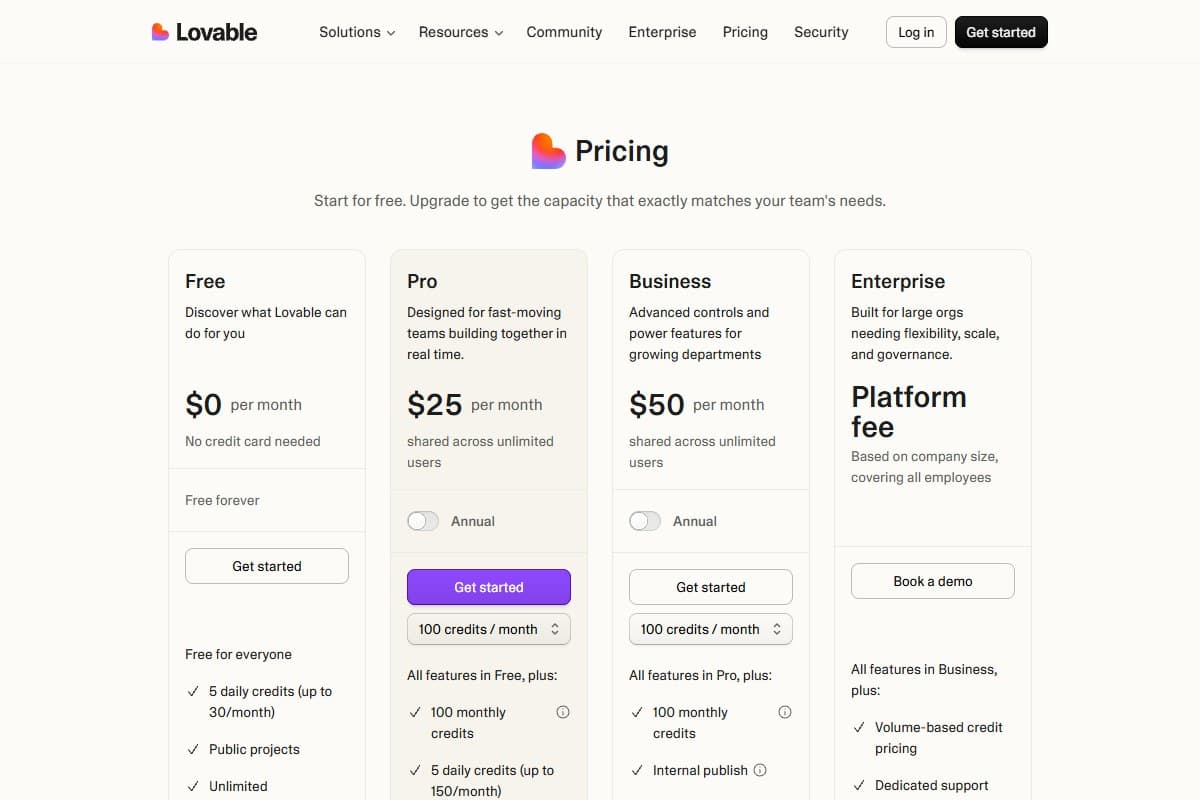
Pricing: did Lovable raise prices for subagents?
No, and that's a meaningful part of the story.
- Daily credit limit
- Subagents included
- Public projects only
- Best for: trying the new flow
- 100 monthly credits
- Subagents included
- Private projects
- Best for: indie founders
- 250 monthly credits
- Subagents included
- Team workspaces
- Best for: small teams shipping serious MVPs
- Unlimited credits available
- Subagents included
- SSO and audit logs
- Best for: orgs piloting AI app dev
The launch ships subagents on every existing tier without changing the price. That's the aggressive choice: Lovable could have spun subagents into a new "Pro Plus" tier and made them an upsell. They didn't. The feature you actually need is included where you already are.
The honest pricing read remains what it was last month, with one update: Business at $50/mo is now even more clearly the right starting tier for serious builds. Subagents reduce the fix-loop credit drain meaningfully, but they don't make it free, and the 250 credits on Business gives you the headroom to absorb subagent overhead without rationing prompts. Pro at $25/mo is fine for landing pages and simple full-stack apps. Business is where it gets fun.
Bolt.new and v0 by Vercel are still the obvious comparison points, and neither has shipped a comparable parallel-subagent architecture yet. For how the parallel-agent approach plays out in full IDEs, see the Google Antigravity 2.0 vs Cursor 3 vs GitHub Copilot comparison. That moat will probably last a couple of quarters before the rest of the category catches up.
Who should jump on Lovable subagents now
Use Lovable subagents if you are:
- A solo founder who hit Lovable's fix-loop wall on a previous build: subagents directly attack that pain
- An indie hacker shipping apps past about 15 features where the old "fix one, break the next" pattern eats your day
- A product team using Lovable for fundraising demos that need to feel solid, not just demoable
- A non-technical founder who wants the Reviewer subagent acting as a second pair of eyes before changes land
Who should still wait
Skip Lovable (try alternatives) if you are:
- Shipping production SaaS handling real customer data and payments: subagents help, but the 70% production-readiness ceiling from my original review hasn't moved
- A senior developer who wants fine-grained control: Cursor 3 or Google Antigravity 2.0 are still the better fits
- Working in a regulated industry where audit trails on the AI itself matter as much as on the application
How Lovable + subagents compares to the alternatives
| Tool | Rating | Price | Best for | Verdict |
|---|---|---|---|---|
| Lovable + Subagents | 4.3/5 | $25/mo Pro | Full-stack apps with parallel review/research | Fix-loop problem materially reduced. Still best for non-technical founders. |
| Bolt.new | 4.1/5 | $25/mo Pro (10M tokens) | Code-visible vibe coding with transparent token billing | More control, no subagents yet. |
| v0 by Vercel | 3.9/5 | $20/mo Premium | Production-quality React components in Next.js | Best for components, not full apps. |
| Cursor 3 | 4.2/5 | $20/mo Pro | Mature parallel-agent IDE for shipping engineers | Different category: full IDE, not a vibe-coding builder. |
| Use case | Winner |
|---|---|
| Non-technical founder shipping a working MVP | Lovable + Subagents |
| Avoiding the "fix one, break next" credit drain | Lovable + Subagents |
| Developer wanting code visibility + AI pairing | Bolt.new |
| Production-quality UI components in Next.js | v0 by Vercel |
| Full-IDE parallel-agent engineering workflow | Cursor 3 |
| Transparent token-based billing | Bolt.new |
If you want the broader Lovable picture, my full Lovable review 2026 covers the platform, the credit-drain history, and the build-three-real-apps test that anchored the original rating. For the IDE side of the AI coding world, the Google Antigravity 2.0 vs Cursor 3 vs GitHub Copilot comparison is the right next read.
Final verdict: 4.3 out of 5
This is a real upgrade and I'm moving the rating up from my original 4.0. Subagents are the architectural shift Lovable needed to escape the "great for demos, dangerous for real apps" ceiling that anchored my last review. The Reviewer subagent catching breakages before they land is the single most valuable feature shipped in vibe coding this year, and it's included at every paid tier without a price increase. That's the right call from Lovable on the right complaint.
I'm holding back the last 0.7 of a point because: (1) 48 hours isn't enough to verify the credit math at scale and I'd rather under-rate now and revise up later than oversell a launch I haven't lived inside for a month, (2) subagent overhead is a real cost that hasn't been fully characterized yet, and (3) the 70% production-readiness ceiling from my original review hasn't moved: Lovable is still better at MVPs than at SaaS-you'd-bill-customers-for.
That nets out to 4.3 out of 5. If you're a solo founder who hit Lovable's fix-loop wall before, log in tonight. If you're building a production system, use it for the prototype and bring in a developer for the real build.
FAQ: Lovable subagents launch
What are Lovable subagents and when did they launch?
Lovable AI subagents launched on May 27, 2026. They're specialized worker agents that the primary Lovable build agent can spawn in parallel: a Researcher subagent that reads the existing codebase to answer questions, a Reviewer subagent that reads proposed changes before they land to catch adjacent-feature breakage, and a Synthesizer subagent that condenses data-shaped subtasks. Each subagent appears in the activity log with its own thread so you can trace what each one decided.
Do Lovable subagents cost extra?
No. Subagents are included on every existing Lovable tier (Free, Pro at $25/mo, Business at $50/mo, and Enterprise) at the same price as before the launch. Subagent calls do consume credits on paid tiers (they're new model calls), but Lovable didn't create a new "Subagents Pro" tier or raise existing prices. The net cost depends on workload: avoided fix loops save credits, but Researcher and Synthesizer calls add some overhead. Expect roughly neutral economics on simple builds and net-positive economics on complex ones where fix loops used to dominate.
Do subagents fix the Lovable credit-drain problem?
They directly attack it, and based on 48 hours of testing the dominant fix-loop pattern is meaningfully reduced, but I'd wait a full month before declaring it solved. The Reviewer subagent catches breakages adjacent to a change before they land, which is exactly the failure mode that used to consume 20–30% of monthly Pro credits in a single afternoon of debugging. The trade-off is that subagent calls themselves cost credits, so the win comes from avoided regressions outweighing the new overhead. On complex builds it does. On simple builds it's roughly neutral.
Lovable subagents vs Claude Code subagents: what's the difference?
Same architectural idea, different audience. Claude Code subagents are configured by developers via markdown files in .claude/agents/ and are explicitly invoked from the terminal. Lovable's subagents are configured by Lovable's platform itself and run automatically inside the vibe-coding flow: a non-technical founder doesn't have to know they exist for them to work. Same insight (smaller specialist agents beat one mega-agent), different ergonomics for different users.
Should I switch from Bolt.new or v0 to Lovable now that subagents exist?
For non-technical founders shipping full-stack MVPs, the case for Lovable just got stronger: subagents directly attack the fix-loop pain that was the biggest knock against the platform. For developers who want code visibility and transparent token billing, Bolt.new is still the better fit. For Next.js teams who mostly need React components, v0 by Vercel is cheaper and more focused. The subagent architecture will probably show up in Bolt and similar competitors within a couple of quarters, but Lovable shipped it first and the lead is real today.
Related reviews
- AI Coding Tools topic hub: every AI coding review on the site in one place.
- Lovable Review 2026: I Built 3 Real Apps to Find Out: the original full-platform review and rating.
- Google Antigravity 2.0 vs Cursor 3 vs GitHub Copilot: the IDE side of the AI coding decision, including parallel-agent comparisons.
- Cursor 3 Review: Are Parallel Agents Worth It?: the parallel-agent IDE that pioneered this architecture for shipping engineers.
Got a Lovable subagents question I didn't cover, or want me to test a specific prompt against the new Reviewer flow? Get in touch: reader questions shape the next round of reviews.
Free interactive tool
Compare Lovable (with Subagents) with other AI toolsSide-by-side pricing, features, and ratings — plus a recommended pick for your use case.
Independent AI tools researcher. Testing and reviewing the tools shipping engineers and indie founders actually rely on.
Keep reading
Related reviews

Lovable Review 2026: Is the $6.6B AI App Builder Worth It? (I Built 3 Real Apps to Find Out)
Lovable hit $400M ARR and a $6.6B valuation in six months. I built three real apps in a week to test whether the hype actually holds up.
Best AI Coding Assistants 2026: I Tested 7 Tools and Ranked Them
I tested 7 of the best AI coding assistants in 2026 on the same three jobs: build, refactor, debug. Here is what each one costs and which one wins.

7 GitHub Copilot Alternatives 2026 That Actually Work
GitHub Copilot hitting its limits? I tested 7 alternatives that are faster, cheaper, or just better. Here's the honest comparison.