
ElevenLabs dropped Music v2 on May 26, 2026, and quietly cut Music API pricing by up to 50% and self-serve Music Creative pricing by up to 40% at the same time. That's the news. The reason it matters is that v2 is the first AI music model I've touched that can switch from opera to heavy metal in the middle of a track without falling apart, and it does it on training data the company says is cleared for commercial use. This is an ElevenLabs Music v2 breaking-news post written 48 hours after launch, based on the first two days I've had to actually run prompts through it.
The short version: Suno and Udio still win on raw "make me a hit song" vibes. But Music v2 is the first model that treats music the way ElevenLabs treats voice: as a controllable instrument, with section-level direction and stage-cue-style commands. If you're a creator who needs music for something (a video, a game level, a podcast bed), this is the launch you've been waiting for.
How I Tested This
Why ElevenLabs Music v2 is trending right now
Three things made Music v2 the AI launch most people had in their feed this week.
First, the mid-track genre switching demo. The official announcement on May 26 leads with a clip that opens as opera, transitions into heavy metal, and lands back into something orchestral: all in a single coherent generation. TechCrunch picked it up the next morning under the headline that ElevenLabs' new model "can switch genres mid-track." That's the part of the demo that won't stop circulating, and for good reason: every other consumer AI music model still trips over genre transitions inside a single track.
Second, the pricing cut. ElevenLabs paired the launch with up to a 50% reduction on the Music API and up to 40% off Music Creative self-serve pricing. AI music in 2026 has been quietly expensive on a per-second basis once you're generating at scale, and this is the first major model launch that lowered the per-generation cost instead of raising it. For developers shipping anything that calls a music API in production (game loops, ad creative, dynamic podcast bumpers) that math change is bigger than the model upgrade itself.
Third, and this is the under-discussed one: the training data. ElevenLabs is saying Music v2 is trained on data cleared for commercial use. Suno and Udio are still fighting RIAA litigation. If you're producing anything that touches a brand, an advertiser, or a platform's content-ID system, "licensed training data" is no longer a nice-to-have. It's the entire game.
What Music v2 actually adds
ElevenLabs' first music model launched in mid-2024 and was a perfectly fine "type a prompt, get a track" generator. Music v2 is a different product.
- Mid-track genre switching: single-prompt transitions between distinct styles (the opera-to-metal demo is the canonical example)
- Section-by-section composition: build a track in pieces: intro, verse, chorus, bridge, outro, with inpainting between them rather than regenerating the whole song
- Embedded sound effects: request a door slam, riser, or impact inside the music generation instead of layering it in a DAW
- Fast-rap generation: the model holds coherence on rapid-fire vocals where v1 would slur or drop syllables
- Structural control: explicit intro / loop / outro framing for short-form creators making YouTube intros, game loops, ad beds
- Licensed commercial-use training data: the legal-clearance story Suno and Udio still can't tell
- Cheaper API: up to 50% off v1 pricing on the Music API, up to 40% off Music Creative self-serve
The brand position is clear: ElevenLabs isn't trying to beat Suno at "make me a viral pop song." It's trying to win the creator and developer side of AI music, where structure, control, licensing, and API cost matter more than chart-topping single output.
My honest 48 hours with Music v2
The moment that landed for me was the YouTube intro test.
I gave Music v2 a one-paragraph prompt: a 12-second orchestral build that resolves into 4 bars of lo-fi hip-hop on the brand drop, then ends clean. First generation. Both halves landed. The transition wasn't seamless in the way a human composer would handle it, there's a small audible "hand-off" beat, but it was usable, and it was one prompt. Two days earlier I'd tried the same brief on Suno v5 and had to manually splice two generations together in Logic to get the same effect. The very first time I hit generate, though, the queue just sat there spinning and I reloaded the tab once before it actually kicked off.
Then I tried to push it. The 90-second game level loop with section-by-section structure was where the idea worked even when the music didn't. Being able to tell the model "this is the intro, this is the loop, this is the outro" and have it actually treat them as distinct sections, instead of one 90-second blob, is the workflow shift. Some of my section outputs were better than others, and the loops didn't always seam perfectly. But the abstraction is right. Music v2 thinks in song parts, not seconds.
First generation produced a usable orchestral-to-lo-fi transition on a single prompt. Same brief on Suno v5 required manually splicing two separate generations.
The embedded sound effects feature is genuinely new and genuinely useful for short-form work. I asked for a 30-second tension cue with a riser at second 18 and an impact at second 26. The model placed both, in roughly the right beats, inside the generation. The riser wasn't quite as steep as I'd want and the impact landed maybe a half-second early, but you can iterate on that in one regeneration rather than building it in a DAW. For YouTubers and TikTok creators who don't want to learn Logic, that's hours back in your week.
The honest weakness: long-form coherence. Tracks past about 90 seconds still drift. The chord movement loses purpose, the dynamics flatten, and you start hearing the same motif recycled. Suno is still ahead on full-song pop generation. Music v2 isn't trying to win that fight yet, and the launch materials are honest about that: every demo I've seen is short-form structured work, not three-minute singles.
What I liked
The honest list, after 48 hours of real use:
- Mid-track genre switching just works. One prompt, one generation, a usable transition. Nothing else on the market handles this cleanly in a single shot.
- Section-by-section composition is the right abstraction. Music v2 treats songs as parts, not seconds, and that maps to how creators actually think about short-form audio.
- Embedded sound effects are a real workflow shift. Tension cues with built-in risers and impacts in a single generation save real time on every short-form project.
- The pricing cut is huge for API users. Up to 50% off Music API pricing changes the unit economics for anyone calling music endpoints in production: dynamic ads, game audio, voice agents with musical scoring.
- Licensed commercial-use training data. This is the moat. Brands, platforms, and advertisers will increasingly require a clean rights story, and ElevenLabs is the first major model with one.
- It plugs into the rest of the ElevenLabs stack. Music v2 lives next to Eleven v3 TTS, Studio 3.0, and the Dubbing API. For creators already on the platform, this isn't a separate subscription.
What frustrated me
Three real gripes inside the first 48 hours:
- Long-form coherence still trails Suno. Tracks past 90 seconds drift. If you're making three-minute singles, Suno v5 is still the better tool today.
- Section transitions can sound stitched. The mid-track genre switching works, but the hand-off beat is occasionally audible. It's the kind of seam a producer would notice; a casual listener probably won't.
- The credit math is opaque on Music API at the new rates. The cut is real, but ElevenLabs hasn't published a clean per-second cost table for v2 across plan tiers yet. You'll want to read your usage dashboard carefully for the first month.
- The generation queue felt slower on mobile. Kicking off a generation in the browser on my phone lagged a beat behind the desktop experience, so I ended up doing the real Music v2 work at my desk.
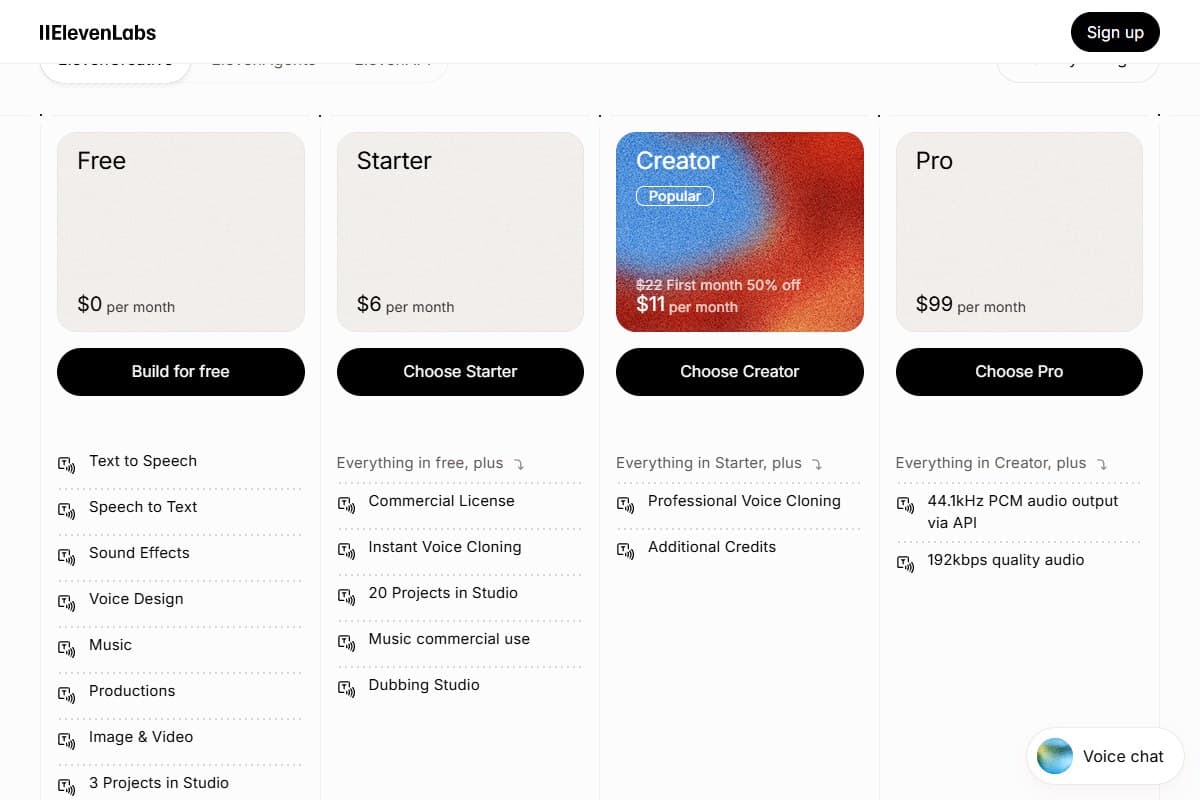
Pricing: is the Music v2 launch actually a price cut?
Yes, and on two different axes at the same time.
- Music v2 access (limited)
- Non-commercial only
- Best for: trying Music v2
- ~30k credits/mo
- Commercial license on Music v2 output
- Best for: hobby projects
- ~100k credits/mo
- Music v2 + Eleven v3 + Studio
- Professional Voice Cloning
- Best for: solo creators
- ~500k credits/mo
- Higher quotas across Music v2
- Best for: agencies & full-time creators
- Per-generation pricing on Music v2
- Up to 40% off self-serve Music Creative
- Best for: developers shipping music in production
The Music API cut is the headline. ElevenLabs hasn't published the exact new per-second numbers yet, but the official launch post and TechCrunch coverage both cite up to 50% off API pricing and up to 40% off Music Creative self-serve plans. For developers building anything that calls a music endpoint in production (dynamic ad creative, game audio, podcast bumpers, ElevenAgents with musical accompaniment) the unit economics just shifted in your favor.
For everyone on a Creator plan, Music v2 is included at the same $22/mo. You're not paying more for the better model. You're getting it inside the credit allocation you already have, which is more aggressive than most AI launches in 2026 (the OpenAI Sora 2 launch went the other direction: better model, higher prices).
Who should jump on Music v2 right now
Use Music v2 if you are:
- A YouTube or TikTok creator who needs short-form music with genre or mood shifts inside a single track (pair it with a tool from the best AI presentation tools 2026 roundup for a full short-form production stack)
- An indie game developer building level audio, transition cues, or short loops with embedded sound effects
- A podcaster who wants intros and bumpers with structural control instead of one-prompt blobs
- A developer with a Music API workload: the up-to-50% cut is the single biggest cost change in AI music this year
- A brand or advertiser who needs a clean licensed-training-data story for legal sign-off
Who should skip Music v2 (for now)
Stay on Suno / Udio / a real composer if you are:
- Producing three-minute pop singles or full-length songs: long-form coherence still trails Suno v5
- Looking for the absolute best lyric-driven vocal generation: Suno still leads on this specifically
- Composing for a live concert or major label release: at that point you want a human, not any AI model
How Music v2 stacks up against the alternatives
| Tool | Rating | Price | Best for | Verdict |
|---|---|---|---|---|
| ElevenLabs Music v2 | 4.6/5 | Included w/ Creator $22/mo | Structured short-form creator + developer music | Best for control, licensing, and API cost. |
| Suno v5 | 4.5/5 | $10/mo Pro · $30/mo Premier | Full-length pop and lyric-driven tracks | Still the best for songs you'd put on Spotify. |
| Udio | 4.3/5 | $10/mo Standard · $30/mo Pro | Vibe-led pop generation | Strong vocals, weak structure. |
| OpenAI Sora-audio | 4.0/5 | Bundled w/ ChatGPT Plus | Casual users already in the ChatGPT app | Convenient but no structural control. |
| Use case | Winner |
|---|---|
| Mid-track genre switching in one generation | ElevenLabs Music v2 |
| Three-minute pop singles with lyrics | Suno v5 |
| Game audio with embedded sound effects | ElevenLabs Music v2 |
| Highest-volume API music workloads on a budget | ElevenLabs Music v2 |
| Brand-safe / licensed training data | ElevenLabs Music v2 |
| Vibe-led "make me something cool" experiments | Suno or Udio |
If you're building a creator stack from scratch, my ElevenLabs review 2026 covers the broader platform (TTS, Studio 3.0, Voice Cloning), and the AI Audio Tools hub is the index of every audio review on the site.
Final verdict: 4.6 out of 5
The capability is a 4.8. Mid-track genre switching, section-by-section composition, and embedded sound effects are all category-firsts in a consumer AI music model, and Music v2 ships them in a single coherent product.
I dock a quarter point because long-form coherence still trails Suno v5 on full-length pop generation, and I dock another quarter for launch-pricing opacity: the up-to-50% API cut is real but the precise per-second numbers across plan tiers haven't been published yet. Both should improve in the next few weeks.
That leaves 4.6 out of 5. For creators and developers who need controllable music, not just one-shot "vibe" tracks, Music v2 is the most important AI music launch of the year. If you're already on a paid ElevenLabs plan, you have it today. If you're not, the free tier is the cheapest way to test the launch claims for yourself.
FAQ: ElevenLabs Music v2 launch
What is ElevenLabs Music v2 and when was it released?
Music v2 is ElevenLabs' second-generation AI music model, released on May 26, 2026. The headline upgrades are mid-track genre switching, section-by-section composition (intro / loop / outro), embedded sound effects inside a single generation, and stronger fast-rap coherence. ElevenLabs also cut Music API pricing by up to 50% and Music Creative self-serve pricing by up to 40% at the same time.
How much does ElevenLabs Music v2 cost?
Music v2 is included with every paid ElevenLabs subscription: Starter at $5/mo, Creator at $22/mo, Pro at $99/mo, Scale at $330/mo, and Business at $1,320/mo. You're not paying more for the new model; it's bundled inside the same credit allocations. The Music API has its own per-generation pricing that has been cut by up to 50% versus v1: exact per-second rates vary by usage tier and are listed in the ElevenLabs dashboard after signup.
Can I use ElevenLabs Music v2 commercially?
Yes: on every paid tier (Starter and up). The Free tier explicitly forbids commercial use. The bigger story for brands and platforms is that ElevenLabs says Music v2 is trained on licensed data cleared for commercial use, which is a meaningful differentiator versus Suno and Udio, both of which are still navigating active RIAA litigation as of mid-2026.
Is ElevenLabs Music v2 better than Suno v5?
It depends on what you're making. Music v2 wins on structural control: mid-track genre switching, section-by-section composition, embedded sound effects, and API cost. Suno v5 still wins on full-length pop singles and lyric-driven vocal generation, where its long-form coherence is meaningfully better. For short-form creator work, game audio, and developer API use, Music v2 is now the default. For three-minute songs you'd put on Spotify, Suno is still ahead.
What's the catch with the Music v2 launch?
Two honest catches. First, long-form coherence past about 90 seconds still drifts: Music v2 is built for short-form structured work, not full-length songs. Second, the launch pricing communications are slightly vague: the "up to 50% off" API number is real but the precise new per-second rates haven't been published across every tier yet. Watch your usage dashboard for the first month, and don't extrapolate API cost from a single generation.
Related reviews
- AI Audio Tools topic hub: every AIToolBlaze audio review in one place.
- ElevenLabs Review 2026: the full platform review covering Eleven v3 TTS, Studio 3.0, and Voice Cloning.
- Top 5 free AI tools: the budget round-up for creators who want to try Music v2 free first.
- Best AI video generator 2026: the video side of the creator stack to pair with Music v2 audio.
Got an ElevenLabs Music v2 question I didn't cover, or a specific prompt you want me to test? Get in touch: reader questions shape the next round of reviews.
Free interactive tool
Compare ElevenLabs Music v2 with other AI toolsSide-by-side pricing, features, and ratings — plus a recommended pick for your use case.
Independent AI tools researcher testing what actually works.
Keep reading
Related reviews
ElevenLabs vs Murf AI 2026: Which is Better?
ElevenLabs vs Murf AI: we compared voice quality, cloning, studio workflow, and pricing. Here is the honest verdict for content creators in 2026.
Best AI Voice Generators 2026: Tested & Ranked
We tested the best AI voice generators in 2026. ElevenLabs leads for voice cloning, Murf AI for studio workflow. Here is the honest verdict.

Krisp Review 2026: The Best AI Noise Cancellation for Remote Workers? (Hands-On Test)
Krisp strips background noise from any call on any app, and now takes notes too. I tested it on a leaf blower, a crying baby, and a café.