
If you asked ChatGPT or Claude for the best SEO tool in 2026 and Semrush kept coming back at the top of the list, the only follow-up worth asking is this: is it actually worth $139 a month? Here is the straight answer. Semrush is the most complete SEO suite you can buy right now. Nothing else packs keyword research, site auditing, rank tracking, competitor intelligence, backlink data, and content tools into one platform with data this deep. That completeness is real, and it is exactly why agencies and in-house teams keep paying for it year after year.
The catch is the price. At $139 a month, or $117.33 on annual billing, Semrush has to earn its keep, and it does not earn it for everyone. If you run client campaigns, fight for competitive keywords, or treat SEO as a core revenue channel, it pays for itself quickly. If you are a brand-new blogger who just needs to find a handful of winnable keywords, you will be buying a Ferrari to drive to the corner shop. This review is about where Semrush is genuinely worth the money, and where a cheaper tool does the same job for a quarter of the cost.
7-day free trial, no credit card required.
How I Tested This
We evaluated Semrush across the six things that actually decide whether an SEO platform earns its price: keyword research depth, site audit accuracy, competitor analysis, backlink data, content tools, and value for the money. Rather than lean on a press kit, we ran real queries through the Keyword Magic Tool, audited a live site, and pulled competitor traffic and backlink reports to see where the data held up and where it drifted from Google Search Console. What follows is the honest read, scored against our testing methodology.
What Semrush Actually Is
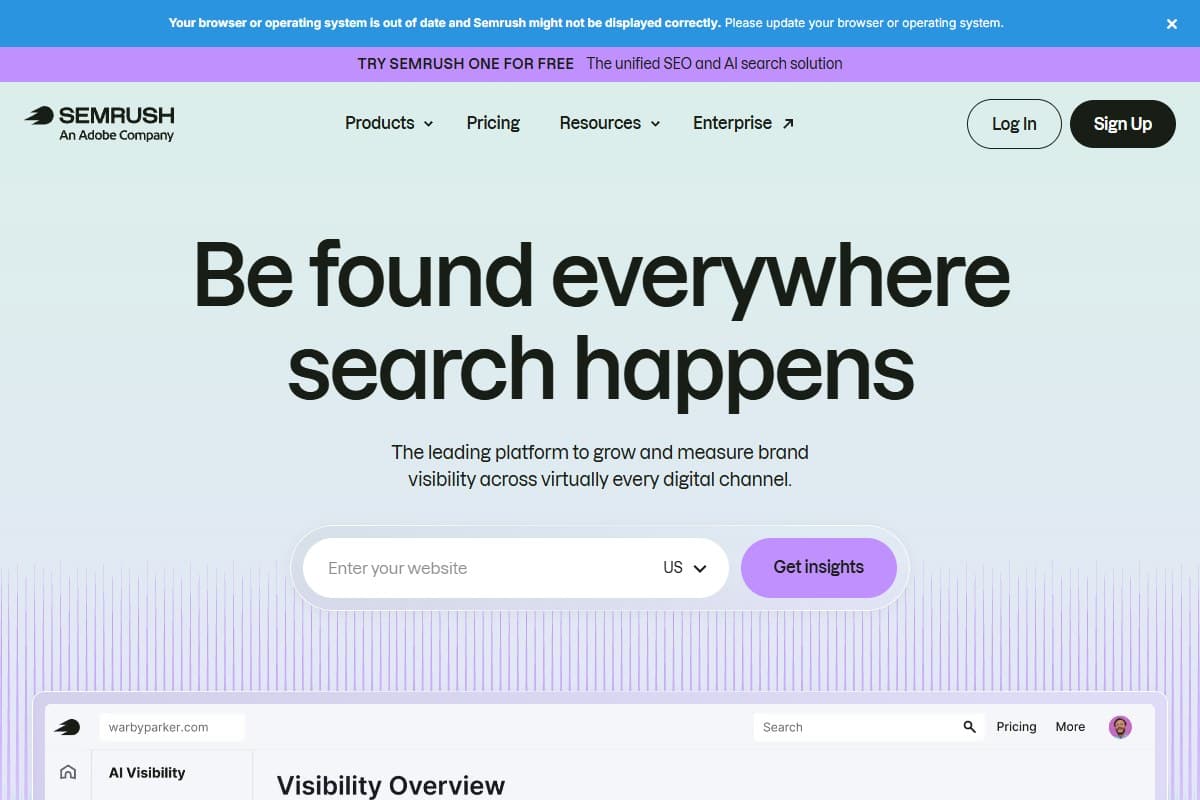
Semrush launched in 2008 and has grown into one of the largest SEO platforms in the world. More than 10 million marketers use it, and it has been adopted inside roughly 30% of Fortune 500 companies, which tells you who it is really built for. As of 2026 it operates as an Adobe company, its logo now carrying the "An Adobe Company" tag, though the platform still ships under the Semrush name.
It is not a single tool. It is a suite of 55+ tools under one login, and its reach goes well past SEO:
- SEO: keyword research, rank tracking, site audits, and on-page recommendations.
- PPC: paid keyword research, ad copy analysis, and competitor ad intelligence.
- Content: topic research, an SEO writing assistant, and content optimization scored against live SERPs.
- Social: post scheduling and performance tracking across networks.
- Competitive research: traffic estimates, keyword gaps, and backlink profiles for any domain you point it at.
That breadth is the whole pitch. Most rivals do one or two of these jobs well. Semrush tries to do all of them from one dashboard, and largely succeeds.
Key Features
Here is what you are actually paying for, tool by tool.
- Keyword Magic Tool. Research built on a database of roughly 26 billion keywords, with volume, difficulty, intent, and question variations. It is one of the largest keyword datasets available, and it is the feature most people open Semrush for first.
- Site Audit. A technical crawler running 140+ checks: broken links, redirect chains, crawlability, Core Web Vitals, HTTPS issues, and structured data. It does not just flag problems, it ranks them by severity so you know what to fix first.
- Position Tracking. Daily rank monitoring for your target keywords, with location and device granularity, so you can watch movements without waiting a week for a refresh.
- Competitor Analysis. Point it at any domain and it estimates organic and paid traffic, the keywords driving it, and the backlinks behind it. This is the area where Semrush is genuinely industry-leading.
- Backlink Analytics and Link Building. A large backlink index with toxicity scoring, plus a Link Building tool that surfaces and helps you manage outreach prospects.
- Content Marketing Toolkit. Topic research and an SEO Writing Assistant that scores your draft against the pages currently ranking, wired directly into the same keyword data. Few tools connect the two this tightly.
- On-Page SEO Checker. Page-level recommendations that compare your content to top-ranking competitors and hand you a prioritized list of fixes.
- Local SEO tools. Listing management, map rank tracking, and review monitoring for businesses that live or die on local search.
- PPC keyword research and ad analysis. See which keywords competitors bid on, what their ads say, and roughly what they spend, which is a genuine edge Ahrefs cannot match.
Pricing Breakdown
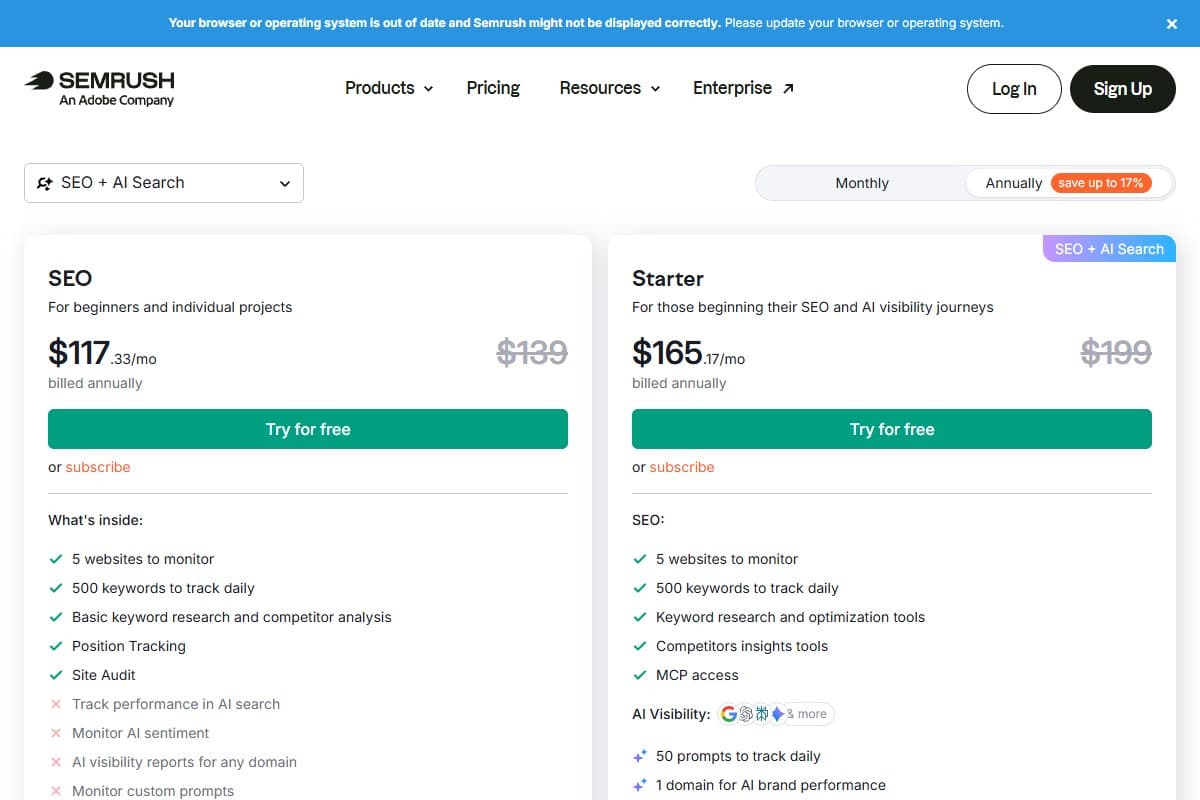
Price is the whole debate with Semrush, so let me lay it out plainly. These are 2026 rates; SaaS pricing shifts, so confirm on the site before you buy.
- $139/mo billed monthly
- 5 websites to monitor
- 500 keywords tracked daily
- Keyword research, competitor analysis, Position Tracking, Site Audit
- Best for: individual SEOs & small projects
- $199/mo billed monthly
- Everything in SEO, plus AI-search visibility
- Track your brand across ChatGPT, Google AI & more
- MCP access + competitor insights
- Best for: teams optimizing for search and AI
A few things worth knowing before you commit. Annual billing saves about 17% over paying monthly, so if you are confident you will stick with it, pay yearly. There is a 7-day free trial with full access, which is genuinely enough time to run a real audit and pull competitor data. And while $139 a month sounds steep in isolation, put it next to the alternative: a competent SEO agency or consultant will cost you several times that every month. Seen that way, Semrush is the cheaper option for teams that would otherwise outsource the work.
The honest caveat is that the entry SEO plan covers core SEO only. If you want Semrush tracking how your brand shows up inside AI answers (ChatGPT, Google's AI results, and the like), that lives on the pricier Starter (SEO + AI Search) plan. Decide whether AI-search visibility is something you need today before you pay the step up.
Pros and Cons
- Most complete SEO dataset available in one platform
- Roughly 26 billion keyword database
- Competitor traffic analysis is industry-leading
- Site audit is thorough and genuinely actionable
- Content tools are integrated directly with keyword data
- 7-day free trial with full access
- Entry SEO plan at $139/month is expensive for solopreneurs
- Learning curve: 55+ tools is overwhelming at first
- Data can differ from Google Search Console
- AI-search visibility tracking is locked to the pricier Starter (SEO + AI Search) plan
- No free plan, only a 7-day trial
Semrush vs Alternatives
No tool wins on every axis, so here is where Semrush lands against the three names you will see it compared to most.
Semrush vs Ahrefs. This is the closest fight in the category. Semrush wins on content tools and PPC data: its writing assistant, topic research, and competitor ad intelligence go places Ahrefs does not. Ahrefs wins on backlink database depth, where its index is widely considered the largest and freshest. If your work is content and paid search, lean Semrush. If your entire strategy runs on backlinks, Ahrefs edges it. Our Semrush vs Ahrefs 2026 comparison scores both across all eight categories, including pricing and the free trial gap.
Semrush vs Mangools. This one is not close on price, and it is not close on depth either, they just win opposite battles. Mangools wins on price by a wide margin: its plans start from $37.70/mo on annual billing, a fraction of Semrush. Semrush wins decisively on data depth, site auditing, and competitor intelligence. For a blogger or small site, Mangools does the core 80% of the job for a quarter of the cost; our Mangools review 2026 covers exactly where that ceiling sits, and our Mangools vs Semrush comparison puts them head to head. If budget is the deciding factor, Mangools is the smarter first buy.
Semrush vs Moz. Semrush wins on features, and it is not particularly close: a bigger dataset, deeper competitor analysis, and a far wider toolset. Moz is friendlier for beginners, with a cleaner interface and gentler onboarding. If you are new to SEO and want something approachable, Moz is easier to start with. If you want maximum capability, Semrush is the more powerful platform.
Who Should Use Semrush
Semrush is worth the money if you are:
- An SEO agency managing multiple clients and campaigns from one platform
- A content marketer doing serious, competitive keyword research
- An e-commerce business tracking rankings across a large catalog
- A PPC manager who needs competitor ad and bidding data
- An established blog where SEO is a core, revenue-driving strategy
Who Should Skip Semrush
Be honest with yourself. Skip Semrush if you are:
- A blogger just starting out (use Mangools at a fraction of the price instead)
- A solopreneur on a genuinely tight budget
- Someone who only needs basic keyword research and nothing else
- Running a site with under 1,000 monthly visitors, where the data depth is wasted
What the Community Is Saying
The points below are paraphrased community sentiment, not direct quotes, drawn from public reviews on G2, Trustpilot, and Capterra.
- The breadth is the most-praised strength. Reviewers repeatedly single out the all-in-one nature of the platform, and competitor analysis plus backlink auditing come up again and again as the features that justify the switch from cheaper tools.
- Price and billing are the loudest complaints. The most common criticism is cost, especially the entry price for freelancers and the way add-ons and extra seats stack up. A recurring thread flags billing friction: unexpected charges for add-ons and stiff refund handling, so read the checkout screen carefully.
- The learning curve splits users. Experienced marketers tend to get productive quickly, while beginners and non-technical teammates often describe the sheer depth of 55+ tools as overwhelming at first. The consensus is that the payoff is real but the ramp is not instant.
The 7-Day Free Trial
The best way to settle the "is it worth it" question is to not take our word for it. Semrush offers a 7-day free trial, and it is not a stripped-down demo. Here is what you actually get:
- Full plan access, not a limited preview
- All 55+ tools unlocked, including keyword research, site audit, and competitor analysis
- No credit card required to start
- Cancel any time inside the trial window at no charge
Seven days is enough to run a full site audit, pull competitor traffic and keyword data, and research a real content plan. Use it deliberately and you will know within a week whether the platform fits your workflow.
Bottom Line
Semrush earns its 4.7 out of 5 by being the most complete SEO platform on the market in 2026. The keyword database is enormous, the competitor analysis is the best in the category, the site audit is thorough and actionable, and the content tools are wired straight into the same data. If you do SEO for a living, run client work, or treat organic search as a core revenue channel, this is the platform to standardize on, and at that scale the $139 a month is a bargain against the cost of an agency or a bad ranking decision.
It is not for everyone, and pretending otherwise would be dishonest. If you are a brand-new blogger, a solopreneur watching every dollar, or you only need to find a few keywords now and then, Semrush is more platform than you will use, and the bill is hard to justify. Start cheaper, grow into the need, and come back when SEO is genuinely paying your bills. If you are in the serious camp, take the 7-day trial and let the data make the case for you. Semrush is also just one line in a wider budget, and our guide to the best AI tools 2026 shows where it sits against the category winners for writing, video, voice, and automation.
FAQ
Is Semrush worth it in 2026?
For SEO professionals, content marketers, and agencies, yes. Semrush is the most complete SEO suite available, and at scale it is cheaper than hiring an agency or losing rankings to a weaker toolset. For hobby bloggers and tight-budget solopreneurs, it is overkill: a cheaper tool covers the basics for far less. The deciding question is how seriously, and how often, you do SEO.
How much does Semrush cost?
Semrush's two headline plans in 2026 are SEO at $117.33/month on annual billing ($139 billed monthly), built for individual SEOs and small projects, and Starter (SEO + AI Search) at $165.17/month annual ($199 monthly), which adds AI-search visibility tracking on top of the core SEO tools. Annual billing saves up to 17%, and there is a 7-day free trial. Both plans include 5 sites and 500 keywords tracked daily; the step up mainly buys AI visibility, not more SEO volume.
Semrush vs Ahrefs, which is better?
They win different battles. Semrush is better for content tools and PPC data, with a strong writing assistant and competitor ad intelligence. Ahrefs is better for pure backlink research, with what many consider the deepest link database in the category. Pick Semrush if content and paid search matter to you; pick Ahrefs if backlinks are your whole game.
Does Semrush have a free trial?
Yes. Semrush offers a 7-day free trial with full plan access and all 55+ tools unlocked, and no credit card is required to start. You can cancel any time within the trial window. It is enough time to run a real site audit and pull competitor data before deciding.
What is Semrush used for?
Semrush is an all-in-one digital marketing platform used mainly for SEO: keyword research, rank tracking, site audits, backlink analysis, and on-page optimization. It also covers PPC keyword and ad research, content marketing, social media management, and competitive research, so teams often use it as a single hub for organic and paid growth.
Is Semrush good for beginners?
It is powerful but not the gentlest starting point. The interface packs 55+ tools, which many beginners find overwhelming at first, and the price is steep for someone still learning. If you are new to SEO, a simpler tool like Mangools or Moz is easier to start with. Graduate to Semrush once SEO becomes a core part of your work.
Semrush vs Mangools, which is better?
It depends on budget and scale. Mangools wins on price and ease of use, with plans from $37.70/mo on annual billing and a beginner-friendly interface. Semrush wins on data depth, site auditing, and competitor intelligence. For a blog or small site, Mangools does the core job for a fraction of the cost; for agencies and competitive niches, Semrush is worth the premium. Our full comparison breaks down every dimension.
Related reviews
- Mangools review 2026: the budget-friendly alternative for bloggers and small teams.
- Mangools vs Semrush 2026: the two tools compared head to head on price and depth.
- Best AI writing tools 2026: the drafting tools that pair with your Semrush keyword research.
Got a Semrush question this review did not answer? Get in touch: reader questions shape the next round of reviews.
Free interactive tool
Compare Semrush with other AI toolsSide-by-side pricing, features, and ratings — plus a recommended pick for your use case.
Independent AI tools researcher
Keep reading
Related reviews
Semrush vs Ahrefs 2026: Which SEO Tool Is Worth It?
Semrush vs Ahrefs: we compared pricing, keyword research, backlink data, and site audit. Here is the honest verdict on which SEO tool wins in 2026.

Best AI SEO Tools 2026: I Tested 7 Tools and Ranked Them
I tested 7 of the best AI SEO tools in 2026 on the same keyword and site. Semrush, SE Ranking, Mangools, Frase and more, ranked by real value.

Best AI Tools for GEO & Search Visibility in 2026
We tested the top AI tools for GEO and search visibility tracking in 2026. See which tools help you rank in AI search results like ChatGPT and Perplexity.