
If you have watched your organic traffic slide this year while your rankings stayed exactly where they were, you already understand the problem this page is about. The click is being intercepted. Someone asks ChatGPT which project management tool to buy, gets a three-name answer, and never sees a search results page at all. Your position two ranking is intact and completely irrelevant to that conversation.
That is the gap GEO tools exist to close. Generative engine optimization is the practice of getting your brand named and cited inside AI-generated answers, and the first thing you need is not a tactic, it is a measurement layer. You cannot optimize for something you cannot see. So this roundup ranks the tools that actually tell you whether ChatGPT, Perplexity, Gemini, Google AI Overviews, and AI Mode are mentioning you, citing you, or handing your customers to a competitor.
Here is the short version before you scroll. SE Ranking is the best pick for most marketers and SEO teams because it is the only tool in this category that bundles AI visibility tracking with a complete traditional SEO suite at a price a normal business can pay, without charging extra for the AI half. Semrush is the better tool if you already live inside Semrush. Ahrefs Brand Radar has the best data and the worst bill. Otterly is the one to buy if you have $29 a month and one brand to watch. Below is what each of them actually does and what it actually costs, which in this category are two questions with surprisingly different answers.
14-day free trial, no credit card required.
How I tested this
Every tool on this list was evaluated on five things that decide whether a GEO tool earns its subscription: engine coverage (which AI platforms it actually queries), prompt volume (how many questions it tracks and how often), the depth of what it reports back (mentions, citations, sentiment, competitor share), how well it connects to traditional SEO data, and the real total cost once add-ons and base plan requirements are counted.
That last criterion matters more here than in any other software category I have reviewed. Almost every tool in this space advertises a headline price that is not the price you pay. Ahrefs Brand Radar's sticker cost excludes the Ahrefs plan it requires. Semrush's AI Toolkit is priced per domain, so an agency with eight clients pays eight times the advertised figure. I have quoted the real all-in numbers throughout, checked against each vendor's own pricing page in August 2026. Confirm before you buy, because pricing in this category is moving faster than any other corner of martech right now.
What GEO actually is (and how it differs from SEO and AEO)
The acronyms are multiplying, so let me settle them quickly.
GEO (generative engine optimization) is optimizing so that generative AI systems cite and recommend you inside the answers they write. The term comes from a 2023 research paper, GEO: Generative Engine Optimization, by Aggarwal, Murahari, Rajpurohit, Kalyan, Narasimhan, and Deshpande, which found that structuring content with citations, quotations, and statistics lifted visibility in generative responses by up to 40%.
AEO (answer engine optimization) is the older, broader idea: optimizing to be the answer rather than a blue link. Featured snippets and voice search were AEO before anyone called it that. In practice most people now use GEO and AEO interchangeably, and arguing about the boundary is a good way to waste a meeting.
SEO is still the foundation, and this is the part the hype cycle gets wrong. AI engines are not pulling answers out of nothing. They retrieve from the live web, and the pages they retrieve tend to be pages that already rank, already have authority, and already answer questions in a clean, extractable structure. GEO is not a replacement for SEO. It is a measurement layer plus a set of formatting habits stacked on top of SEO you were supposed to be doing anyway.
The genuinely new part is the reporting. Traditional rank tracking asks "where does this URL sit for this keyword." AI visibility tracking asks a harder set of questions: does the model mention my brand at all, in what order, with what sentiment, does it link to me or just name me, and which competitors get recommended instead. Those are five separate metrics, and no keyword rank tracker was built to answer any of them.
Quick comparison: best GEO and AI visibility tools in 2026
| Tool | Rating | Price | Best for | Verdict |
|---|---|---|---|---|
| SE Ranking | 4.5/5 | From $103.20/mo, GEO included | AI visibility plus full SEO suite | Best overall value for most teams |
| Semrush AI Toolkit | 4.2/5 | $99/mo per domain add-on | Existing Semrush users | Best if you already pay for Semrush |
| Ahrefs Brand Radar | 4.0/5 | $328+/mo all-in | Enterprise data depth | Best data, punishing total cost |
| Otterly.ai | 4.1/5 | From $29/mo | Solo founders and single brands | Cheapest genuine tracking |
| Peec AI | 4.0/5 | From about $89/mo | Mid-market GEO specialists | Purpose-built, no SEO suite |
| Profound | 4.0/5 | Custom, sales-led | Enterprise brand teams | Deepest analytics, enterprise only |
Two things to notice in that table. First, the ratings are close, because these tools are all young and all doing a version of the same job. What separates them is price structure and whether they connect to your existing SEO data. Second, the cheapest tool with real tracking is $29 a month and the most expensive realistic setup is over $800. That is a 27x spread for a category that barely existed two years ago, which tells you the market has not settled on what this is worth.
Pay particular attention to the pricing column, because it is not comparing like with like. SE Ranking's figure is a complete platform with GEO tracking inside it. Semrush's $99 is an add-on that assumes you already pay for Semrush, and it multiplies by domain. Ahrefs' number assumes a base plan plus platform indexes. Otterly and Peec are standalone trackers with no SEO tooling attached. The sticker prices look closer than the actual bills.
1. SE Ranking: best AI search visibility tool overall
What it is
SE Ranking is a full SEO platform that added a serious AI visibility product, rather than a GEO startup that bolted on some SEO. That order of operations is the whole reason it wins here.
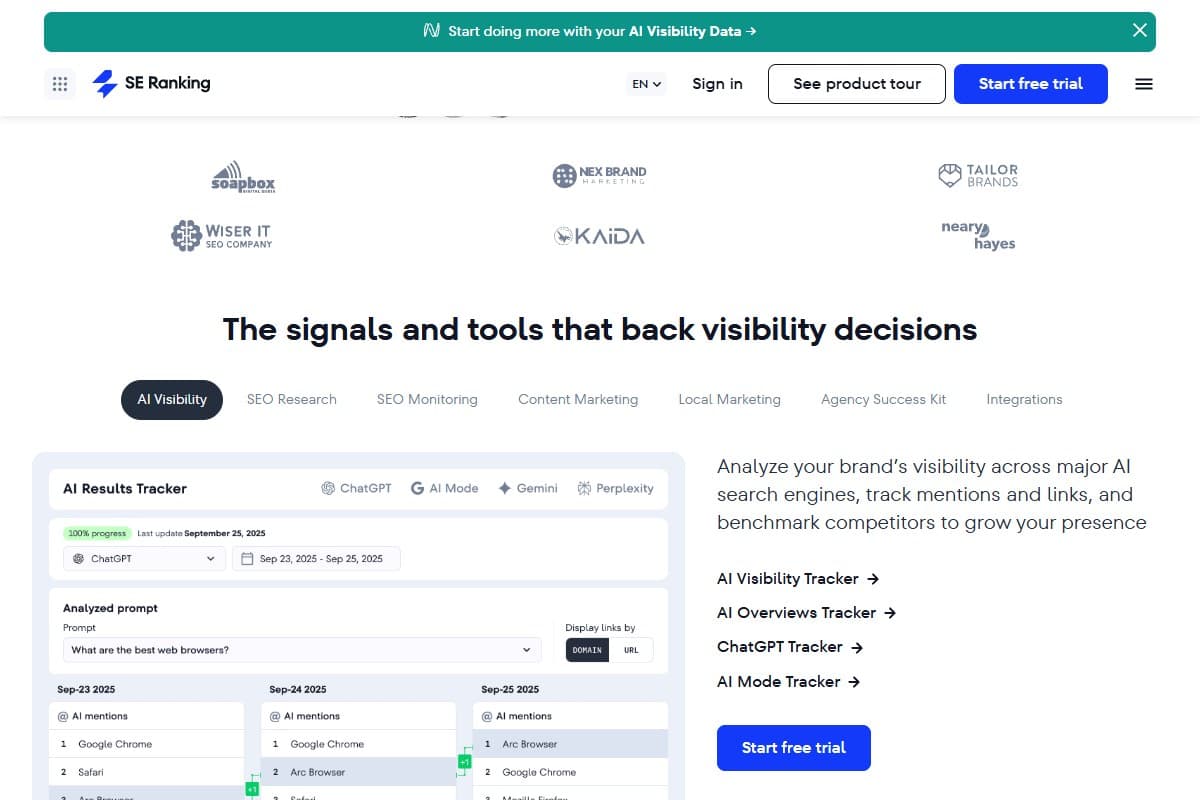
The AI side runs through the AI Results Tracker, which queries Google AI Overviews, Google AI Mode, ChatGPT, Gemini, and Perplexity the way a real user would, captures the answers, and reports what it found. A separate strategic dashboard called SE Visible layers citation and sentiment trend analysis on top. Underneath both sits the platform SE Ranking has been building since 2013: rank tracking, keyword research, site audits, backlink analysis, competitor research, and an on-page checker.
The important structural detail, and the one most roundups get wrong: GEO tracking is included in the base plans, not sold as a separate module. SE Ranking's own plan cards describe Core as "SEO + GEO for marketing teams" and ship it with 100 daily prompt checks and five domains of GEO research. That is the opposite of how Semrush and Ahrefs price the same capability, and it is the single biggest reason SE Ranking takes the top spot on this page.
That combination is rarer than it sounds. The pure-play GEO tools tell you that ChatGPT is not mentioning you and then leave you there. SE Ranking lets you go from "we are invisible for this prompt" to "here is the page that should be earning that citation, here is what it is missing, here is what the pages currently cited are doing," without changing tabs or paying a second vendor.
Key features
- AI Results Tracker across five engines: AI Overviews, AI Mode, ChatGPT, Gemini, and Perplexity, using direct UI-based monitoring rather than API calls, so what it captures is closer to what a real user sees.
- Dedicated per-engine trackers for AI Overviews, ChatGPT, and AI Mode, which is useful when one platform is disproportionately important to your category.
- Brand mention tracking, separating linked mentions from unlinked ones. This distinction matters more than most people expect, because being named without a citation drives zero traffic but still shapes buyer perception.
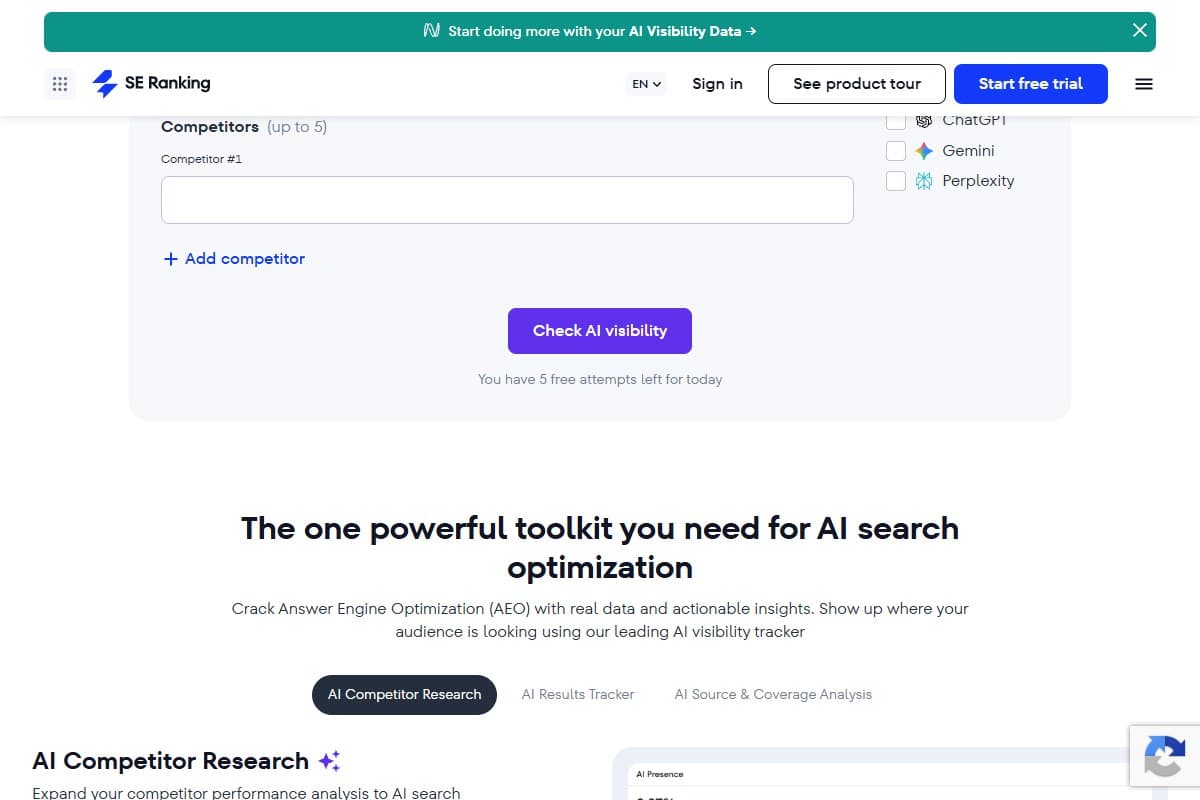
- Competitor visibility comparison against up to five rivals, so you can see who the models recommend when they do not recommend you.
- Source and citation mapping, showing which domains and URLs the engines actually pull from for your prompt set. This is the single most actionable report in the product, because it hands you a target list.
- Daily prompt tracking included in the base plans: 100 prompts a day on Core, 250 on Growth, with GEO research across 5 and 15 domains respectively.
- SE Visible, an optional strategic dashboard for citation and sentiment trend analysis, available through the AI Search add-on when you need more than the base allowance.
- The traditional suite: rank tracking, a keyword database, site audit, backlink checker, on-page SEO checker, content marketing tools with an AI writer, local SEO, and API plus MCP access included on both plans.
- A free AI visibility checker on the site giving five checks a day with no account, which is a genuinely useful way to sanity-check the product before you spend anything.
Pricing
Two self-serve plans plus optional add-ons. The important thing to note is what is already inside the base price.
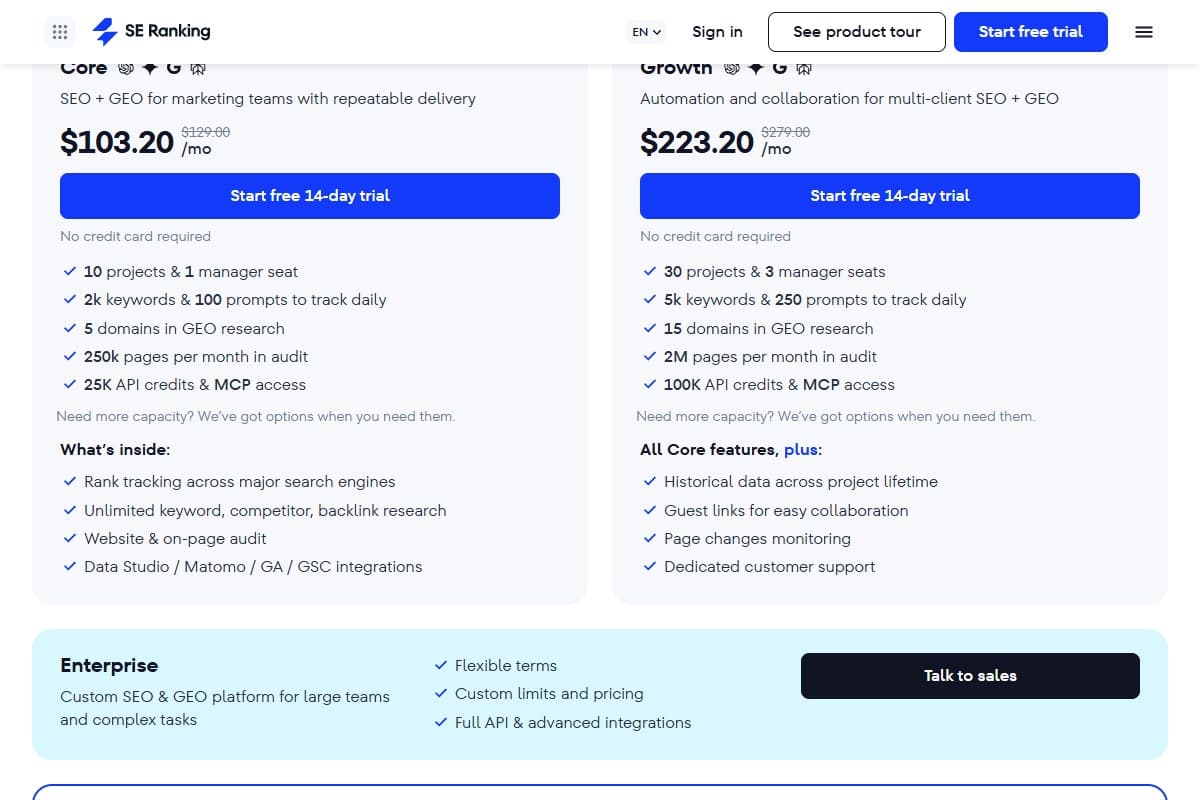
- $129/mo billed monthly
- 10 projects, 1 manager seat
- 2,000 keywords and 100 prompts tracked daily
- 5 domains in GEO research
- 250k pages/month audit, 25k API credits, MCP access
- $279/mo billed monthly
- 30 projects, 3 manager seats
- 5,000 keywords and 250 prompts tracked daily
- 15 domains in GEO research
- Historical data across project lifetime
- $89/mo list price, annual billing
- From 200 prompts, scalable
- AI Results Tracker: AI Overviews, AI Mode, Perplexity, ChatGPT
- Unlimited AI competitor research
- SE Visible dashboard: mentions, citations, sentiment trends
Annual billing saves 20% across the board. The trial is 14 days, fully functional, with no credit card, which is genuinely enough time to build a prompt set and find out whether the models know you exist. Other add-ons exist if you need them: an Agency Pack at $69 a month for white-label reporting and client seats, and an API bundle at $45 a month.
The honest math for most readers: $103.20 a month on annual billing, or $129 billed monthly, and you are tracking GEO from day one. You only need the AI Search add-on if 100 daily prompts is not enough or you specifically want SE Visible's sentiment and citation trend dashboard, which pushes the all-in figure to $174.40 a month annual.
Compare that to the alternatives honestly. Semrush charges $99 a month per domain for its AI Toolkit on top of a Semrush subscription. Ahrefs charges for Brand Radar indexes on top of an Ahrefs plan. SE Ranking is the only tool in this roundup where the AI visibility layer is treated as part of the product rather than as an upsell, and at this price point that is not a small distinction.
- GEO tracking is included in the base plans rather than sold as an add-on, unlike Semrush and Ahrefs
- Only tool here that pairs five-engine AI visibility tracking with a complete SEO suite in one login
- Total cost a fraction of the equivalent Ahrefs Brand Radar setup, and cheaper than Semrush per domain
- Separates linked from unlinked brand mentions, which most competitors flatten into one number
- Source and citation mapping gives you an actionable target list, not just a visibility score
- 14-day fully functional trial with no credit card, plus five free AI visibility checks per day with no account at all
- Claude is not among the tracked engines, which is a real gap for B2B and developer audiences
- 100 daily prompts on Core runs out fast if you track multiple brands or a wide query set
- SE Visible's sentiment and citation trend dashboard needs the $71.20/mo add-on
- $103.20/mo is still steep for solo bloggers and side projects
- Keyword database is smaller than Semrush or Ahrefs, a long-standing complaint in user reviews
- Reviewers report occasional incomplete daily scans and failed automated report delivery
2. Semrush AI Toolkit: best if you already pay for Semrush
Semrush's AI Visibility Toolkit does the same core job: it shows you how ChatGPT, Google AI Mode, and other AI platforms describe your brand relative to competitors, with sentiment analysis and share-of-voice reporting layered on top.
It is genuinely good, and the analysis is presented more clearly than most rivals manage. The problem is the pricing structure. The AI Toolkit is $99 a month per domain, with 25 tracked prompts included. Fifty more prompts costs another $60 a month. A second domain is another $99. If you are an agency with eight clients, do that multiplication before you get attached to the interface.
Semrush also bundles it as Semrush One, starting at $199 a month for one domain with 50 daily prompt checks, then $299 and $549 for the higher tiers.
The case for it is simple: if Semrush is already your platform, adding the AI Toolkit is one line item and zero migration. The case against it is equally simple: the per-domain pricing punishes exactly the agencies and multi-brand teams most likely to want it. Our full Semrush review rates the platform 4.7 out of 5 overall, and it remains the most complete SEO suite you can buy. The AI Toolkit specifically scores lower here because of what it costs to scale, not what it does.
3. Ahrefs Brand Radar: best data, worst bill
Ahrefs Brand Radar tracks brand mentions across AI platforms with the data quality you expect from Ahrefs, which is to say very high. If money were not a factor, this would be a closer fight for the top spot.
Money is a factor. Brand Radar requires an active Ahrefs subscription, which starts at $129 a month for Lite and runs to $249 for Standard and $499 for Advanced. On top of that, AI platform indexes cost roughly $199 per platform individually, or around $699 for the bundle covering all of them. A realistic all-platforms setup lands somewhere between $828 and $1,199 a month.
For an enterprise brand team with a real budget and a genuine need to watch six engines at once, that is defensible. For everyone else it is not a close call. You are paying five to seven times what SE Ranking's equivalent costs for data that is better but not five to seven times better. If you want the fuller picture on how these two platforms compare on the traditional SEO side, our Semrush vs Ahrefs comparison covers that ground.
4. Otterly.ai: cheapest tool that actually works
Otterly's Lite plan starts at $29 a month, and it is the honest answer for anyone who wants to start measuring without a six-month budget conversation.
It monitors brand mentions and links across AI search results, tracks a prompt set, and reports changes over time. It is not trying to be an SEO platform and it will not tell you what to fix. What it will do is answer the first and most important question, which is whether the models mention you at all, and it will do it for less than the cost of a team lunch.
The upgrade path is the honest weakness. Once you have your answer and want to act on it, you will need something with SERP data and content tooling behind it. But paying $29 to find out whether you have a problem is a much better sequence than paying $103 a month to confirm one you have not measured yet.
5. Peec AI: purpose-built for GEO specialists
Peec AI is a dedicated AI visibility platform starting around $89 a month, aimed at mid-market teams who have already decided GEO is a discipline rather than an experiment.
The pitch is depth of prompt-level analysis: what the models say, how it changes, which sources drive the answer. It is a serious product and the people who love it tend to be the ones doing GEO as a specialism rather than as one line in a broader SEO role.
The tradeoff is the same one Otterly makes at a higher price point. There is no keyword research, no site audit, no backlink index. If you already have that stack and just want the best pure GEO layer on top, Peec is a strong pick. If you are choosing one subscription, SE Ranking does more for the money.
6. Profound: enterprise only
Profound is the name that comes up most in enterprise conversations, and its pricing is sales-led and unpublished, which tells you most of what you need to know about who it is for.
The analytics are the deepest in the category, with conversation-level analysis of how AI systems discuss your brand across a large prompt universe. If you are a brand where a single misleading AI answer costs real revenue, it is worth the call. If you are reading a roundup to figure out whether GEO tools are worth paying for at all, you are not the customer, and that is fine.
7. Mangools: the budget SEO foundation underneath all of this
Mangools does not track AI visibility. It is on this list because the most common mistake I see in GEO conversations is buying a $200 visibility tracker while having no functioning SEO foundation for it to measure.
AI engines retrieve from the live web. They favor pages with authority, clean structure, and topical depth, which is a list of things traditional SEO produces. If your site has 40 pages of thin content and no backlinks, a GEO tool will faithfully and expensively report that no model mentions you, and you will have paid $103 a month to learn something a five-minute audit would have told you.
Mangools starts at $37.70 a month on annual billing and covers keyword research, SERP analysis, rank tracking, and backlinks well enough for a small site or a solo operator. Our Mangools review rates it 4.4 out of 5. Get the foundation working, then buy the measurement layer.
Head to head: SE Ranking vs Semrush AI Toolkit
This is the comparison most readers will actually be deciding, so let me be direct about it.
On cost for one domain, it is not as close as the headline numbers suggest. SE Ranking's Core plan is $103.20 a month annual and includes 100 daily prompt checks plus five GEO research domains. Semrush's AI Toolkit is $99 a month for 25 tracked prompts, and that sits on top of whatever Semrush plan you already pay for. You are comparing a complete platform against an add-on.
On cost for multiple domains, it is a rout. Semrush charges $99 per additional domain. SE Ranking's Core plan covers five domains in GEO research before you buy anything extra, and Growth covers 15. For agencies this single difference is worth more than every feature comparison combined.
On engine coverage, SE Ranking's five-engine spread across AI Overviews, AI Mode, ChatGPT, Gemini, and Perplexity is the broader default. Neither tracks Claude, which remains an industry-wide gap and an increasingly odd one given where B2B and developer research now happens.
On the surrounding platform, Semrush wins on raw depth. Its keyword database is larger, its competitor traffic estimates are better, and its content tooling is more mature. If your work is heavily competitive-research driven, that gap is real.
On presentation, Semrush's AI reporting is cleaner and easier to hand to a client without annotation.
The rule of thumb: pick Semrush if you already pay for Semrush and manage one or two domains. Pick SE Ranking if you manage several brands, or if you are buying your SEO platform and your AI visibility layer in the same decision. If you are starting from zero in 2026, SE Ranking is the better first purchase, and it is not particularly close on price.
How to actually get cited by AI engines
A tracking tool tells you where you stand. It does not fix anything. Here is what the evidence, including the original GEO research, actually supports.
- Cite primary sources and name them. Content with attributed citations gets pulled into generated answers more often than content that asserts things without support. This is the single highest-leverage change in the paper's findings.
- Add real statistics with attribution. Numbers with a named source are extractable in a way that adjectives are not. "Significantly faster" gives a model nothing to quote. "38% faster in our testing" gives it a sentence.
- Quote named experts. Attributed quotations improved citation rates in the research, and they are a signal of the firsthand reporting that AI systems increasingly weight.
- Structure for extraction. Clear headings phrased as questions, direct answers in the first sentence under each heading, and short self-contained paragraphs. A model retrieving a chunk of your page should get a complete thought.
- Answer the actual question early. The inverted pyramid works on AI systems for the same reason it works on readers: the answer needs to survive being read in isolation.
- Keep your traditional SEO healthy. Crawlability, internal linking, page speed, and authority still gate whether you are in the retrieval set at all.
- Track sentiment, not just presence. Being mentioned negatively is worse than not being mentioned. This is the metric most teams forget to look at until a customer forwards them a screenshot.
- Update and date your content. AI systems favor content that appears current, and staleness is one of the easiest signals to fix.
None of this is exotic, and that is the point. Most of GEO is good editorial practice, made measurable by tools that did not exist three years ago. If your content operation needs help executing on it, our roundup of the best AI writing tools 2026 covers the drafting layer, and tools like Frase handle the SERP-driven briefing that keeps you in the retrieval set.
Who should buy a GEO tool
- Agencies and consultants, because clients are already asking about AI visibility and "we do not measure that" is a losing answer in a pitch.
- B2B SaaS teams, where buyers research through AI assistants and a single recommendation can shape a shortlist.
- Ecommerce brands in categories where AI shopping assistants are being used to compare products.
- Anyone who has watched impressions hold steady while clicks fall, which is the clearest signal that answers are being consumed without visits.
Who should skip it for now
- Sites without an SEO foundation. Fix crawlability, content depth, and authority first. A GEO tool will only measure the problem you already have.
- Purely local businesses. If your customers find you through Maps and reviews, AI visibility across five engines is not your bottleneck.
- Anyone expecting a lever to pull. These tools measure. They do not optimize. The work still lands on your content team.
- Solo bloggers on tight budgets. Use SE Ranking's five free daily checks or Otterly at $29 rather than committing to a full stack you cannot yet act on.
What the community is saying
Paraphrased community sentiment, not our own testing:
- SE Ranking holds 4.7 out of 5 across 297 verified reviews on Capterra, where the recurring praise is accurate rank tracking, a genuinely beginner-friendly interface, and being meaningfully cheaper than Ahrefs and Semrush for comparable work. The complaints are consistent too: several reviewers flag significant price increases over recent years, occasional incomplete daily scans, and a keyword database smaller than the market leaders.
- On G2, SE Ranking carries a 4.7 out of 5 average across a large review base, with competitor analysis and API access singled out most often by heavier users.
- Trustpilot sits lower at roughly 4.2 across 700-plus reviews, which is a familiar pattern: Trustpilot skews toward billing and support experiences rather than product capability, and the negative reviews there cluster around plan changes and renewals rather than the tooling itself.
- SoftwareAdvice reviewers echo the value framing, repeatedly describing SE Ranking as the tool agencies move to when Semrush or Ahrefs stops justifying its cost.
- Industry sentiment on GEO itself remains split. eMarketer's FAQ on GEO and AEO captures the mainstream position well: most practitioners now treat AI search optimization as an extension of SEO rather than a separate discipline, and the loudest disagreement is about how much of the traffic loss is attributable to AI answers versus ordinary SERP changes.
- The original GEO research paper remains the most-cited evidence base in these conversations, and its finding that citations, quotations, and statistics lift generative visibility by up to 40% is the closest thing this field has to a settled result.
The bottom line
SE Ranking is the best AI search visibility tool for most people in 2026, and the reason is structural rather than featural. It measures your presence across five AI engines, gives you the SEO platform to do something about it, and does not charge you separately for the AI half. At $103.20 a month on annual billing with 100 daily prompt checks and five GEO research domains included, it is the only tool here where the sticker price and the actual bill are the same number. Every alternative either costs multiples more for the same combination, charges per domain in a way that punishes agencies, or measures without giving you any means to act.
The caveats are real and worth repeating. Claude is not among the tracked engines, which is a genuine blind spot for B2B audiences. A hundred daily prompts sounds generous until you are tracking three brands across a wide query set, and the SE Visible sentiment dashboard sits behind a $71.20 add-on. And if you manage one domain and already pay for Semrush, adding the Semrush AI Toolkit is the lower-friction move even though it is worse value on paper.
The bigger point is one no tool on this page will tell you: GEO is mostly SEO with better measurement and stricter formatting discipline. The teams winning AI citations in 2026 are, with almost no exceptions, the teams that were already publishing well-sourced, well-structured, genuinely useful content. The tracking tools are how you prove it is working and where you are losing. They are not how you win. Start with a free check, confirm you have a problem worth $103 a month, and build the content foundation with something like Mangools if you do not have one yet.
FAQ: GEO and AI search visibility in 2026
What is generative engine optimization (GEO)?
Generative engine optimization is the practice of structuring and promoting content so that generative AI systems such as ChatGPT, Perplexity, Gemini, and Google's AI Overviews cite and recommend it inside the answers they write. The term comes from a 2023 academic paper by Aggarwal and colleagues, which found that adding citations, attributed statistics, and expert quotations lifted visibility in generative responses by up to 40%. In practice GEO is not a separate discipline from SEO. It is SEO plus a measurement layer for AI answers plus a stricter set of formatting habits that make your content easy to extract and quote.
How do I get cited by ChatGPT?
Four things move the needle most. First, cite primary sources by name and link to them, because content with visible attribution gets pulled into generated answers more often than content that asserts without support. Second, include real statistics with sources attached, since a number with a citation is quotable in a way that an adjective is not. Third, structure your page for extraction: question-shaped headings, the direct answer in the first sentence underneath, and short self-contained paragraphs. Fourth, keep your traditional SEO healthy, because ChatGPT retrieves from the live web and pages that already rank and carry authority are far more likely to be in the retrieval set at all. There is no submission form and no shortcut. Being genuinely the best answer, formatted so a model can lift it cleanly, is the whole mechanism.
How do I track my AI search visibility?
You need a tool that queries the AI engines on a recurring schedule with a fixed set of prompts and records what comes back. SE Ranking's AI Visibility Tracker does this across ChatGPT, Perplexity, Gemini, Google AI Overviews, and AI Mode, reporting brand mentions, whether those mentions carry a link, sentiment, competitor share, and the source URLs the engines pulled from. Semrush's AI Toolkit, Ahrefs Brand Radar, Otterly, Peec AI, and Profound all do versions of the same thing at different price points. If you want to check manually first, SE Ranking gives five free visibility checks per day with no account, which is enough to find out whether you have a problem before you spend anything.
What is the difference between GEO and AEO?
AEO, answer engine optimization, is the older and broader idea of optimizing to be the answer rather than a link, which covers featured snippets and voice search as well as AI chat. GEO, generative engine optimization, is specifically about being cited inside answers that a generative model writes. In everyday use the two terms have collapsed into each other, and most practitioners now use them interchangeably. The distinction is worth understanding once and then not arguing about, because the tactics that serve one serve the other.
Is GEO replacing SEO?
No, and the framing misleads people into the wrong spending. AI engines retrieve from the live web, and the pages they retrieve are overwhelmingly pages that already rank, already carry authority, and already answer questions cleanly. That is a description of good SEO. What has genuinely changed is measurement: rank tracking no longer captures the full picture, because a user can get your answer without ever loading a results page. Treat GEO as an additional reporting layer and a formatting discipline sitting on top of SEO, not as a replacement for it.
How much do AI search visibility tools cost in 2026?
The range is wide, and comparing sticker prices will mislead you. Otterly starts at $29 a month for basic tracking of a single brand. Peec AI runs from around $89. SE Ranking's Core plan is $103.20 a month on annual billing and includes GEO tracking with 100 daily prompts and five research domains, with an optional AI Search add-on at $71.20 if you need more volume or the SE Visible dashboard. Semrush's AI Toolkit is $99 a month per domain on top of an existing Semrush plan, or $199 and up for the bundled Semrush One tiers. Ahrefs Brand Radar requires an Ahrefs base plan from $129 plus platform indexes at roughly $199 each or about $699 bundled, landing most real setups between $828 and $1,199 a month. Profound is enterprise-only with unpublished, sales-led pricing. The question to ask any vendor is not what the plan costs but what the plan costs for the number of brands and prompts you actually need to track.
Is SE Ranking good for GEO and AI visibility tracking?
Yes, and it is our top pick for most teams. It tracks five AI engines, separates linked from unlinked brand mentions, compares you against up to five competitors, and maps the source URLs the engines actually cite, which is the most actionable report in the product. Two things set it apart. GEO tracking is included in the base plans rather than sold as an add-on, with 100 daily prompt checks and five research domains on the $103.20 Core plan. And it sits inside a complete SEO platform, so you can move from finding a visibility gap to fixing the page that should be filling it without buying a second tool. The real drawbacks: Claude is not currently among the tracked engines, and the SE Visible sentiment dashboard needs the $71.20 AI Search add-on. Our rating is 4.5 out of 5.
Can I do GEO without paying for a tool?
Partially, and it is a reasonable place to start. You can manually prompt ChatGPT, Perplexity, and Gemini with the 10 or 20 questions your customers actually ask and record who gets named. SE Ranking's free checker gives you five automated checks a day. That is enough to establish whether you have a problem. What manual checking cannot give you is consistency over time, sentiment tracking, competitor share of voice, or the source mapping that tells you which domains to target. Once you are acting on AI visibility rather than just curious about it, the manual approach breaks down quickly.
Do AI citations actually drive traffic?
Some, and the quality is unusually high. Referral volume from AI engines is still small compared to organic search for most sites, but visitors arriving from an AI recommendation tend to convert at notably higher rates than typical organic traffic, because the model has effectively pre-qualified them. The more important effect is harder to measure: being named in an AI answer shapes a buyer's shortlist even when they never click. That is also why unlinked mentions and sentiment are worth tracking separately from citations, since both influence the decision without producing a single session in your analytics.
Which AI engines matter most for visibility tracking?
ChatGPT first, by a wide margin, because it carries the largest share of AI assistant usage and the conversational, comparison-shaped queries brands most want to win. Google's AI Overviews and AI Mode come next, since they intercept traffic at the exact moment someone runs a traditional search. Perplexity punches above its user numbers because it cites sources aggressively and its audience skews toward researchers and buyers. Gemini matters and is growing. Claude is the notable gap in most tracking tools right now, which is worth knowing if your audience is technical or B2B, since a meaningful amount of professional research happens there and almost nobody is measuring it.
Free interactive tool
Compare SE Ranking with other AI toolsSide-by-side pricing, features, and ratings — plus a recommended pick for your use case.
Independent AI tools researcher
Keep reading
Related reviews
Best AI SEO Tools 2026: I Tested 7 Tools and Ranked Them
I tested 7 of the best AI SEO tools in 2026 on the same keyword and site. Semrush, SE Ranking, Mangools, Frase and more, ranked by real value.
Semrush vs Ahrefs 2026: Which SEO Tool Is Worth It?
Semrush vs Ahrefs: we compared pricing, keyword research, backlink data, and site audit. Here is the honest verdict on which SEO tool wins in 2026.
Semrush Review 2026: Is It Worth $140/Month?
Semrush is the most complete SEO suite in 2026. We tested keyword research, site audit, and competitor analysis. Here is the honest verdict.