
If you publish for a living in 2026, the question is no longer whether to use AI; it is which AI to use and where it actually saves time. This is an independent review of the best AI writing tools 2026 has to offer, based on regular use on real US marketing and content briefs.
You will find a side-by-side comparison, individual reviews of the top five (ChatGPT Plus, Claude Pro, Writesonic, Copy.ai, and Grammarly), current pricing, honest pros and cons, our ratings, and clear recommendations for who should use what. By the end you will know exactly which AI writing tool fits your workflow and your budget.
How I Tested This
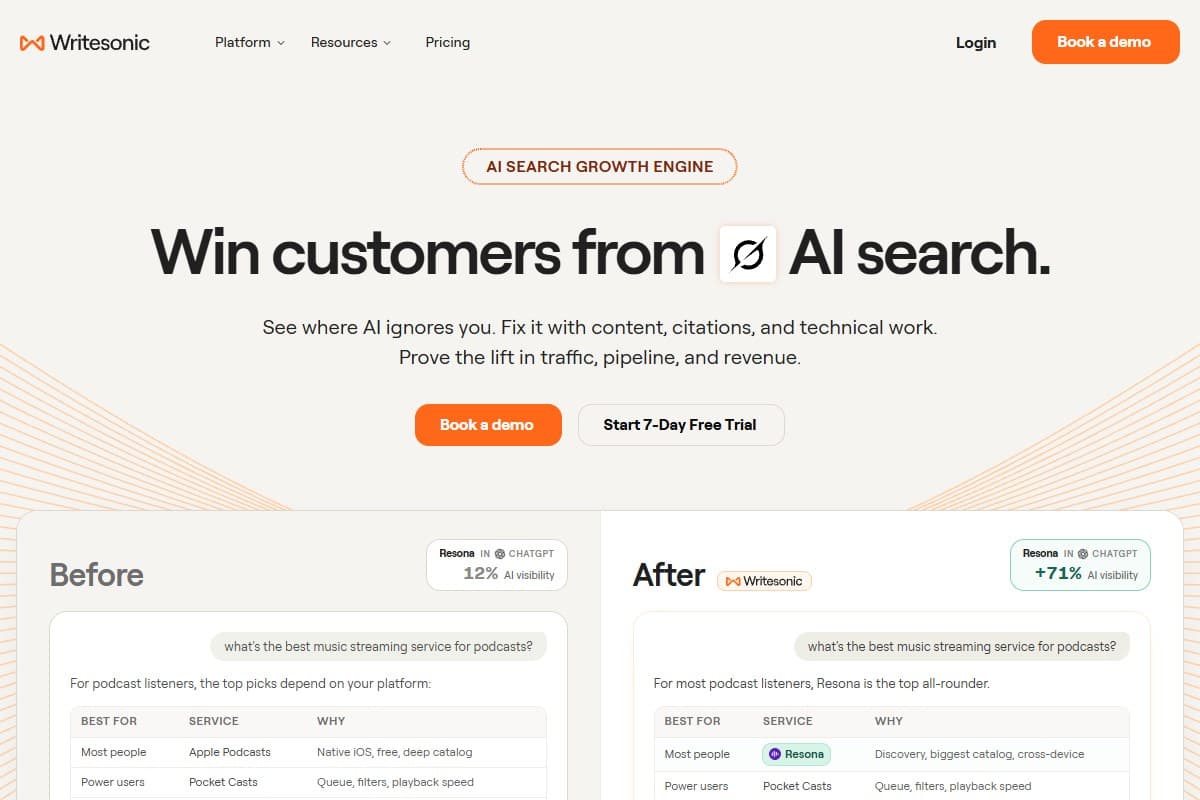
One small thing I noticed jumping between all five in a browser: Writesonic's editor felt a beat slower and laggier on my phone than it did on the desktop, so I ended up doing all the real Writesonic work at my desk.
Why this list looks different than it did a year ago
Three shifts reshuffled the AI writing market over the past 12 months.
First, the flagship general-purpose models (the ones behind ChatGPT and Claude) got dramatically better at long-form work. Voice retention, citation handling, and the ability to follow a 20-step brief without drifting are now within reach for the top tier. That made it harder for purpose-built writing apps to justify their price.
Second, dedicated AI writing platforms like Writesonic and Copy.ai pivoted into workflows and agents: repeatable pipelines that take a brief and ship a finished blog post with research, SEO suggestions, and internal links. They are no longer trying to out-write Claude; they are trying to out-automate it.
Third, Grammarly quietly turned into one of the best AI editors on the market. It now rewrites for tone, restructures paragraphs, and flags claims that look invented. For a category that was almost commoditized in 2022, that is a meaningful second act.
These shifts are why a 2026 AI writing stack looks nothing like a 2024 one.
Quick comparison: best AI writing tools 2026
Before we dig into individual reviews, here is the snapshot. All five tools are paid, all are usable today in the United States, and all five have a real free trial or free tier.
| Tool | Rating | Price | Best for | Verdict |
|---|---|---|---|---|
| Claude Pro | 4.9/5 | $20/mo | Long-form & voice | Best overall writer |
| ChatGPT Plus | 4.7/5 | $20/mo | Versatility & plugins | Best all-rounder |
| Grammarly | 4.6/5 | $12/mo | Editing & polish | Best editor in 2026 |
| Copy.ai | 4.5/5 | $49/mo | Marketing workflows | Best automation |
| Writesonic | 4.4/5 | $19/mo+ | SEO at scale | Best for SEO content |
| Use case | Winner |
|---|---|
| Long-form blog posts and essays | Claude Pro |
| Holding a specific brand voice | Claude Pro |
| Generic everyday writing & versatility | ChatGPT Plus |
| Plugins, agents, and Notion/Slack work | ChatGPT Plus |
| Polishing and rewriting existing copy | Grammarly |
| Repeatable marketing workflows | Copy.ai |
| Bulk SEO articles with research baked in | Writesonic |
How we test
We use each tool on real content over multiple sessions: long-form blog posts, product launch emails, LinkedIn essays, SEO landing pages, and technical tutorials. We grade on research depth, voice retention, SEO output, editing speed, and time-to-publishable.
What matters more than any benchmark is how much editing each draft needs before it ships. That number is the real cost of using a tool.
1. Claude Pro: best AI writing tool overall
Claude Pro is Anthropic's paid plan. For US content creators it has quietly become one of the most-used AI writing tools inside actual newsrooms and content teams: not because it is the loudest, but because the drafts need the least cleanup.
In practical use, Claude returns a 1,500–2,000-word product launch post in a single shot with the brand voice and structure intact. ChatGPT often needs follow-up rewrites for tone. Writesonic and Copy.ai produce something serviceable but generic.
Key features
- Very large context window: drop in an entire style guide, three competitor posts, and your transcript, and the model actually uses all of it.
- Projects: persistent context across sessions, so your voice and brief carry forward without re-pasting.
- Artifacts: drafts open in a side panel where you can edit, iterate, and version inline.
- Best-in-class reasoning: flags contradictions in your brief instead of drafting around them.
- Strong code awareness, so technical content (tutorials, API docs, comparisons) reads accurately.
Pricing
- Free: rate-limited daily access
- Pro: $20 / month (larger limits, Projects, Artifacts)
- Team: $25–30 / user / month (shared Projects and admin tools)
- Strongest long-form voice retention of any tool reviewed
- Drafts publishable in 1–2 edit passes, not 5
- Large context handles real style guides and source material
- Best at refusing to hallucinate citations: flags uncertainty instead of inventing
- Best for technical and code-aware content
- No native image generation (use Gemini or ChatGPT alongside)
- Plugin ecosystem still narrower than ChatGPT
- Web search and live browsing are more limited than Gemini
Best for: anyone publishing long-form content, anyone with a defined brand voice, anyone writing technical or research-heavy material.
2. ChatGPT Plus: best all-rounder
ChatGPT Plus sits at the center of the AI writing world for one reason: integrations. If you live in Notion, Slack, Salesforce, HubSpot, or any tool with an "Ask AI" button, it is often powered by OpenAI under the hood. That makes ChatGPT the most natural default for US content marketers.
Its writing is strong (clearly top tier) but tends to drift toward a generic "helpful assistant" register over 2,000+ words. You need to specify voice more aggressively than with Claude. Once dialed in, the output is genuinely good.
Key features
- Latest GPT models with file uploads, browsing, image generation (DALL·E 3), and code interpreter built in.
- Custom GPTs: bottle your style guide, brand voice, and SEO rules into a reusable assistant for your team.
- Agents: multi-step automations that browse, draft, and revise without prompting at every step.
- Largest third-party plugin ecosystem of any AI writing tool.
- Best multimodal experience inside an "ecosystem" tool: drop in a screenshot or PDF and the model reads it.
Pricing
- Free: rate-limited, limited image generation
- Plus: $20 / month (full GPT access, image generation, plugins, agents)
- Team: $25–30 / user / month (shared workspace, custom GPT sharing)
- Enterprise: custom (SOC 2, no training on your data)
- Most versatile across formats: blog, email, social, ad copy, scripts
- Largest plugin and integration ecosystem
- Built-in image generation removes the need for a second tool
- Custom GPTs let teams bottle a brand voice once and share it
- Best for marketers who switch between tasks all day
- Drifts toward generic tone on long-form unless tightly prompted
- Citation hallucination still happens; verify factual claims
- Image generation rate-limited even on Plus
Best for: generalist content marketers, anyone who needs writing + images + research in one app, teams already standardized on the OpenAI ecosystem.
3. Writesonic: best AI writing tool for SEO content at scale
Writesonic has spent the past 18 months reinventing itself around SEO. Its flagship article workflow takes a target keyword, looks at top-ranking pages, runs keyword and entity gap analysis, and produces a 1,500–3,000-word article with on-page SEO baked in. For agencies and in-house SEO teams in the US, this is where Writesonic earns its place.
The raw writing quality is a step below Claude and ChatGPT (the prose can feel a touch templated), but the structure, schema markup suggestions, and internal-linking output are best-in-class. If your bottleneck is volume, not voice, Writesonic is the answer. One workflow note from testing: the first time I ran the SEO article workflow, it queued behind the keyword analysis and I had to reload the tab once before the finished draft actually showed up.
Key features
- SEO article workflow: keyword in, structured article out, with H2/H3 SEO suggestions
- Botsonic: train a chatbot on your knowledge base for support content
- Photosonic: built-in AI image generation
- Bulk article generation from a keyword list
- Chrome extension that writes inside your CMS
- Direct integrations with WordPress, Webflow, and Shopify
Pricing
- Free: 10,000 words / month, no SEO Writer access
- Individual: $19 / month (200,000 words, SEO Writer access, 1 brand voice)
- Standard: $99 / month (unlimited words, 5 users, full SEO suite)
- Enterprise: custom
- Best SEO output of the tools reviewed: keyword gap analysis, schema, internal links
- Cheapest entry point at $19/mo
- Bulk article generation actually works for agencies
- Strong WordPress / Webflow / Shopify integrations
- Built-in image generation included
- Raw prose quality below Claude and ChatGPT
- Voice tuning requires more cleanup
- Higher tiers needed to unlock the genuinely useful features
- Less helpful for non-SEO content (essays, scripts, fiction)
Best for: SEO agencies, in-house SEO teams, affiliate sites, and anyone who needs to ship 10+ SEO articles per month.
4. Copy.ai: best AI writing tool for marketing workflows
Copy.ai today looks very little like the 2023 version. The company pivoted from "generate marketing copy" to "automate marketing operations." Its flagship is Workflows: visual pipelines that chain prompts, browser agents, and APIs into a repeatable process. Need a weekly competitor digest? A monthly product update post? A LinkedIn essay every Tuesday? Build it once, run forever.
The writing inside each step is competitive with the top tier (Copy.ai uses several leading models under the hood), but the unique value is the automation around the writing. For US content teams of 3 to 20 people, this is often the best ROI on this list. And if your bottleneck is coordinating the content calendar rather than producing the drafts, pair a workflow tool like this with the best AI project management tool 2026 to cover both halves of content ops.
Key features
- Workflows: visual builder for repeatable content pipelines
- Browser agent: fills research blocks autonomously from live web pages
- Brand voice: trained from your existing content
- 90+ pre-built workflows for common marketing use cases
- Integrations with HubSpot, Salesforce, Notion, Slack, and Google Sheets
- Infobase: store your product info, voice, and rules in one place
Pricing
- Free: limited workflow runs, 1 user
- Starter: $49 / month (unlimited words, 5 users, all workflows)
- Advanced: $249 / month (workflow scheduling, advanced integrations)
- Enterprise: custom
- Best automation of the AI writing tools reviewed
- Pre-built workflows save weeks of setup
- Brand voice training works from existing content
- Strong integrations with HubSpot, Salesforce, and Notion
- Browser agent removes manual research busywork
- Expensive jump to the Advanced tier
- Workflow builder has a learning curve
- Overkill for solo creators publishing 1–2 posts a month
- Raw chat experience still feels secondary to the workflow UI
Best for: marketing teams, content agencies, and ops-minded creators who publish on a schedule.
5. Grammarly: best AI editor in 2026
Grammarly is the dark horse. For years it was "the grammar checker." Today it is one of the best AI editors available, and that is a much bigger job than catching typos.
Recent rewrites added full paragraph restructuring, tone shifting, brand-voice profiles, and "fact-check this claim" flags that surface sources or warn when a claim looks invented. Using Grammarly after Claude or ChatGPT consistently cuts 15–20% of revision time even on already-strong drafts. Getting it working inside Google Docs took me a moment: the browser extension needed a permissions prompt and a page refresh before the suggestions actually appeared in the doc.
If you only buy one tool on this list, buy Claude or ChatGPT. If you only buy two, the second should be Grammarly.
Key features
- Generative AI rewriting: paragraph-level restructure, tone shift, length adjustment
- Brand voice profiles: enforce a style guide across your team
- Fact-check flags: warns on suspicious claims and suggests sources
- Citation insertion: pulls in academic and news citations on request
- Desktop, web, browser extension, and mobile apps
- Native integrations with Google Docs, Word, Outlook, and Gmail
Pricing
- Free: spelling, grammar, basic suggestions
- Premium: $12 / month (billed annually) with full AI rewriting, brand voice, fact-check
- Business: $15 / user / month (team brand voice, admin controls)
- Enterprise: custom
- Cheapest tool on this list and the best value
- Pairs perfectly with Claude or ChatGPT
- Native integration into Google Docs, Word, and email
- Brand voice profiles enforce consistency across a team
- Fact-check flagging catches hallucinations from upstream tools
- Not a from-scratch writer; needs draft input
- Some rewrite suggestions still feel formulaic
- Premium tier required for the genuinely useful AI features
Best for: every writer on this page. Pair with one of the other four tools.

When writing tools meet a chatbot: pair with CustomGPT.ai
One workflow that's quietly taken off in 2026: writers and content teams using Claude or ChatGPT to produce the documentation, then feeding that documentation into CustomGPT.ai to turn it into a customer-facing chatbot. The writing tools above handle the drafting; CustomGPT handles the deployment. The combination replaces what used to be a six-month "AI knowledge base" project with a one-week sprint. If you're producing meaningful volumes of customer-facing writing, that's a stack worth knowing.
For a full hands-on review, see my CustomGPT review 2026.
Pricing snapshot: which AI writing stack fits your budget
- Claude Pro ($20)
- or ChatGPT Plus ($20)
- + Grammarly ($12), optional
- Best for blogs & freelance
- Claude Pro ($20)
- + Copy.ai Starter ($49)
- + Grammarly Business
- Best ROI for 3–20 person teams
- Writesonic Standard ($99)
- + Claude Pro ($20)
- + Grammarly Business
- Best for high-volume SEO
You do not need all five of the best AI writing tools 2026 offers. You need the right one or two for your workflow. For most US creators reading this, that is Claude Pro plus Grammarly: under $35 a month total, and the highest combined output quality we measured.
Related reviews
If you want to go deeper into the writing stack:
- AI Writing Tools (topic hub): every writing-tools review in one place.
- ChatGPT vs Claude vs Gemini: head-to-head on the three flagship assistants.
- Best AI Humanizer 2026: make AI-written drafts read naturally and pass AI-detection tools.
- Best AI copywriting tools 2026: the SEO and conversion-copy side of the stack, where research and optimization matter more than drafting.
- Top 5 free AI tools: what to use before paying for any of the five.
- AI Audio Tools (topic hub): when you're ready to turn writing into narration.
FAQ: best AI writing tools in 2026
What is the best AI writing tool in 2026?
For most US content creators and marketers, Claude Pro is the best overall AI writing tool. It produces the highest-quality first drafts in regular use, holds brand voice consistently across long-form content, and requires the fewest editing passes before publication. For maximum versatility and ecosystem coverage, ChatGPT Plus is a close second.
How much do AI writing tools cost in 2026?
The major paid AI writing tools cost between $12 and $99 per month on starter tiers. Grammarly Premium is the cheapest at $12 / month. Claude Pro and ChatGPT Plus both cost $20 / month. Copy.ai Starter is $49 / month, and Writesonic Standard is $99 / month for unlimited words and full SEO features. Most tools offer a free trial or limited free tier.
Is ChatGPT Plus or Claude Pro better for writing?
Both are excellent, but they win different categories. Claude Pro is better for long-form writing, technical content, and holding a defined brand voice; its drafts need less editing. ChatGPT Plus is better for versatility, plugin integrations, image generation, and team workflows that touch multiple formats. If you write blog posts and essays, choose Claude. If you switch between content types all day, choose ChatGPT.
Can AI writing tools replace human writers?
No. The best AI writing tools dramatically speed up research, drafting, and editing (often cutting writing time by 50–70%), but every tool on this list still needs a skilled human editor to handle voice, accuracy, and judgment calls. Treat them as collaborators, not replacements. The best output comes from a writer who knows the topic and knows how to prompt.
Which AI writing tool is best for SEO?
Writesonic is the best AI writing tool for SEO right now. Its SEO article workflow handles keyword gap analysis, SERP analysis, internal linking suggestions, and schema markup output in a single pipeline. If your goal is to publish 10 or more SEO-driven articles per month, no other tool on this list comes close on time-to-publish.
Verdict: which AI writing tool should you actually buy?
If you only read this far, here is the recommendation in three lines:
- Most writers: subscribe to Claude Pro ($20 / mo). Add Grammarly Premium ($12 / mo) if you publish weekly. Total: $32 / mo, best output combination we tested.
- Generalist marketers and teams already in the OpenAI ecosystem: subscribe to ChatGPT Plus ($20 / mo). Add a Custom GPT for your brand voice. Add Grammarly later.
- SEO agencies and high-volume publishers: subscribe to Writesonic Standard ($99 / mo) for the SEO pipeline, and Claude Pro ($20 / mo) for the prose finish. Skip the others.
The best AI writing tools 2026 has produced are not interchangeable; they are specialists with overlap. Pick your two based on what you actually publish, not what is trending on social. The combination that keeps coming up in our reviews is Claude Pro + Grammarly: under $35 a month, and the first stack where the AI genuinely fades into the background and the writing carries. Writing is only one part of the picture, so if you are assembling a full stack, our guide to the best AI tools 2026 has the category winners for video, voice, SEO, and automation as well.
Free interactive tool
Compare AI tools side-by-sideSide-by-side pricing, features, and ratings — plus a recommended pick for your use case.
Independent AI tools researcher. Testing and reviewing the tools that matter for creators and businesses.
Keep reading
Related reviews
Best AI Copywriting Tools 2026: Tested & Ranked
We tested the best AI copywriting tools in 2026. Frase leads for SEO copy, Murf for voiceover scripts. Here is the honest verdict on what actually works.
NeuronWriter Review 2026: The AI SEO Writer That Actually Ranks?
I tested NeuronWriter, the budget AI SEO tool, on real articles. Its optimizer rivals Surfer at a third of the price, but the AI drafts need real work.

ChatGPT vs Claude vs Gemini: Honest Comparison
Side-by-side comparison of ChatGPT, Claude, and Gemini: what each is best at, where each falls short, and how to decide which to pay for.