
Most SEO tools punish you for being a beginner. Mangools does the opposite, and that's the whole pitch. This Mangools review comes from running real keyword research, tracking rankings, and digging through backlinks across its five tools, then weighing it against the two giants it undercuts: Ahrefs and SEMrush. Mangools (the suite behind the well-known KWFinder) has long been the affordable, friendly option, and in 2026 it's repositioned itself as an "AIO + SEO bundle" that now folds AI search tracking into every plan.
So is it the best affordable SEO tool suite, or a budget compromise you'll outgrow? Honestly, a bit of both, and which one depends entirely on your scale. Worth it for most. Here's where the line is.
Source check: Mangools is a real, established SEO company, not a fly-by-night tool. Its flagship KWFinder launched in August 2014, and the unified five-tool Mangools suite followed in 2016, founded by Peter Hrbáčik and bootstrapped (no outside funding) to more than a million users from its base in Bratislava, Slovakia. Official site: mangools.com (company background · self-funded growth story). Pricing and features below are checked against Mangools' own pages; independent user ratings are linked in What the Community Is Saying.
How I Tested This
One small thing I noticed early: the daily lookup counter sits up in the corner, and I burned through a chunk of it on day one just poking around KWFinder, so I learned to be a little more deliberate with my searches.
Why Mangools is trending right now
The reason Mangools is back in the SEO conversation this year is AI search.
In 2026 it leaned hard into Generative Engine Optimization (GEO): getting found inside AI answers, not just Google's blue links. It launched a free AI Search Grader and, more importantly, now bundles AI Search Watcher into its paid plans. That tool tracks how your brand shows up across ChatGPT, Gemini, Claude, and other models: monitoring visibility, position, and citations the way SERPWatcher tracks Google rankings. The entire lineup got rebranded around being an "AIO + SEO bundle" to reflect it.
That matters because the big tools charge extra for the same thing. SEMrush sells its AI visibility features as add-on bundles; Ahrefs gates depth behind credits. Mangools folding AI search tracking into a sub-$40 plan is a sharp move at exactly the moment every blogger is wondering whether ChatGPT is eating their traffic.
What Mangools actually is
Mangools is a suite of five SEO tools under one login, built around being approachable. You don't need a certification to use it.
- KWFinder: keyword research with search volume, trends, and the flagship Keyword Difficulty score (a single 0–100 number that tells you how hard a keyword is to rank for).
- SERPChecker: analyzes a specific search result page, showing the authority and link metrics of every site ranking for your keyword.
- SERPWatcher: rank tracking with daily updates and a "Dominance Index" that estimates your overall visibility.
- LinkMiner: backlink analysis for you and your competitors, with link-quality scoring.
- SiteProfiler: a domain overview: authority, top competitors, and best-performing content.
There's also a handy browser extension that overlays SEO metrics right on Google as you search, and, new for 2026, AI Search Watcher for tracking your visibility inside AI engines.
What the Community Is Saying
My hands-on take lines up with a large body of public reviews, and Mangools is one of the better-rated tools in its category. Here's what's verifiable across the major platforms as of mid-2026.
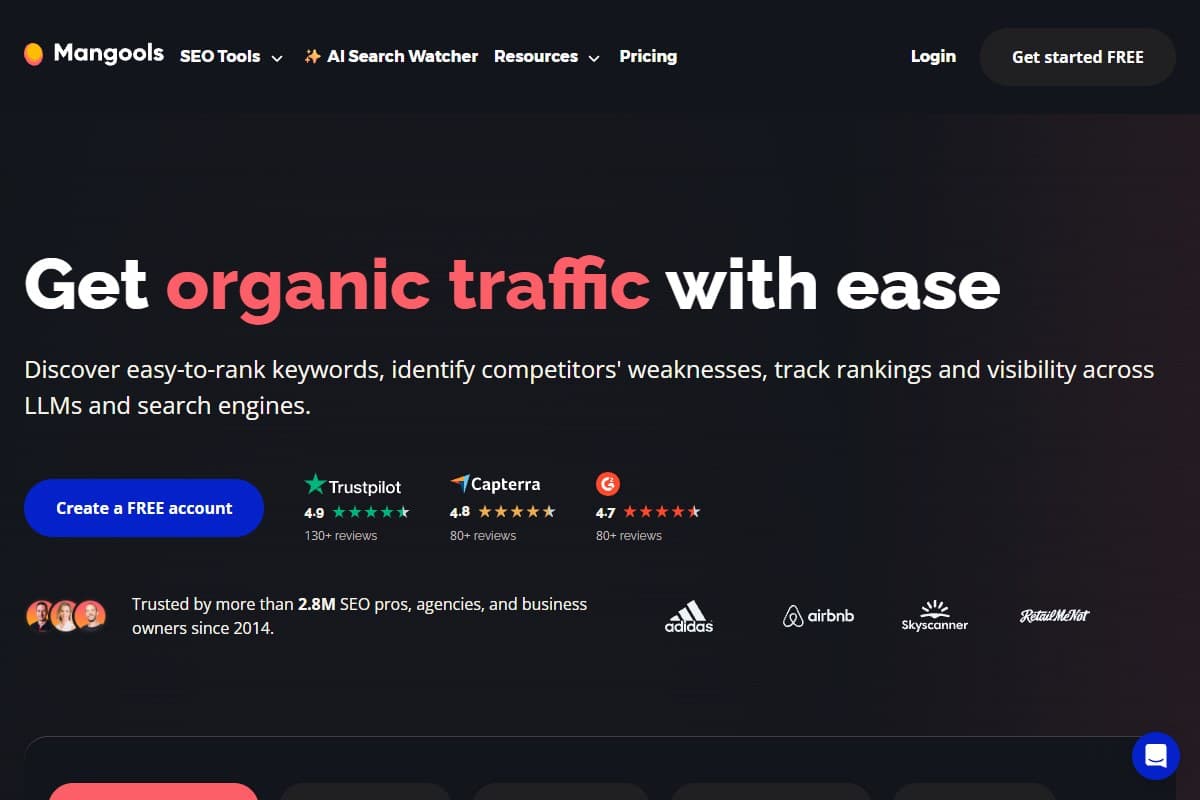
The aggregate scores are unusually high. Mangools holds roughly 4.9/5 on Trustpilot (~150 reviews), 4.8/5 on Capterra, and 4.7/5 on G2 (~90 reviews). For a budget tool competing with Ahrefs and SEMrush, those are strong, consistent numbers.
What reviewers consistently praise. The two themes that recur everywhere are ease of use and customer support. Users repeatedly describe the interface as intuitive enough that keyword research stops feeling intimidating, and the support team as fast and genuinely helpful: multiple long-term reviewers report sticking with Mangools for years specifically because it stays simple while the data keeps improving. KWFinder's keyword data and the Difficulty score are the most-cited individual strengths.
What reviewers consistently criticize. The complaints track the same gaps I hit: no site audit / technical crawler (the single most-cited limitation), a smaller keyword and backlink database than the premium competitors, Google-only coverage, daily lookup caps on lower plans, and slower data refreshes than Ahrefs. The recurring summary across reviews is that Mangools is excellent for small sites and lean teams but not built for complex, enterprise-scale campaigns.
The community consensus, in short: among the most-loved tools in the affordable tier, held back from a perfect score by the missing site auditor and database depth: almost exactly the trade-off this review lands on.
My honest testing experience
The moment Mangools won me over was the Keyword Difficulty score, of all things.
In Ahrefs I'd stare at a wall of metrics and second-guess myself. In KWFinder, the Difficulty number is color-coded (green is winnable, red isn't) and across every target I picked with it, it was reliably right. I'd find a green keyword, write for it, and it was genuinely less competitive than the red ones beside it. That single distilled number is why beginners love this tool, and it's not dumbed-down; it's just clear.
The color-coded Keyword Difficulty score consistently steered me toward genuinely less competitive keywords, and the clean interface meant I spent my time choosing targets instead of decoding dashboards: the opposite of my usual experience in Ahrefs.
Rank tracking in SERPWatcher and backlink digging in LinkMiner were similarly painless. The whole suite shares one clean design language, so moving between tools doesn't mean relearning anything. The one bit of friction: jumping from KWFinder over to SERPWatcher with a keyword list wasn't as seamless as I expected: I ended up re-adding a couple of terms manually rather than carrying them straight across.
The limits showed up exactly where the research warned they would. Mangools' keyword and backlink databases are smaller than Ahrefs' or SEMrush's: for a couple of very niche long-tail terms, the big tools surfaced data Mangools didn't. There's also no technical site audit crawler, which every major rival includes, so Mangools won't flag your broken redirects or crawl errors. And the daily lookup limits, while generous on higher tiers, are a real ceiling if you're doing heavy agency-scale research. None of this is a dealbreaker for a blogger or small site. All of it would be for an enterprise team.
How to Find a Low-Competition Keyword with KWFinder
The clearest way to understand what Mangools actually does is to walk its core workflow: finding a keyword you can realistically rank for. This is a representative flow of how the tool is meant to be used, not a timed benchmark; your exact volumes and difficulty scores will vary by niche.
- Start with a seed keyword. Type a broad topic into KWFinder: say "cold brew coffee." The tool returns the seed plus hundreds of related keywords, each with monthly search volume, a trend graph, CPC, and the flagship Keyword Difficulty (KD) score.
- Mine the suggestion views. Switch to the Autocomplete and Questions tabs to surface long-tail variations: "how long does cold brew last," "cold brew vs iced coffee." Long-tail phrases are where low competition usually hides.
- Filter for winnable and worthwhile. Set the filters: KD under ~30 (KWFinder color-codes the score green/yellow/red, green being easiest) plus a search-volume floor worth your effort: say 100–300+ a month. That trims hundreds of results down to a realistic shortlist.
- Sanity-check the SERP. Click a candidate to open SERPChecker (or the inline SERP preview). It shows the current top-ranking pages with their Domain Authority, Page Authority, backlink counts, and estimated traffic. If page one is full of low-authority sites, forum threads, or thin content, a newer site can realistically break in: a low KD plus a weak SERP is the green light.
- Confirm intent, then lock it in. Read the titles actually ranking to make sure they match the content you plan to write (informational vs. commercial). Then add the keyword to a KWFinder list, and once you publish, drop it into SERPWatcher to track the ranking over time.
What the tool is doing under the hood is collapsing a volume/CPC/trend dataset and a link-based difficulty model into one number, so you're not eyeballing a dozen metrics to make a call. That distilled KD score is why beginners tend to pick winnable keywords faster here than in heavier suites: with the caveat reviewers and I both note: the underlying database is smaller than Ahrefs', so genuinely obscure long-tail terms can come back thin.
What I liked
After real use, the honest list:
- It's the friendliest SEO suite in the category. The interface is clean, fast, and genuinely beginner-proof: the lowest learning curve of any tool here.
- The Keyword Difficulty score is excellent. One color-coded number that reliably points you at winnable keywords. It's the feature people stay for.
- The price is a fraction of the giants. Basic starts at $37.70/month on annual billing: roughly a quarter to a third of what Ahrefs or SEMrush charge to start.
- AI search tracking is now bundled in. AI Search Watcher across ChatGPT, Gemini, and more comes included in 2026, where competitors charge extra.
- Five tools, one clean login. Keyword research, SERP analysis, rank tracking, backlinks, and domain analysis without context-switching between products.
- The browser extension is genuinely useful. SEO metrics overlaid on Google as you search saves real time.
What frustrated me
The honest gripes:
- Smaller databases than Ahrefs and SEMrush. For very niche long-tail keywords and deep backlink profiles, the big tools surface data Mangools misses.
- No site audit / technical SEO crawler. This is the most-cited missing feature: Mangools won't crawl your site for broken links, redirects, or technical errors. SiteProfiler analyzes domains, but it's not an auditor.
- Daily lookup limits. Generous enough for a blogger, but heavy or agency-scale users will hit the per-day caps.
- Not built for enterprise. Fewer advanced features, seats, and bulk workflows than the giants: you'll graduate to Ahrefs or SEMrush if you scale way up.
Pricing: is it worth it?
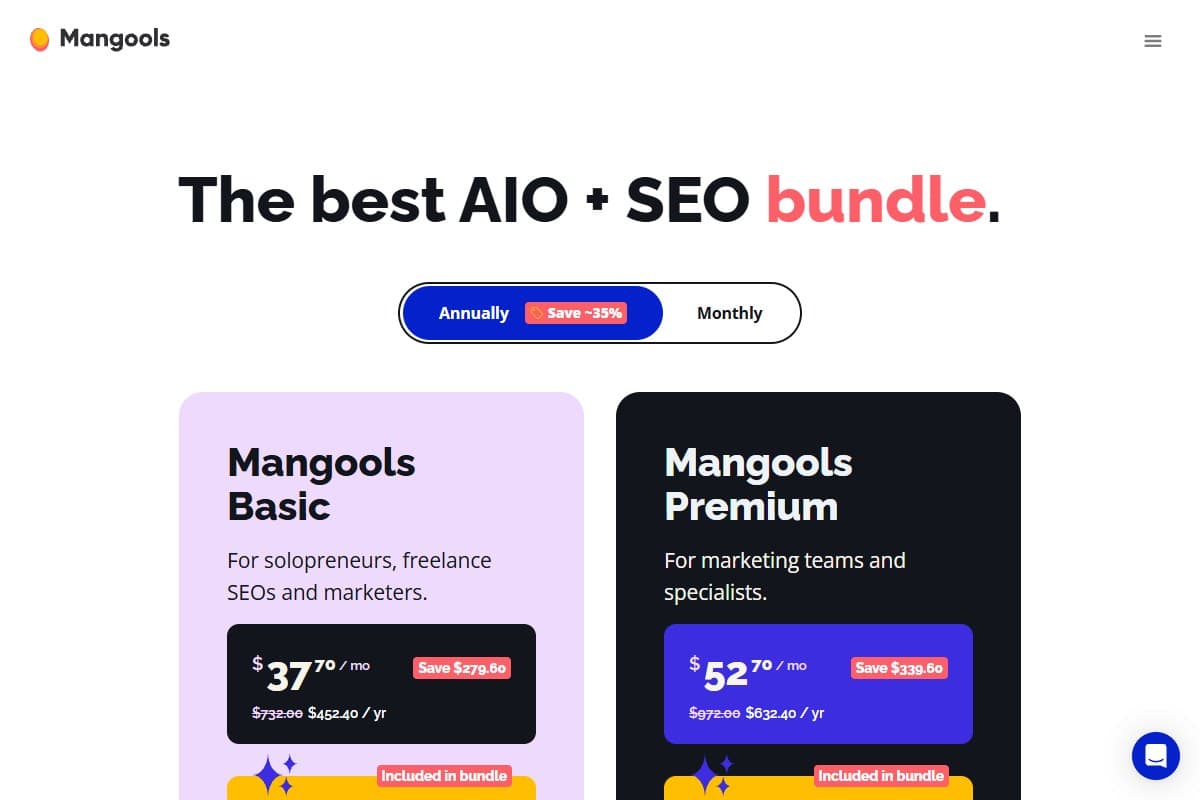
Three tiers, all bundling the five-tool suite plus AI Search Watcher. Annual billing saves about 35% over monthly: the numbers below are the annual (per-month) rates straight off Mangools' pricing page.
- 100 keyword lookups/day
- 200 tracked keywords
- AI Search Watcher included
- 1 seat
- Best for: solopreneurs & freelancers
- 500 keyword lookups/day
- 700 tracked keywords
- Unlimited keyword suggestions
- 3 extra seats
- Best for: marketing teams
- 1,200 keyword lookups/day
- 1,500 tracked keywords
- 1.2M backlink rows/mo
- 5 extra seats
- Best for: agencies
The honest math: Basic at $37.70/month is the sweet spot for most people reading this. It covers everyday keyword research, rank tracking for a real site, and now AI search visibility: for less than a third of an Ahrefs Lite or SEMrush Pro seat. Premium mainly buys you higher daily limits and extra seats once you're doing this for clients. There's a 10-day trial to test all five tools, plus a 48-hour money-back guarantee, so the risk of trying it is essentially zero. Worth flagging, though: the trial asked me for card details up front rather than letting me poke around first, which is a small thing but the kind of step I always brace for before a renewal.
Put it next to the alternatives and the value is stark: Ahrefs starts around $129/month and SEMrush around $139.95/month, and both charge extra for the AI search tracking Mangools now includes. You're trading database size and a site auditor for a bill that's a quarter the size.
Who should use Mangools
Buy it if you are:
- A blogger or content creator who needs fast, clear keyword research and rank tracking
- A freelance SEO or small agency serving clients without an enterprise budget
- A small-business owner doing your own SEO who wants a gentle learning curve
- Anyone who wants Google rankings and AI search visibility tracked in one affordable tool
Who should avoid Mangools
Skip it (try alternatives) if you are:
- An enterprise team that needs the largest possible keyword and backlink databases
- Someone who relies on a technical site audit crawler: Mangools doesn't have one
- A heavy power user who'll blow through daily lookup limits
- An agency needing advanced bulk workflows, many seats, and deep API access
How Mangools compares to the alternatives
| Tool | Rating | Price | Best for | Verdict |
|---|---|---|---|---|
| Mangools | 4.4/5 | $37.70+/mo | Affordable, beginner-friendly SEO | Best value; smaller data, no site audit |
| Ahrefs | 4.6/5 | $129+/mo | Backlinks & big-data SEO | Most powerful; premium price |
| SEMrush | 4.5/5 | $139.95+/mo | All-in-one marketing suite | Feature-packed; expensive & complex |
| Use case | Winner |
|---|---|
| Best value / lowest cost | Mangools |
| Beginner-friendliness | Mangools |
| Largest backlink & keyword database | Ahrefs |
| All-in-one marketing features | SEMrush |
| Technical site audit | Ahrefs / SEMrush |
| AI search tracking included in price | Mangools |
Ahrefs is the more powerful tool, a bigger database and the best backlink index in the business, but it starts around $129/month and can overwhelm a beginner. SEMrush is the everything-suite, with site audits, PPC tools, and more, for around $139.95/month and a matching complexity. Mangools' pitch is focus: it does core SEO research beautifully, includes AI search tracking, and costs a quarter as much. If you pair it with an AI writer to actually produce the content, my NeuronWriter review covers the closest budget complement, and the AI writing tools hub collects the rest of the content stack. For turning those keywords into SERP-driven content briefs, my Frase review covers the research-and-outline side of the workflow. For a quick side-by-side of SEO tools, see the tool comparison page.
Final verdict: 4.4 out of 5
Here's the breakdown.
On value and usability, Mangools is a 4.7. It's the friendliest SEO suite I've used, the Keyword Difficulty score is genuinely the best beginner feature in the category, and bundling AI search tracking into a sub-$40 plan in 2026 is a smart, forward-looking move. For bloggers, freelancers, and small teams, it does the SEO work that actually moves the needle for a quarter of what the giants charge.
I dock the score for the database size and the missing site audit. Ahrefs and SEMrush index far more keywords and backlinks, and both include a technical crawler that Mangools simply doesn't have. For a small site that's irrelevant; for an enterprise team it's disqualifying.
That nets out to 4.4 out of 5. If you're doing SEO for a blog, a small business, or a handful of clients and you don't need enterprise-scale data, Mangools is the SEO suite I'd buy: the value is hard to argue with. Scale past it and Ahrefs or SEMrush await: my Semrush review 2026 covers whether the step up is worth the money. If you're building out the content side too, my best AI writing tools of 2026 round-up pairs naturally with this.
Bottom Line
Mangools scores 4.4 out of 5 as the best beginner-friendly SEO suite I've tested: five tools under one login, the category's clearest Keyword Difficulty score, and AI search tracking bundled into a plan that stays under $40/month in 2026. The trade-offs are a smaller keyword and backlink database than Ahrefs or SEMrush and no built-in site audit, which is irrelevant for small sites and disqualifying for enterprise teams. Buy it if you do SEO for a blog, a small business, or a handful of clients and want most of the data for a quarter of the price; skip it if you need enterprise-scale indexes or a technical crawler.
What I'd change about Mangools
If the Mangools team handed me the roadmap for a week, here's what I'd push on: all of it from time actually spent in the suite.
- Fix the handoff between tools. Moving a keyword list from KWFinder over to SERPWatcher wasn't seamless: I re-added a couple of terms by hand instead of carrying them straight across. For a suite that sells "five tools, one login," that gap is the one place the unified design language breaks.
- Rethink the daily lookup counter. Burning a chunk of my limit on day one just poking around KWFinder taught me to ration my own curiosity, which is the wrong instinct for a research tool. Even on Basic's 100 lookups/day, I'd love a way to preview a search's "cost" before it counts against me.
- Make the browser extension install cleanly. It needed a reinstall before it would overlay metrics on Google. For a feature this genuinely useful, first-run shouldn't fumble.
- Add a lightweight site crawler. No technical audit is the most-cited gap, and SiteProfiler is domain research, not auditing. Even a basic broken-link and redirect checker would close it.
- Drop the card-up-front trial. Asking for card details before I could poke around adds friction to an otherwise risk-free pitch.
FAQ: Mangools review
How much does Mangools cost in 2026?
Mangools has three tiers, all bundling its five SEO tools plus AI Search Watcher: Basic ($37.70/mo), Premium ($52.70/mo), and Agency ($97.70/mo) on annual billing, which saves about 35% over monthly. There's a 10-day trial to test everything and a 48-hour money-back guarantee. Basic is plenty for most bloggers and freelancers; you only move up for higher daily limits and extra seats.
Is Mangools better than Ahrefs?
For value and ease of use, yes; for raw power, no. Ahrefs has a far bigger keyword and backlink database, a technical site auditor, and deeper features, but it starts around $129/month and can overwhelm beginners. Mangools does the core research most people need in a much friendlier interface for roughly a quarter of the price. Choose Mangools for a blog or small site; choose Ahrefs if you need maximum data and enterprise depth.
What tools are included in Mangools?
Five: KWFinder (keyword research), SERPChecker (SERP analysis), SERPWatcher (rank tracking), LinkMiner (backlink analysis), and SiteProfiler (domain analysis). You also get a browser extension that overlays SEO metrics on Google, and in 2026 every plan now includes AI Search Watcher for tracking your visibility inside AI engines like ChatGPT and Gemini.
Does Mangools have a site audit feature?
No, and it's the most notable gap. Mangools doesn't include a technical site audit crawler, so it won't scan your site for broken links, redirect issues, or crawl errors the way Ahrefs and SEMrush do. SiteProfiler analyzes a domain's authority and competitors, but that's domain research, not a technical audit. If site auditing is essential, you'll need to pair Mangools with a free crawler or choose a bigger suite.
Is Mangools good for beginners?
It's arguably the best SEO suite for beginners. The interface is clean and fast, there's almost no learning curve, and the color-coded Keyword Difficulty score turns complex competitiveness data into a single number you can act on immediately. Add a low entry price and a risk-free trial, and it's the easiest SEO tool to start with before you're ready for the heavyweight platforms.
Related reviews
- SEO Tools topic hub: keyword research, rank tracking, and AI search tools, all in one place.
- Best AI SEO tools 2026: seven SEO tools tested on the same keyword and site, including where Mangools ranks.
- NeuronWriter review 2026: the budget AI SEO writer that pairs naturally with Mangools' keyword research.
- Best AI writing tools in 2026: turn your Mangools keywords into ranking content.
- Top 5 free AI tools: more affordable tools for a lean SEO stack.
Got a Mangools question I didn't cover, or a keyword you're stuck ranking for? Get in touch: reader questions shape the next round of reviews.
Free interactive tool
Compare Mangools with other AI toolsSide-by-side pricing, features, and ratings — plus a recommended pick for your use case.
Independent AI tools researcher testing what actually works.
Keep reading
Related reviews

Best AI SEO Tools 2026: I Tested 7 Tools and Ranked Them
I tested 7 of the best AI SEO tools in 2026 on the same keyword and site. Semrush, SE Ranking, Mangools, Frase and more, ranked by real value.

Frase Review 2026: The SEO Writing Tool That Actually Helps You Rank?
Frase promises SERP-driven briefs and AI writing that ranks. Tested hands-on against NeuronWriter and Surfer: honest verdict on whether it's worth it.

Best AI Tools for GEO & Search Visibility in 2026
We tested the top AI tools for GEO and search visibility tracking in 2026. See which tools help you rank in AI search results like ChatGPT and Perplexity.