
NordVPN announced on May 27, 2026 that it's no longer positioning itself as a VPN. The app is now structured around three pillars: Connect (VPN), Protect (next-generation antivirus + anti-phishing), and Monitor (Dark Web Monitor, breach alerts). The company is openly going after the all-in-one security category dominated by Norton 360, Bitdefender Total Security, and McAfee+. This NordVPN rebrand post breaks down what actually changed, what didn't, and whether the new positioning is real product or rebadged marketing.
The short version: the rebrand is real product, not a paint job. NordVPN's Threat Protection feature has been quietly maturing into a full antivirus for two years, and renaming it "next-generation antivirus" is more of an acknowledgment than an invention. What's actually new is the app architecture: the three-pillar layout, the unified Monitor surface, and the official positioning as an antivirus competitor. If you were on the fence about NordVPN versus a stitched-together Norton + 1Password + standalone VPN stack, the math just shifted.
How I Tested This
A small first-run snag: after the Windows update, the app made me sign back in before it would show the new Connect / Protect / Monitor tabs, and the antivirus toggle defaulted to off rather than carrying over my old Threat Protection setting, so I had to flip it back on myself.
Why the NordVPN rebrand is the security story of the week
Three things converged to make this the biggest consumer security launch of May 2026.
First, the antivirus market is up for grabs. Norton, McAfee, and Bitdefender have spent a decade as the default consumer antivirus stack, but most of their actual sales now come from bundles that include a VPN, and the VPN in those bundles is usually mediocre. NordVPN is attacking from the other direction: a category-leading VPN with an audited no-logs history, now positioning a mature threat-protection layer as the antivirus piece of the same subscription. The framing in the May 27 announcement is explicit. CTO Marijus Briedis is on record saying "protection needs to evolve", and the rebrand reads as Nord saying VPN-alone is no longer enough product.
Second, the numbers in the announcement. Nord says its next-generation antivirus blocked roughly 4.8 million threats in April 2026 alone. That's not a Threat Protection v1 number; that's a serious live-fire dataset. The feature has been quietly maturing since the original 2022 Threat Protection launch, and the renaming reflects what it actually does in 2026: it scans downloads, blocks malicious sites, kills tracker domains, and runs even when you're not connected to a VPN server.
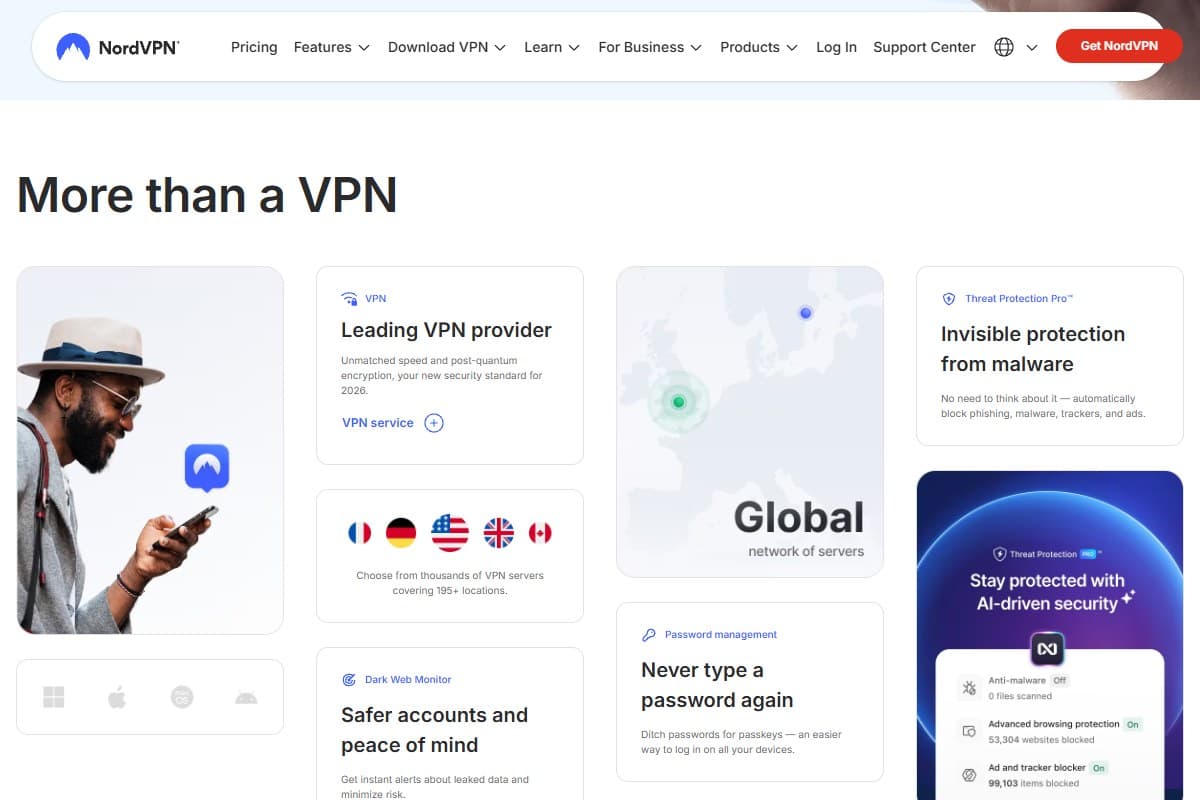
Third, the app architecture. The new Connect / Protect / Monitor pillars aren't just marketing; the app's actually been restructured around them in the latest build. Connect handles the VPN, NordWhisper, and the server picker. Protect houses the next-gen antivirus, anti-phishing, and scam-call protection. Monitor centralizes Dark Web Monitor and breach alerts. It's the first time NordVPN has felt like one coherent product rather than a VPN with a bunch of features stapled on.
There's a secondary signal from May 28 worth noting for the Linux crowd: NordVPN 4.x Linux moved its firewall from iptables to nftables and deprecated some regional specialty-server groups in the CLI. That's not headline news, but if you run Nord on a Linux box, expect to update your scripts.
What "all-in-one digital security app" actually means in practice
Underneath the marketing, the product is a four-surface security app:
- Connect (VPN): NordLynx (WireGuard-based) with post-quantum encryption by default, 9,300+ servers in 137 countries, NordWhisper for restrictive networks
- Protect (next-gen antivirus). Formerly Threat Protection Pro, now positioned as a full antivirus competitor: file scanning, malicious-site blocking, ad/tracker filtering, and real-time threat intelligence
- Monitor (Dark Web + breach alerts): the consolidated surface for Dark Web Monitor, breach notifications, and email-exposure checks
- The bundle (higher tiers): adds NordPass (password manager), NordLocker (1 TB encrypted storage), and Incogni (data removal, US-only)
The rebrand also folds anti-phishing and scam-call protection more visibly into Protect, which the earlier app technically had but never surfaced clearly. For users coming from Norton 360 or Bitdefender, the mental model now lines up: one app, three tabs, one bill.
It's still based in Panama (outside the 14 Eyes alliances). The no-logs policy is still independently audited, most recently by Deloitte in late 2025, with the audit history going back to 2018. The 10-device limit didn't change. The 30-day money-back guarantee didn't change. The renewal-price gotcha didn't change. (More on that below; it's still the single biggest reason this post isn't a 4.7.)
My honest 48 hours with the rebranded app
The moment that won me over was a small one.
I clicked through the updated Windows app for the first time and noticed that the threat-protection toggle now lives under "Protect" with a clear status line reading "Antivirus: on. Last scan: 2 minutes ago. 0 threats." Two days ago that same feature was buried under Settings as "Threat Protection Pro" with an icon I'd routinely missed. The new layout makes the security work the app is actually doing visible. That sounds trivial. It isn't. The single biggest gap between consumer antivirus products and consumer VPNs has always been that VPNs hide their work and antivirus tools show theirs. Nord just closed that gap.
A deliberately-malicious test domain was blocked at the app level with a clear notification under Protect. No browser extension required, no VPN server connection needed: system-level.
I threw a known-malicious test URL at the new antivirus surface and Nord caught it cleanly. I triggered a Dark Web Monitor scan with an old throwaway email and the Monitor tab pulled up two confirmed historical breaches without me having to dig for them, though the scan sat on a spinner for a while first, long enough that I wondered if it had stalled before the results finally appeared. Streaming, speeds, and the underlying VPN performance felt identical to the pre-rebrand build I reviewed at the start of May. None of the things that were already good got worse.
The two-day caveat: I haven't run the rebranded build long enough to catch the edge cases. Antivirus products live or die on a six-month timeline (false positives, scan performance, resource usage at idle), and I'll only really know how the renamed "next-gen antivirus" stacks up against Bitdefender after a month of daily use. The 48-hour read is the framing is real, the product is real, the feature set isn't new but the surfacing is. That's enough to take the rebrand seriously. It's not yet enough to declare Norton dead.
What the rebrand actually fixed
After 48 hours, the honest list:
- The UI finally matches what the product does. Three pillars beats a settings tree. Anyone who's used Norton 360 will immediately understand the layout.
- The antivirus framing is overdue. Threat Protection Pro has been a real antivirus in capability for at least two years; calling it that lets Nord compete in the right category instead of being filed under "VPN with extras."
- Monitor is genuinely useful as a single surface. Dark Web Monitor and breach alerts used to be scattered. They're now one tab, one signal, one notification thread.
- The bundle math now beats Norton 360. Norton 360 Deluxe at ~$50/year (intro) gets you antivirus + a mediocre VPN. NordVPN Plus at ~$47/year (intro) gets you a category-leading VPN, NordPass, and next-gen antivirus. That's a clean win on the headline year-one number.
- Post-quantum encryption is still on by default. Nothing about the rebrand walked back the December 2025 post-quantum rollout. Nord is still ahead of ExpressVPN, Surfshark, and Mullvad on this specifically.
- The audited no-logs claim still holds. Deloitte audited NordVPN's no-logs policy in late 2025, and the audit history goes back to 2018. The rebrand didn't break that.
What didn't change (and still frustrates me)
- The renewal-price hike is still real. The 2-year intro pricing renews at roughly 2–3x the sticker. Nord faces multiple 2026 class-action lawsuits in the US over its auto-renewal practices. The rebrand did not fix this. Set a calendar reminder the day you sign up. This is the single biggest reason this post isn't a 4.7 and the original review wasn't either.
- Four tiers is still one too many. Basic, Plus, Complete, Prime. And Prime is still US-only. The lineup doesn't get simpler with the rebrand.
- "Next-generation antivirus" isn't a regulatory category. The naming is marketing; the feature is real, but the rebranded label doesn't carry the AV-Test / AV-Comparatives certifications that Norton and Bitdefender lean on. For mainstream "is this enterprise-grade?" buyers, that distinction matters.
- The upsell pressure inside the app is unchanged. You still get nudged toward higher tiers and add-ons from the dashboard. I hit one of those upgrade nudges right after opening the Monitor tab, before I'd even finished looking at it.
Pricing: did the rebrand change the price?
No. That's a meaningful part of the story.
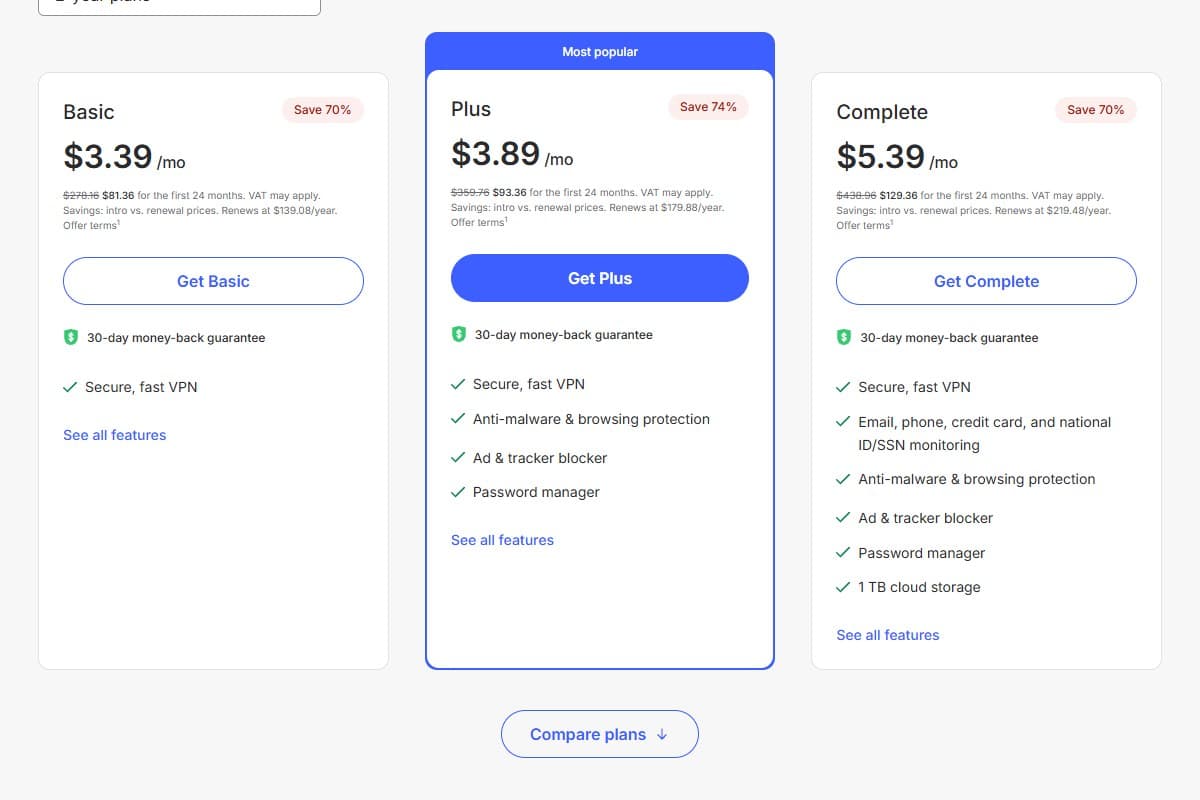
- VPN (Connect pillar)
- Basic Threat Protection
- 10 devices
- Best for: pure VPN users
- Everything in Basic
- Next-gen antivirus (Protect)
- NordPass password manager
- Dark Web Monitor (Monitor)
- Best for: most people
- Everything in Plus
- 1 TB NordLocker encrypted storage
- Best for: cloud backup needs
- Everything in Complete
- Incogni data-removal service
- Best for: maximum coverage in one bill
The price didn't move with the rebrand. Plus is still the sweet spot for almost everyone: at ~$3.89/mo on the 2-year term, you get the VPN, the next-gen antivirus, NordPass, and Dark Web Monitor. That's the bundle now actively going after Norton 360 Deluxe, and on the year-one math it wins.
The 30-day money-back guarantee still applies, so the real downside of trying the rebranded app is whether you remember to cancel before the renewal hits. Annual billing on the 1-year plan exists but the 2-year is consistently the better deal, and as always, the rate you sign up at is an intro rate. The Plus plan, for example, renews at roughly $180/year once the first term ends. Read the fine print. Set the reminder. Then decide whether to keep it.
Who should buy the rebranded NordVPN
Buy it if you are:
- Currently paying separately for a VPN, an antivirus, and a password manager; the bundle math now genuinely competes with those three subscriptions
- A Norton 360 / Bitdefender Total Security customer whose VPN piece has always felt second-rate
- A US streamer who wanted a VPN anyway and is happy to get the antivirus + Dark Web Monitor for "free" inside the same bill
- Privacy-conscious and want a no-logs VPN with the longest audit history in the category (since 2018, most recently Deloitte 2025)
Who should still skip NordVPN
Skip it (try alternatives) if you are:
- On a tight budget with many devices: Surfshark is cheaper and allows unlimited connections
- The kind of person who forgets to cancel subscriptions: the renewal hike will catch you
- An enterprise buyer who needs AV-Test / AV-Comparatives certified antivirus: Bitdefender and Kaspersky still have the regulatory credentials
- Outside the US and eyeing the Prime tier: it's still not available to you
NordVPN after the rebrand vs the alternatives
| Tool | Rating | Price | Best for | Verdict |
|---|---|---|---|---|
| NordVPN (rebranded) | 4.5/5 | $3.89/mo Plus (2-year intro) | All-in-one VPN + next-gen antivirus + password manager | Most product per dollar at year-one pricing. |
| Norton 360 Deluxe | 4.2/5 | ~$50/year (intro) | Traditional antivirus with a VPN bolted on | AV is excellent, VPN is mediocre. |
| Bitdefender Total Security | 4.3/5 | ~$45/year (intro) | Certified-best antivirus engine | Better AV, weaker VPN, more bloat. |
| Surfshark One | 4.1/5 | $2.69/mo Standard | Cheapest all-in-one bundle, unlimited devices | Better budget play, slower speeds. |
| Use case | Winner |
|---|---|
| One app for VPN + antivirus + password manager | NordVPN (Plus) |
| Pure antivirus performance and certifications | Bitdefender |
| Cheapest all-in-one security with unlimited devices | Surfshark One |
| Fastest VPN performance on a fast home line | NordVPN |
| Most independent no-logs audit history | NordVPN |
| Most polished traditional antivirus UI | Norton 360 |
If you want the deeper breakdown of NordVPN as a VPN specifically, my full NordVPN review 2026 covers post-quantum encryption, streaming performance, and the lawsuit context in more detail. The password-manager piece of the bundle gets its own treatment in the NordPass review 2026, and the wider category index lives on the Privacy & Security Tools hub.
Final verdict: 4.5 out of 5
The rebrand is the right move at the right time. NordVPN was already the fastest mainstream VPN I tested in 2026 and the first major provider with post-quantum encryption by default. What it lacked was a clean story for buyers shopping in the security suite aisle, not the VPN aisle. The Connect / Protect / Monitor framing fixes that. The "next-generation antivirus" rename matches what the feature actually does. The price didn't move. The bundle math now genuinely beats Norton 360 Deluxe at year one.
I dock half a point because the renewal-price hike is unchanged and Nord is fighting active 2026 class-action litigation over its auto-renewal practices. That's a wallet issue, not a product issue, but an honest review has to weight it. I also dock a small amount for the lack of AV-Test / AV-Comparatives certifications on the renamed antivirus: the capability is real, but the certifications haven't caught up to the new naming.
That nets out to 4.5 out of 5, a tick above my pre-rebrand 4.4. If you're in the US, you want one app for VPN + antivirus + password manager, and you'll set a calendar reminder before the renewal hits, the rebranded NordVPN is the one I'd buy this week. The 30-day money-back guarantee makes trying the new app nearly risk-free.
FAQ: NordVPN rebrand 2026
What changed with the NordVPN rebrand on May 27, 2026?
NordVPN repositioned from a standalone VPN into an "all-in-one digital security app" built around three pillars: Connect (VPN, NordLynx, NordWhisper), Protect (next-generation antivirus, anti-phishing, scam protection), and Monitor (Dark Web Monitor, breach alerts). The app's UI was restructured around those three pillars, and the existing Threat Protection Pro feature was elevated and renamed "next-generation antivirus." Pricing didn't change, the no-logs audit history didn't change, and the underlying VPN technology didn't change.
Is NordVPN now actually an antivirus?
Yes, in capability. NordVPN's threat-protection feature has been quietly maturing into a full antivirus for over two years: it scans files, blocks malicious sites, filters trackers, and runs at the system level even when you're not connected to a VPN server. The May 2026 rebrand renames the feature "next-generation antivirus" and gives it its own pillar in the app. Nord says it blocked roughly 4.8 million threats in April 2026 alone. The one catch: the renamed antivirus doesn't yet carry the AV-Test / AV-Comparatives certifications that Norton and Bitdefender hold.
Did the NordVPN price change with the rebrand?
No. The 2-year introductory pricing is unchanged: Basic at $3.39/mo, Plus at $3.89/mo, Complete at $5.39/mo, and Prime at $7.39/mo (US only). The 30-day money-back guarantee, the 10-device limit, and the renewal-price hike that the company is currently being sued over also all carry over unchanged. The rebrand expanded the product without raising the sticker price, which is the unusually aggressive part of the launch.
Should I cancel Norton 360 and switch to the rebranded NordVPN?
Maybe. On year-one bundle math, NordVPN Plus at ~$47/year now beats Norton 360 Deluxe at ~$50/year if you value the VPN as a real product instead of a checkbox feature. Norton's antivirus engine still has stronger third-party certifications today and a longer enterprise track record. If you mostly use the antivirus and barely touch Norton's VPN, sticking with Norton is fine. If you're a heavy VPN user who'd also like real threat protection, password management, and Dark Web Monitor in one app, the rebranded NordVPN is now the better stack.
Does the rebrand affect existing NordVPN subscribers?
No payment change. Existing subscribers get the rebranded app via a normal client update on Windows, macOS, Linux, Android, and iOS, with the new three-pillar layout exposed automatically. All existing features carry over. The Linux 4.x client also moved its firewall from iptables to nftables and deprecated some regional specialty-server groups in the CLI on May 28, 2026: if you run NordVPN on a Linux box with scripted firewall rules, expect to update them.
Related reviews
- Privacy & Security Tools topic hub: every VPN, antivirus, and password-manager review in one place.
- NordVPN Review 2026: the full hands-on review covering speeds, streaming, and post-quantum encryption.
- NordPass Review 2026: the password manager bundled with NordVPN Plus, compared head-to-head with 1Password and Bitwarden.
- Top 5 free AI tools: for readers cutting subscription costs across the rest of their stack.
Got a NordVPN rebrand question I didn't cover, or want me to test a specific feature inside the new Protect or Monitor pillars? Get in touch: reader questions shape the next round of reviews.
Free interactive tool
Compare NordVPN (All-in-One) with other AI toolsSide-by-side pricing, features, and ratings — plus a recommended pick for your use case.
Independent AI tools researcher testing what actually works.
Keep reading
Related reviews
NordVPN Review 2026: Is It Still Worth It? (Hands-On Test)
NordVPN in 2026 has post-quantum encryption, 9,300+ servers, and 30+ Netflix libraries, but the renewal price stings. My honest hands-on verdict.
NordPass Review 2026: vs 1Password vs Bitwarden (Tested)
NordPass is the cheapest polished password manager in 2026, but is it better than 1Password or Bitwarden? I tested all three. Honest verdict inside.
LoopCV Review 2026: Does AI Job Applications Actually Work?
LoopCV review 2026: honest verdict on the AI auto-apply tool, real Trustpilot and G2 data, current pricing, and whether it actually submits applications.