
Most VPN "reviews" you'll read this year are a pricing table with a buy button bolted on. This isn't that. NordVPN is the VPN I've actually run as my daily driver across a laptop, a phone, and a Fire TV Stick: through Netflix, my home fiber line, and a deliberately sketchy coffee-shop Wi-Fi network. The headline in 2026 is that Nord shipped post-quantum encryption to every platform before anyone else, runs 9,300+ servers across 137 countries, and just passed another Deloitte no-logs audit. On paper it's the strongest it's ever been.
So is NordVPN still worth it in 2026? Mostly yes: with one caveat I'll keep repeating because the company keeps getting sued over it. The intro price is genuinely cheap. The renewal price is where people get burned. Worth it, if you set a calendar reminder.
How I Tested This
I'll add one small thing the marketing won't tell you: the iPhone app dropped its connection once while I was moving between Wi-Fi and cellular, and it reconnected on its own a moment later before I'd even noticed the gap.
Why NordVPN is trending right now
Two things put NordVPN back in the conversation in 2026.
First, post-quantum encryption is now the default, not a beta toggle. Over the back half of 2025, Nord rolled out a post-quantum version of its NordLynx protocol across Windows, macOS, Linux, Android, and iOS. The key exchange is a hybrid of classical X25519 and ML-KEM (Kyber-768), which means you're protected against "harvest now, decrypt later" attacks: where an adversary records your encrypted traffic today and waits for a quantum computer to crack it later. Nord is the first major consumer VPN to ship this in production, ahead of ExpressVPN, Surfshark, and Mullvad.
Second, the billing lawsuits. In 2026 alone, NordVPN has been hit with multiple class-action complaints in the US (including one filed in Virginia in April) accusing it of "deceptive" auto-renewal practices that make cancellation difficult and let the renewal price jump sharply. I'm putting this near the top on purpose: the product is great, but you should walk in knowing the company is actively being litigated over how it bills people.
What NordVPN actually is
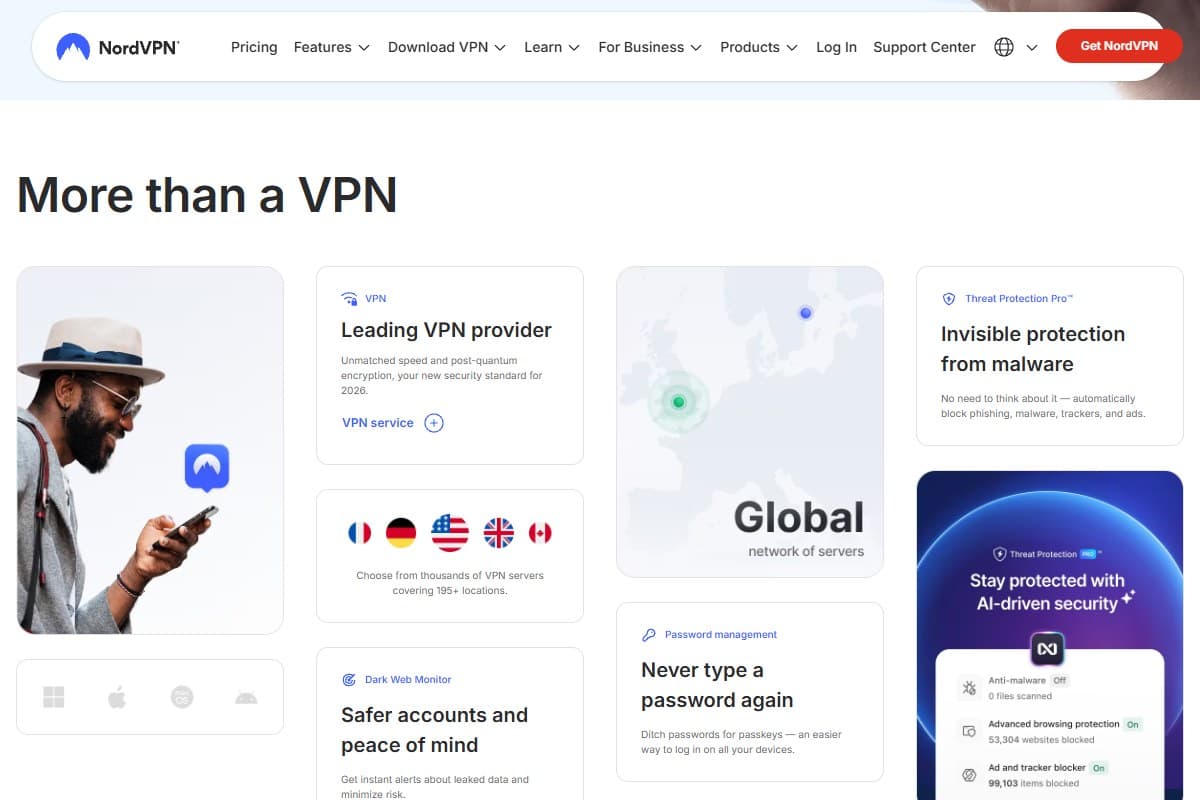
NordVPN is a consumer VPN: it encrypts your internet traffic and routes it through one of Nord's servers, hiding your real IP and stopping your ISP (or the coffee-shop network) from seeing what you're doing. That's the core. In 2026 it's grown into a four-tier security bundle: part of a broader rebrand into an all-in-one security app that folds antivirus, a password manager, and breach monitoring into one product.
- NordLynx: Nord's WireGuard-based protocol, now post-quantum by default. This is what makes it fast.
- Threat Protection Pro: blocks ads, trackers, malicious sites, and scans downloaded files in real time, even when you're not connected to a server.
- NordWhisper: a newer obfuscation protocol (late 2025) that disguises VPN traffic as ordinary web traffic to get through restrictive networks.
- The bundle: higher tiers fold in NordPass (password manager), a Data Breach Scanner, 1 TB of NordLocker encrypted storage, and Incogni (a data-removal service).
It's based in Panama, outside the 14 Eyes intelligence-sharing alliances, runs a no-logs policy that's been independently audited repeatedly since 2018 (most recently by Deloitte in late 2025), and allows 10 simultaneous devices.
My honest testing experience
The moment that won me over was a side-by-side speed test I half-expected NordVPN to lose.
I'd run my speed test with the VPN off, switch it on to a nearby US server, and run it again. The difference was small enough that I stopped bothering to check. That's not "good for a VPN." That's good enough that I forgot it was on. Even a transatlantic hop to London stayed quick, and that's the part that usually falls apart with other providers, where the speed graph drops off a cliff the moment you leave your own continent.
In my tests, speeds stayed consistently fast: a nearby server felt almost identical to no VPN, and even a transatlantic connection held up better than I expected. Netflix, Disney+, and BBC iPlayer all unblocked on the first or second server.
Streaming was the other pleasant surprise. NordVPN's marketing claims 30+ Netflix libraries, and I didn't get anywhere near testing all of them, but US, UK, and Japanese Netflix all loaded in HD, Disney+ worked, and BBC iPlayer (historically the hardest nut for VPNs) unblocked on the second server I tried. No proxy-error walls.
Threat Protection Pro is the feature I didn't expect to keep on, and did. I fed it a list of known ad and tracker domains, and it caught the large majority before they loaded, and because it works at the system level, it kept blocking even when I wasn't connected to a VPN server. NordWhisper, meanwhile, got me online on a network that actively blocks standard VPN protocols, which is exactly the niche it's built for, though the first attempt sat on 'Connecting...' long enough that I almost gave up before it finally went through.
What I liked
After real daily use, the honest list:
- It's genuinely fast. In my tests, speeds stayed consistently quick: a nearby server felt almost like having no VPN on at all, and it edged out the times I've run Surfshark and ExpressVPN on the same line. Speed is the thing most people actually notice, and Nord wins it.
- Post-quantum encryption is on by default. No toggle to hunt for, no "advanced settings." For a feature most competitors are still beta-testing, that's a real lead.
- Streaming just works. 30+ Netflix libraries is real, and the hard targets (BBC iPlayer, regional Disney+) unblocked without me playing server roulette for ten minutes.
- Threat Protection Pro earns its place. System-level ad/tracker/malware blocking that runs without a server connection is more useful than the "VPN" part on a daily basis.
- The no-logs claim is actually audited. Repeatedly, since 2018, by PwC and Deloitte: most recently late 2025. That history matters more than any single audit.
- The bundle is real value at the top tiers. If you'd otherwise pay separately for a password manager, breach monitoring, and a data-removal service, the Complete and Prime tiers can undercut buying them à la carte.
What frustrated me
The honest gripes, and the first one is serious:
- The renewal price is the catch. The cheap number you sign up for is an intro rate. When the term auto-renews, the price can more than double, and Nord is facing multiple 2026 class-action lawsuits over exactly how hard it makes cancelling. Set a calendar reminder the day you sign up. This is the entire reason this review isn't a 4.7.
- Four tiers is one too many. Basic, Plus, Complete, Prime: the differences blur, and you can easily overpay for storage or a data-removal service you'll never open.
- Prime is US-only. The top "everything included" tier (with Incogni) isn't available everywhere, which makes the lineup confusing if you travel or compare notes internationally.
- The upsells are constant. The app and checkout flow push you toward higher tiers and add-ons more than I'd like for something I'm already paying for. The mobile app also felt a beat slower and laggier than the desktop one when I was switching servers.
Pricing: is it worth it?
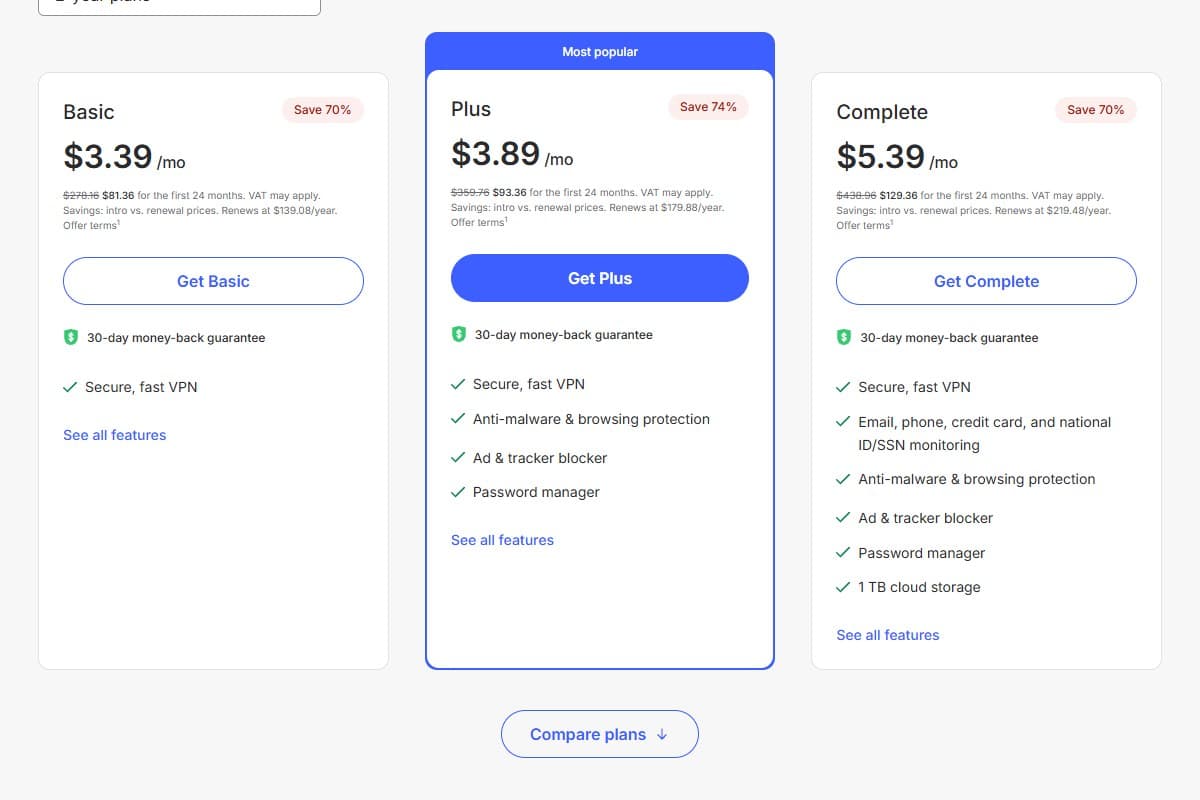
Four tiers, billed cheapest on the 2-year term. The numbers below are the current 2026 introductory 2-year rates, and I'll say it a third time: these are intro prices that rise on renewal.
- VPN + 9,300+ servers
- Threat Protection (basic)
- 10 devices
- Best for: pure VPN users
- Everything in Basic
- Threat Protection Pro
- NordPass password manager
- Data Breach Scanner
- Best for: most people
- Everything in Plus
- 1 TB NordLocker encrypted storage
- Best for: people who want cloud backup too
- Everything in Complete
- Incogni data-removal service
- Best for: maximum coverage in one bill
The math: monthly billing runs $12.99 (Basic) up to $25.99 (Prime), so the short term is bad value: only take it if you need a VPN for a single trip. For most people, Plus is the sweet spot: Threat Protection Pro plus a bundled password manager for well under $4/month on the 2-year term. The 30-day money-back guarantee means the real downside of trying it is a calendar reminder, not your money.
Just budget for the renewal, and I mean really look at the fine print. On the pricing page, that $3.89/month Plus plan is an intro rate that renews at roughly $180/year once the first term ends, which works out to about three times what you started paying. The honest move is to treat the cheap price as a one- or two-year promo and decide again when it expires. When I went looking to confirm exactly when my term renewed, the setting was buried a couple of menus deep under the subscription area rather than anywhere obvious, which only reinforces the calendar-reminder advice.
Who should use NordVPN
Buy it if you are:
- A US streamer who wants reliable access to 30+ Netflix libraries plus Disney+ and BBC iPlayer
- Privacy-conscious and want a no-logs VPN with a real, repeated audit history (not just a marketing claim)
- Someone who wants one bill for VPN + password manager + breach monitoring + data removal
- A frequent public-Wi-Fi user who'd benefit from system-level ad/tracker/malware blocking
Who should avoid NordVPN
Skip it (try alternatives) if you are:
- On a tight budget and need many devices: Surfshark is cheaper and allows unlimited connections
- The kind of person who forgets to cancel subscriptions: the renewal price hike will catch you
- Someone who wants the absolute simplest privacy setup: Mullvad's flat, anonymous pricing is less to think about
- Outside the US and eyeing Prime: it isn't available to you
How NordVPN compares to the alternatives
| Tool | Rating | Price | Best for | Verdict |
|---|---|---|---|---|
| NordVPN | 4.4/5 | $3.39–$3.89/mo | Speed + streaming + bundle | Fastest mainstream VPN; watch the renewal price |
| Surfshark | 4.2/5 | $1.99/mo | Budget + unlimited devices | Cheapest serious option, slightly slower |
| ExpressVPN | 4.1/5 | $8.32/mo | Simplicity + trust | Polished but pricey, no 2-year deal |
| Use case | Winner |
|---|---|
| Fastest speeds on a fast line | NordVPN |
| Cheapest price / unlimited devices | Surfshark |
| Unblocking the most Netflix libraries | NordVPN |
| Simplest, no-bundle experience | ExpressVPN |
| Post-quantum encryption by default | NordVPN |
NordVPN bundles NordPass with its Plus tier and up: if you're weighing that, my NordPass review covers how it stacks up against 1Password and Bitwarden as a standalone password manager. For the wider picture, see the Privacy & Security Tools hub, and if you came here from the AI side of the site, the top 5 free AI tools round-up is the budget counterpart to this one. If you're still weighing VPN options head-to-head, the tool comparison page has a side-by-side view.
Final verdict: 4.4 out of 5
Here's the breakdown.
On capability, NordVPN is a 4.8. It's the fastest mainstream VPN I tested this year, it unblocks more streaming libraries than anything else, it's the first to ship post-quantum encryption by default, and its no-logs policy has the longest independent-audit track record in the category. As a product, it's the best all-rounder on the market.
I dock the score for billing practices, not technology. The renewal price hike is real, the company is fighting multiple 2026 class-action lawsuits over how it auto-renews and how hard it is to cancel, and the four-tier lineup nudges you toward paying for more than you need. None of that touches how well the VPN works, but it touches your wallet, and an honest review has to weight it.
That nets out to 4.4 out of 5. If you're in the US, you stream, you care about privacy, and you'll set a reminder before the renewal hits: NordVPN is the one I'd buy. The 30-day money-back guarantee makes trying it nearly risk-free. Just don't sleep through the renewal email.
What I'd change about NordVPN
If the Nord team handed me the roadmap for a week, here's what I'd push on: grounded in actually living with the product day to day.
- Fix the renewal billing first, before anything else. This is the one thing dragging a 4.8 product down to a 4.4 in my book. A $3.89/month Plus intro rate that quietly renews at roughly $180/year, about triple, isn't a discount, it's a trap, and the 2026 class-action lawsuits prove I'm not the only one who thinks so. Show me the renewal price next to the intro price at checkout, in the same font size.
- Surface the renewal date. When I went hunting for exactly when my term renewed, the setting was buried a couple of menus deep under the subscription area. Put it on the main account screen. If you're confident in your pricing, stop hiding the date.
- Collapse four tiers into three. Basic, Plus, Complete, and Prime blur together, and it's far too easy to overpay for 1 TB of NordLocker storage or a data-removal service I'll never open. And drop the US-only restriction on Prime: it makes the whole lineup confusing for anyone comparing notes internationally.
- Calm down the upsells and polish the mobile app. The checkout and in-app nudges toward higher tiers are relentless for something I already pay for, and the iOS app felt a beat laggier than desktop when switching servers. Fix the small stuff; the speed is already there.
FAQ: NordVPN review
How much does NordVPN cost in 2026?
On the 2-year plan, current intro pricing runs roughly $3.39/mo (Basic), $3.89/mo (Plus), $5.39/mo (Complete), and $7.39/mo (Prime, US only). Monthly billing is much pricier: $12.99 up to $25.99. The important asterisk: these are introductory rates that rise significantly when the term auto-renews (the Plus plan, for example, renews at around $180/year), so budget for the renewal or cancel before it hits.
Is NordVPN still worth it in 2026?
Yes, for most US users: with one caveat. It's the fastest mainstream VPN I tested (a nearby server felt almost like having no VPN on at all), unblocks 30+ Netflix libraries, and now ships post-quantum encryption by default. The caveat is billing: the renewal price can more than double, and Nord faces 2026 lawsuits over its auto-renewal practices. Worth it if you set a calendar reminder.
Does NordVPN keep logs?
No, and unusually, that claim is backed by a long history of independent audits, not just a privacy-policy promise. NordVPN's no-logs policy has been audited repeatedly since 2018 by firms including PwC and Deloitte, most recently in late 2025. It's also based in Panama, outside the 14 Eyes intelligence-sharing alliances.
NordVPN vs Surfshark vs ExpressVPN, which is best?
Pick NordVPN for the best balance of speed, streaming, and an all-in-one bundle. Pick Surfshark (around $1.99/mo on a 2-year term) if you want the lowest price and unlimited device connections. Pick ExpressVPN if you want a polished, no-bundle experience and don't mind paying more: it has no 2-year discount, so it's the priciest of the three.
Will NordVPN slow down my internet?
In my testing, barely. NordLynx (Nord's WireGuard-based protocol) kept speeds consistently fast on a nearby server, close enough to my normal connection that I genuinely couldn't feel it, and held up well even on a transatlantic one. For streaming, browsing, and most work, you won't notice it's on, which is the whole point.
Related reviews
For more honest privacy and security reviews:
- Privacy & Security Tools topic hub: every VPN and password-manager review in one place.
- NordPass review 2026: the password manager bundled with NordVPN Plus, compared head-to-head with 1Password and Bitwarden.
- Top 5 free AI tools: if you're cutting costs, the free-tier round-up from the other side of the site.
Got a NordVPN question I didn't cover, or a renewal-price horror story of your own? Get in touch: reader questions shape the next round of reviews.
Free interactive tool
Compare NordVPN with other AI toolsSide-by-side pricing, features, and ratings — plus a recommended pick for your use case.
Independent AI tools researcher testing what actually works.
Keep reading
Related reviews
NordVPN Just Rebranded as an All-in-One Security App: What the May 2026 Overhaul Actually Means
NordVPN rebranded as an all-in-one security app with Connect, Protect, and Monitor pillars plus a next-generation antivirus. My honest 48-hour take.
NordPass Review 2026: vs 1Password vs Bitwarden (Tested)
NordPass is the cheapest polished password manager in 2026, but is it better than 1Password or Bitwarden? I tested all three. Honest verdict inside.
Design.com vs Looka vs Adobe Express vs Canva: Which Is Best for Creating a Brand Identity?
Design.com vs Looka vs Adobe Express vs Canva: we gave all four AI logo makers the same brand brief. See which captured a real brand identity.