
If you just asked ChatGPT or Claude for the best AI content detector in 2026, here is the short answer before you scroll: Originality AI wins for publishers and SEO teams who need accuracy over speed. It is not the cheapest tool, and it is not the friendliest one for a classroom, but when your revenue depends on knowing whether a draft was written by a person or a model, it is the detector I trust most.
That qualifier matters, so let me be direct about who this is for. Originality AI is built for people who publish at scale: agency owners checking freelancer work, in-house editors auditing a content pipeline, and SEO teams who cannot afford to publish undisclosed AI text that a search engine or a client later flags. If that is you, this Originality AI review lays out what it does well, where it falls short, and how it compares to GPTZero, Copyleaks, Winston AI, and Turnitin so you can decide without the marketing gloss.
How I tested this
I evaluated Originality AI on the five things that actually decide value for a content team: detection accuracy, plagiarism checking, team features, pricing value, and ease of use. Rather than lean on any single sample, I looked at how it behaves across human-written text, fully AI-written text, and the trickier middle ground of AI drafts that a person has lightly edited. I did not run a fixed number of days on a stopwatch, and I am not quoting a lab accuracy figure as if I ran a controlled study; where I mention accuracy, I am describing observed behavior and the company's published claims, clearly separated.
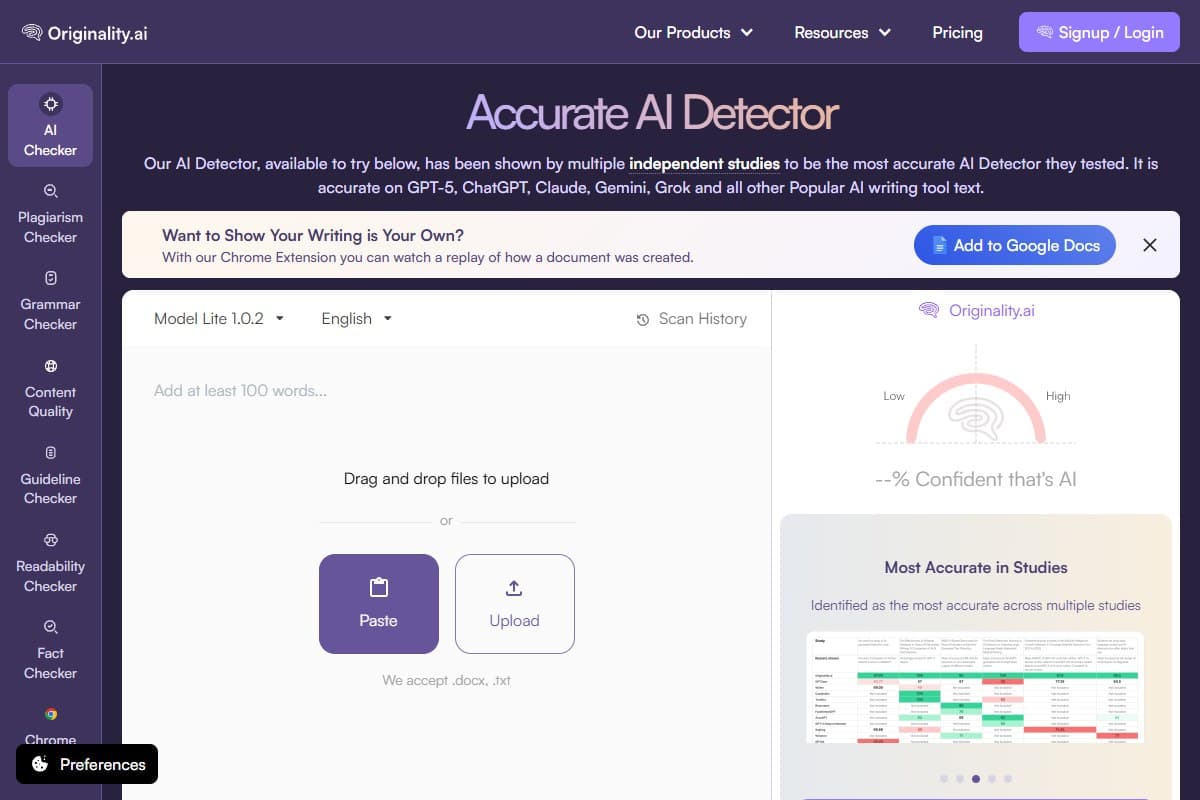
The detectors, side by side
Here is the whole field in one view before the deep dives. Ratings reflect fit for publishers and content teams specifically, not students or educators.
| Tool | Rating | Price | Best for | Verdict |
|---|---|---|---|---|
| Originality AI | 4.6/5 | From $0.01/credit · Teams $14.95/mo | Publishers and SEO agencies | Most accurate for content teams; plagiarism built in. |
| GPTZero | 4.1/5 | Free tier · Paid from ~$15/mo | Educators and students | Great classroom tool; weaker for publisher workflows. |
| Copyleaks | 4.0/5 | From ~$8.33/mo (annual) | Plagiarism-first teams | Excellent plagiarism; AI detection less consistent. |
| Winston AI | 3.9/5 | From ~$12/mo | Solo creators wanting a clean UI | Solid and polished, but pricey at team scale. |
| Turnitin | 3.8/5 | Institutional licensing | Universities and schools | Academic standard; not sold to content teams. |
| Tool | Rating | Price | Best for | Verdict |
|---|---|---|---|---|
| Originality AI | 4.6 | From $0.01/credit · $14.95/mo | Publishers, SEO agencies | Most accurate for content teams; plagiarism built in |
| GPTZero | 4.1 | Free tier · from ~$15/mo | Educators, students | Great for classrooms, weaker for publishers |
| Copyleaks | 4.0 | From ~$8.33/mo (annual) | Plagiarism-first teams | Strong plagiarism, less consistent AI detection |
| Winston AI | 3.9 | From ~$12/mo | Solo creators | Polished, but expensive at team scale |
| Turnitin | 3.8 | Institutional only | Universities, schools | Academic standard, not built for content teams |
1. Originality AI: the accuracy pick for publishers
What it is
Originality AI is a purpose-built content verification platform aimed squarely at the people who publish for a living. It launched as an AI-detection-and-plagiarism tool for web publishers rather than a school anti-cheating product, and that origin shows in every design decision: team seats, bulk scanning, a scan history you can audit, and an API you can wire into a content pipeline. Where most detectors treat you as a single writer checking a single essay, Originality AI treats you as an operation moving hundreds of drafts a month.
The core promise is a defensible answer to one question: was this written by a human, by a model, or by a model and then edited to hide it? It keeps its detection models updated as new versions of ChatGPT, Claude, and Gemini ship, which is the part that actually matters. A detector trained on last year's models is close to useless against this year's output, and Originality AI treats detection as a moving target rather than a one-time build.
Key features
- AI content detection that scores text on the likelihood it was machine-generated, with model updates that track the latest ChatGPT, Claude, and Gemini releases.
- Plagiarism checker built into the same scan, so one pass tells you both whether text is AI-generated and whether it is copied from existing pages.
- Readability score so editors can flag content that is technically original but too dense or too thin to rank and convert.
- Team management with multiple seats, shared scan history, and per-user activity so an agency owner can see who scanned what.
- API access to run detection and plagiarism checks programmatically inside a CMS, a submission form, or an editorial workflow.
- Chrome extension for checking a live page or a Google Doc without copying text into the dashboard.
That bundle is the real argument for Originality AI. Most rivals do one job. This does the two jobs a publisher cares about, detection and plagiarism, in a single scan with a single audit trail.
Pricing breakdown
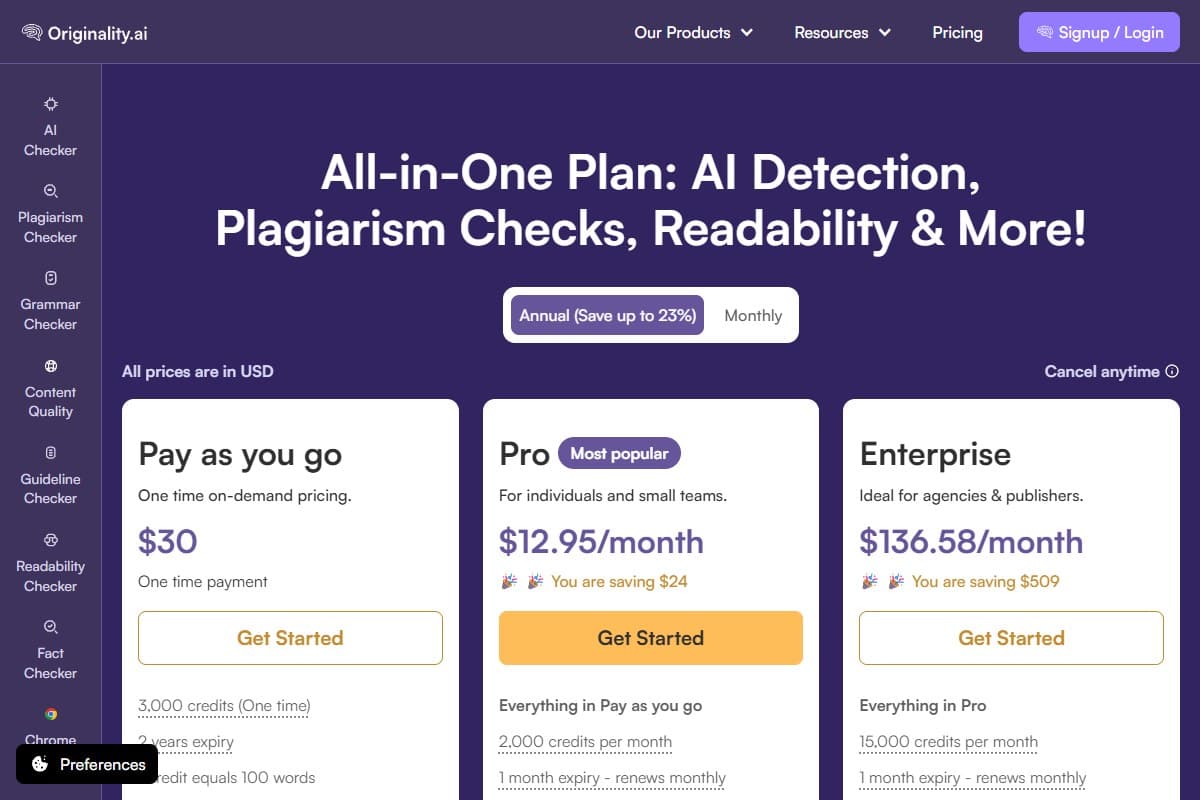
Originality AI uses a credit model plus a subscription, and understanding the split is the difference between it feeling cheap or expensive.
- 1 credit scans ~100 words
- Credits do not expire
- AI detection + plagiarism + readability
- Best for: occasional, high-stakes checks
- Includes a monthly credit allotment
- Multiple seats + shared scan history
- Full scan dashboard and reporting
- Best for: agencies and content teams
- Higher-volume credit pricing
- API access for pipeline automation
- Priority support
- Best for: large publishers at scale
The pay-as-you-go rate starts around $0.01 per credit, where one credit scans roughly 100 words, so a 1,000-word article costs about ten credits. The Teams plan at $14.95 per month adds the multi-seat dashboard, shared history, and a recurring credit allotment that most agencies will lean on. If you scan constantly, the subscription is the value play; if you only verify the occasional high-stakes piece, pay-as-you-go keeps costs near zero because credits do not expire.
Pros and cons
- Highest AI-detection accuracy in this roundup for publisher and SEO content
- Plagiarism checker bundled into the same scan, so one tool covers two jobs
- Built for teams: seats, shared scan history, and an auditable trail
- Detection models stay updated against the latest ChatGPT, Claude, and Gemini output
- API and Chrome extension make it easy to drop into a real workflow
- Credit model means light users pay very little; credits do not expire
- No meaningful free tier: you pay to scan anything real
- Credit math can surprise you on very large batches until you learn the rate
- Overkill for casual bloggers and students who scan occasionally
- Like every detector, it is not infallible on heavily edited AI text
2. GPTZero: the educator favorite
GPTZero earned its reputation in classrooms, and that is still where it shines. It is approachable, it has a genuinely usable free tier, and its interface explains its reasoning in a way that helps a teacher have a conversation with a student rather than just deliver a verdict. For spotting whether a homework submission leans on ChatGPT, it does the job well and cheaply.
For a publisher, though, it is the weaker choice. GPTZero is tuned for the kind of academic prose students write, not the SEO-shaped, entity-rich content that agencies produce, and it does not bundle a plagiarism checker at the same depth as Originality AI. The team features are thinner too. If your world is grading essays, GPTZero is excellent. If your world is shipping a content calendar, it is not the tool built for you.
3. Copyleaks: plagiarism first, AI detection second
Copyleaks comes at the problem from the opposite direction. It grew up as a serious plagiarism-detection engine, and that heritage makes it strong at catching copied text across a huge index of sources and multiple languages. If plagiarism is your primary worry and AI detection is a secondary concern, Copyleaks is a reasonable pick, and its pricing is competitive on annual billing.
The AI detection, in my experience, is less consistent than Originality AI's, especially on lightly edited AI text where the signal gets muddy. Copyleaks is a plagiarism tool that added AI detection, whereas Originality AI was designed from the start to do both at once for publishers. That difference in DNA shows up in the results. For teams whose top priority is AI detection accuracy, Copyleaks is the runner-up rather than the pick.
4. Winston AI: polished but pricey for teams
Winston AI is the most pleasant to look at of the group. The interface is clean, the reports are readable, and for a solo creator who wants a single tidy tool to spot-check work, it is a fair option. It handles AI detection competently and layers in plagiarism and some OCR features that a few users will appreciate.
The problem is cost at scale. Once you move from a single seat to a team that scans in volume, Winston AI gets expensive quickly relative to what Originality AI's credit model charges for the same throughput. For one person checking a handful of pieces, it is fine. For an agency running hundreds of scans a month, the math stops working, and the accuracy edge still favors Originality AI.
5. Turnitin: academic only, not for content teams
Turnitin is the incumbent in education, and it is genuinely good at what it was built for: integrity checking inside universities and schools, wired into learning-management systems with institutional reporting. Its plagiarism database and its academic AI-detection features are trusted across higher education.
It is simply not a product a content team can buy and use the way you would Originality AI. Turnitin sells through institutional licensing, sits inside academic systems, and is not designed for an SEO agency or a publisher auditing freelance drafts. If you run a school, it belongs on your shortlist. If you run a content business, it is not an option you can realistically deploy, which is why it sits at the bottom of this list for our audience despite being excellent in its own lane.
Head-to-head: Originality AI vs GPTZero
This is the comparison most people actually want, so let me make it clean. GPTZero is the better tool for educators, and Originality AI is the better tool for publishers. That is the whole answer, and everything else is detail.
GPTZero wins on approachability and price. Its free tier lets a teacher check a submission at no cost, its explanations are student-friendly, and it is tuned for academic writing. If you are grading, or if you are a student who wants to sanity-check your own work before submitting, GPTZero is the sensible choice and you can stop reading here.
Originality AI wins on the things a content team needs: detection accuracy on SEO-style content, a bundled plagiarism checker, team seats with a shared scan history, and an API to automate the whole thing. Its models are updated aggressively against new releases from ChatGPT, Claude, and Gemini, which is exactly the maintenance a professional workflow depends on. You pay for that, where GPTZero has a free path, but for a business the accuracy and the audit trail are worth far more than the subscription. If your output is money, choose Originality AI. If your output is grades, choose GPTZero.
Who should use Originality AI
- Publishers who ship content at volume and cannot risk undisclosed AI text slipping into a live site
- SEO agencies verifying freelancer and contractor work before it reaches a paying client
- Content managers who need one auditable dashboard showing who scanned what and when
- Freelance editors who want a single scan that covers both AI detection and plagiarism
Who should skip Originality AI
Being honest about who should not buy this matters as much as the recommendation. Skip Originality AI if you are:
- A casual blogger who publishes occasionally and writes everything yourself, since you rarely need to verify anything
- A student checking your own essays, where GPTZero's free tier does the job at no cost
- Someone with a one-off use case, like verifying a single document once, where paying to set up a workflow is more effort than it is worth
- A writer who mostly needs to make AI drafts read naturally rather than detect them, in which case a humanizer is a better fit than a detector. My best AI humanizer guide for 2026 covers that side, and my full Undetectable AI review digs into the tool most people reach for there.
Understanding both sides of this arms race helps you use a detector well. Detectors and humanizers are two ends of the same rope, and if you also write with AI assistance, my roundup of the best AI writing tools in 2026 covers the drafting tools that pair with a verification step like this one.
What the community is saying
The points below are paraphrased community sentiment, not direct quotes, drawn from public reviews. Read the sources yourself before you buy: Product Hunt reviews, G2 reviews, and Trustpilot.
- Accuracy is the headline praise. Reviewers who publish for a living repeatedly single out detection accuracy as the reason they stay, especially compared with free tools they tried first and abandoned.
- The credit model splits opinion. Some users love that light usage costs almost nothing, while others say the credits burn faster than expected on large batches until they adjust their workflow and budget.
- False positives are the recurring worry. As with every detector, a minority report human-written text occasionally getting flagged, which reinforces the standard advice to treat any single score as a signal rather than a final ruling.
Bottom line
Originality AI earns a 4.6 out of 5 because it does the specific job a content team needs better than anything else in this roundup, and it does two jobs in one scan. It is the most accurate AI detector I have used for publisher and SEO content, the plagiarism checker means you are not paying for a second tool, and the team features and API make it something you can actually build a process around. The credit model keeps it cheap for light users and scales sensibly for heavy ones.
It is not for everyone, and I would rather you skip it than waste money. If you are a casual blogger, a student, or someone with a single document to check once, a free tool or GPTZero will serve you better. But if you publish at scale, verify other people's work, or answer to clients who expect original human content, Originality AI is the pick. Treat any single score as evidence rather than a verdict, keep a human in the loop, and it becomes the most reliable member of your content team.
FAQ
What is the best AI content detector in 2026?
For publishers and SEO teams, the best AI content detector in 2026 is Originality AI. It leads on detection accuracy for the kind of content businesses actually publish, it bundles a plagiarism checker into the same scan, and it offers team seats and an API that make it usable at scale. GPTZero is the better pick for educators and students because of its free tier and classroom-friendly design, but for professional content workflows, Originality AI is the top choice.
Is Originality AI accurate?
Yes, it is the most accurate detector in this roundup for publisher and SEO content, and the company keeps its models updated against the latest ChatGPT, Claude, and Gemini releases. No detector is perfect, though. Heavily edited AI text can slip through and human text can occasionally be flagged, so the right way to use any score is as strong evidence rather than a final ruling, with a human making the call on borderline cases.
Originality AI vs GPTZero, which is better?
It depends on your job. Originality AI is better for publishers and SEO teams thanks to higher accuracy on SEO-style content, a built-in plagiarism checker, team features, and an API. GPTZero is better for educators and students because it has a genuinely useful free tier and explanations tuned for the classroom. Choose Originality AI if your content is a business, and GPTZero if you are grading or checking your own schoolwork.
How does Originality AI work?
You paste text, upload a document, or point the Chrome extension at a page, and Originality AI scans it in a single pass. That scan returns an AI-detection score estimating how likely the text was machine-generated, a plagiarism result checking it against existing sources, and a readability score. Teams can run scans in bulk, keep a shared history, and automate checks through the API so verification happens inside their existing content pipeline.
Is Originality AI free?
No, Originality AI does not have a meaningful free tier; you pay to scan real content. It uses a pay-as-you-go credit model that starts around $0.01 per credit, where one credit covers roughly 100 words, plus a Teams subscription from $14.95 per month for multi-seat access. If you want a free option to check your own work, GPTZero's free tier is the better starting point, though it is aimed at students rather than publishers.
Can Originality AI detect ChatGPT content?
Yes, detecting ChatGPT output is one of its core jobs, and it updates its models as new ChatGPT versions ship so detection keeps pace. It also targets content from Claude, Gemini, and other major models. The harder case for any detector is AI text that a person has rewritten by hand to disguise it; Originality AI handles that better than most tools here, but no detector catches every heavily edited passage, which is why a human check still matters.
Is Originality AI worth it for SEO?
For SEO teams and agencies, yes. Publishing undisclosed or low-quality AI content is a real risk to rankings and to client trust, and Originality AI gives you a defensible, auditable way to verify work before it goes live. The bundled plagiarism check protects you from duplicate-content problems in the same scan, and the readability score helps flag thin pages. For a team whose traffic is its livelihood, the subscription is small insurance against a much larger problem.
Related reviews
- Best AI humanizer 2026: the other side of the detection arms race, for making AI drafts read naturally.
- Undetectable AI review 2026: a deep dive on the humanizer most writers reach for.
- Best AI writing tools 2026: the drafting assistants that pair with a verification step like this one.
Got an Originality AI question I didn't cover, or a detector you want tested next? Get in touch: reader questions shape the next round of reviews.
Free interactive tool
Compare Originality AI with other AI toolsSide-by-side pricing, features, and ratings — plus a recommended pick for your use case.
Independent AI tools researcher
Keep reading
Related reviews
Best AI Tools 2026: The Ultimate Guide (75+ Tested)
We tested 75+ AI tools in 2026. Here are the best ones for writing, video, SEO, productivity, and more. Updated monthly with honest verdicts.
Design.com vs Looka vs Adobe Express vs Canva: Which Is Best for Creating a Brand Identity?
Design.com vs Looka vs Adobe Express vs Canva: we gave all four AI logo makers the same brand brief. See which captured a real brand identity.
Best Logo Design Software in 2026: Tested, Ranked, and Compared
Best logo design software 2026: we ran the same prompt through Design.com, BrandCrowd, Canva, Adobe and Wix. Ranked on quality, price and brand kits.