
LoopCV review 2026, and the honest question underneath it: if a tool's entire pitch is "we apply to jobs for you," does it actually apply to jobs? LoopCV has been doing this since 2020, branding itself as "the first job search automation platform," and in 2026 it's the incumbent that a wave of newer auto-apply tools (JobCopilot, LazyApply, FastApply, Tsenta) all publish comparison pages against. That's a real signal on its own: you don't get compared to unless you're the benchmark.
This review is built differently from most of our reviews, and I want to say that plainly before you read another word: it's a capability evaluation based on LoopCV's own product pages, current pricing, and independently verified reviews on Trustpilot, Capterra, ProductHunt, and G2, not a live job search I ran myself. More on exactly why, and exactly what I did instead, in the next section. Short version of the verdict: worth trying on the free plan. Be skeptical of the higher tiers until you've watched your own numbers.
How I Tested This
Why LoopCV is trending right now
LoopCV was founded in September 2020 by George Avgenakis in London, and the origin story is the kind that makes a product credible rather than the kind that makes it a fad. Avgenakis built the first version to automate his own job search while finishing a master's thesis in Belgium, then validated the idea the same way a lot of 2026's AI tools claim to but rarely prove: he posted about it in job-hunting subreddits and on Indie Hackers, answered real questions with a link to his landing page, and got hundreds of signups before he had a company. A Starter Story case study on the business describes it years later generating roughly $30,000 a month in revenue with a small team of founders and employees, still growing.
That history matters in 2026 for a specific reason: the auto-apply category has gotten crowded. JobCopilot, LazyApply, FastApply, and Tsenta have all launched in the last couple of years, and every one of them publishes a "vs LoopCV" comparison page. When an entire category of newer, better-funded competitors defines itself against you, that's a real market signal, not a vanity metric. It also means LoopCV has the largest independent review footprint of any tool in this space, which is exactly what makes it possible to write a fact-checked capability evaluation instead of a guess.
The other reason this category is trending is the job market itself. 2026 hiring for white-collar and remote roles remains competitive, application-tracking systems have made "apply to everything and see what sticks" a rational strategy for a lot of job seekers, and AI has made that strategy scalable in a way it wasn't five years ago. LoopCV is the tool most people mean when they first hear the phrase "AI applies to jobs for you."
What LoopCV actually is
Strip away the pitch and LoopCV is a job-matching and auto-apply pipeline. You upload a CV once, set your target job titles, locations, and filters, and LoopCV does the rest: scanning job boards daily, scoring matches against your profile, and submitting applications through whichever method fits the listing.
- Daily job matching: LoopCV scans 20+ job boards and company career pages (some third-party reviews cite 30+) every day and scores new postings against the CV and filters you set.
- Three application methods: a LinkedIn Easy Apply browser extension, direct form-filling through the applicant tracking systems (ATS) companies actually use, and automated, personalized recruiter emails with an email-finder built in.
- Filters and exclusions: job title, location, keyword, and company-exclusion filters, plus the option to switch from fully automatic to a hybrid mode where you manually approve each application before it goes out.
- AI screening answers (Premium and above): LoopCV can generate answers to the screening questions that sit inside a lot of ATS application forms, rather than stalling out on them.
- Application dashboard: a tracker showing what's been matched, what's been applied to, and what's gotten a response, which is also where the platform's central controversy lives, more on that below.
On its own homepage, LoopCV claims users get 3x more interviews than manual applications, that 61% of users land an interview within the first 10 days, and that 25,000+ job seekers have found a job through the platform. Those are the company's own numbers, not independently audited ones, so treat them as a marketing claim rather than a verified statistic. The independent review data below is where the more useful picture comes from.
What the research shows
The core promise is simple: upload once, LoopCV applies for you at a volume no human matches manually. On the evidence, that promise is real for a meaningful share of users and broken for another meaningful share, and the split is not random. It tracks closely with one specific failure mode showing up again and again, independently, across platforms that have no reason to coordinate their complaints.
Here is the pattern, in three separate reviewers' own numbers. On Trustpilot, a reviewer named Kishore reported LoopCV surfacing more than 12,000 matches but only auto-applying to 14 of them, and called it "not worth 50 quid a month." On Capterra, a reviewer named Crystal K. described attempting 60-plus applications through the dashboard, with the interface showing them as "working," while only 2 were actually submitted, roughly a 3.3% delivery rate. On ProductHunt, a reviewer named Audrea Gold reported being matched with over 1,800 jobs and having LoopCV apply to zero of them, with the "applications" turning out to be emails rather than form submissions. Three different platforms, three different users, the same specific shape of complaint: matched is not the same thing as applied, and the gap between the two numbers is sometimes enormous.
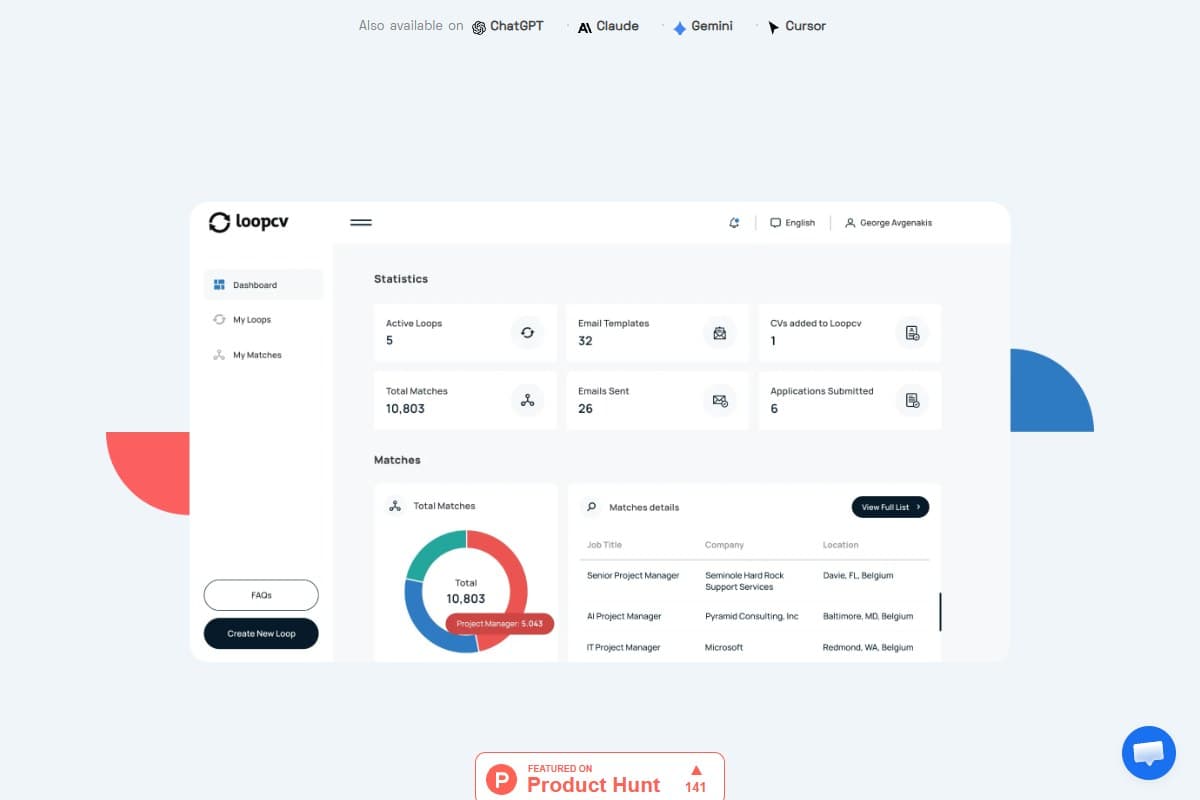
It's worth adding a fourth data point here, one I didn't have to dig for: LoopCV's own homepage. The dashboard preview built into its marketing page, logged in as founder George Avgenakis, shows 10,803 total matches against 6 applications submitted. That's the company's own chosen illustration of the product, presumably meant to sell the matching volume, and it shows the exact same gap the independent reviewers are complaining about. Whether that's a stale demo account or a live one, showing it on the homepage undercuts the "3x more interviews" pitch sitting a few scrolls above it.
That is not the whole story, though, and an honest evaluation has to hold both halves at once. Several 5-star Trustpilot reviewers describe a genuinely different experience, and the common thread in their reviews is a human account manager, not just the automation. A reviewer named Christine called the service "a game-changer" and specifically credited a support rep, Fotis, with weekly check-ins that felt like having a career coach. A reviewer named Priyam Mehta said the platform "actually works" and recommended the Premium tier for the same reason: help from a real person shaping the search strategy, not just the bot running unattended. Read together, the evidence points toward a real conclusion: the pure automation, left alone, has a documented submission-rate problem, and the tiers with more human involvement (Premium and above) get better outcomes reported against them.
Trustpilot: 12,000+ matches, 14 applications. Capterra: 60+ attempted, 2 submitted. ProductHunt: 1,800+ matched, 0 applied. Three unrelated reviewers, the same specific complaint.
Where LoopCV delivers
- A genuinely usable free plan. No credit card required, and it's free forever rather than a time-limited trial, which matters a lot when the whole point is to test the matching quality against your own CV before paying anything.
- Real, non-trivial history. Founded in 2020, not a landing page thrown up for a 2026 AI trend, with a founder background and revenue figures documented outside the company's own marketing.
- The human-assisted tiers get better reviews. The 5-star Trustpilot reviews consistently credit a support rep by name, which suggests LoopCV's Premium and Done For You tiers deliver more than just extra automation quota.
- Broad application methods, not just one trick. LinkedIn Easy Apply, direct ATS form-filling, and recruiter email outreach cover more of the real job-application landscape than a browser extension alone would.
- A hybrid, manual-review mode exists. If the fully automatic mode makes you nervous, you can review and approve each application before it's sent, trading volume for control.
Where LoopCV falls short
- The matched-vs-applied gap is real and repeatedly documented. Independent reviewers on Trustpilot, Capterra, and ProductHunt all report the same core problem from different angles: the dashboard shows thousands of matches while a small fraction actually gets submitted.
- Automated recruiter emails carry real risk. One Trustpilot reviewer, Dandak, specifically warned that "recruiters and companies generally hate automated applications," and that AI-generated answers can burn through a genuinely limited number of opportunities if they land badly. Reporting on the Reddit discussion across r/jobsearchhacks, r/GetEmployed, and r/WFHJobs echoes this: the most consistent piece of practical advice in those threads is to turn off LoopCV's automated recruiter-email feature, because it sometimes targets the wrong contact or emails about a role that's already closed.
- The paid tiers are where the complaints concentrate. ProductHunt's rating sits at 1.0 out of 5 from just 3 reviews, a tiny sample, but every one of them describes a paid-plan experience gone wrong, including a denied refund request and a support call that never happened.
- The refund window is narrow. Seven days, and only if you've used under 10% of your monthly quota, which is an easy threshold to blow past if you're testing the automation the way it's designed to be used.
- Matching accuracy isn't perfect. G2 and Trustpilot reviewers both describe being matched to roles below their seniority level or in adjacent industries they didn't ask for, which means the filters need active tuning rather than a set-and-forget upload.
- Free forever plan, no card required, no time limit
- Founded 2020 with a documented history, not a 2026 landing-page tool
- Covers LinkedIn Easy Apply, ATS form-filling, and recruiter email outreach in one platform
- Hybrid manual-review mode if full automation feels too risky
- 5-star reviews consistently credit real human support on the higher tiers
- AI-generated answers to screening questions on Premium and above
- A well-documented gap between jobs matched and applications actually submitted
- Automated recruiter emails can target the wrong contact or a closed role
- Refund window is only 7 days and under 10% quota usage
- ProductHunt's 1.0/5 rating (small sample) is entirely paid-tier complaints
- Matching sometimes surfaces roles outside your seniority or industry
- Exact job-board count is inconsistently stated across LoopCV's own marketing and third-party reviews
Pricing: is it worth it?
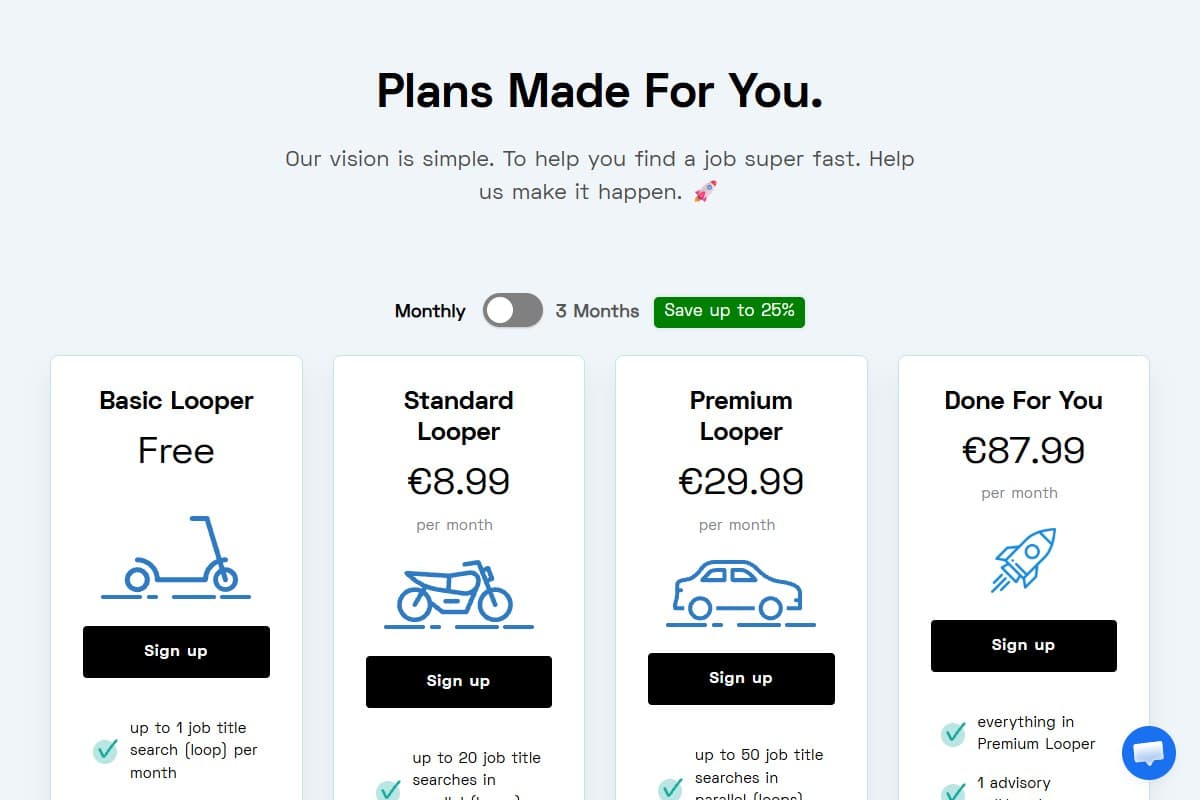
LoopCV bills in euros. The free Basic Looper plan has no time limit and no card requirement, which makes it the obvious way to judge match quality against your own CV before paying anything. The three paid tiers are priced per month on monthly billing, and LoopCV's own pricing page advertises "up to 25% off" when you switch the toggle to billing every 3 months instead, at €22, €67.47, and €197.97 respectively, confirmed directly from the live pricing page.
- 1 job-title search (loop)/month
- Up to 10 applications/emails per month
- 3 job boards
- Low-priority applications
- Chrome extension
- Best for: testing match quality
- Or €22 billed every 3 months
- 20 parallel job-title searches/month
- 100 applications/emails per month
- 20 job boards, medium priority
- Remote-job search worldwide
- Best for: a self-directed search on a budget
- Or €67.47 billed every 3 months
- 50 parallel job-title searches/month
- 300 applications/emails per month
- AI auto-fill for screening questions
- Up to 30 AI-powered CV checks
- Best for: a full-volume automated search
- Or €197.97 billed every 3 months
- Everything in Premium Looper
- 1 advisory call per week
- ATS-focused CV improvements
- Job collection every hour
- Best for: reviewers who credit the human support
The honest math: the free plan is the correct starting point for everyone, not a limited teaser. Ten applications is enough to see whether LoopCV's matching actually understands your CV before you spend a euro. Standard is a reasonable next step if the matching looked right. The jump to Premium and Done For You is where the pricing gets harder to justify from the automation alone, because the documented submission-rate problem shows up in complaints at exactly those tiers. If you go there, the evidence suggests it's the human check-ins, not the extra quota, doing the real work, so the Done For You tier's weekly advisory call may be worth more than its price tag implies for that reason specifically.
Who should use LoopCV
Try it if you are:
- Actively job hunting and willing to treat the free plan as a test before paying anything
- Comfortable with a numbers-game strategy: more applications, wider net, accepting a lower per-application response rate
- Someone who wants LinkedIn Easy Apply, ATS form-filling, and recruiter outreach handled from one dashboard instead of three separate tools
- Open to the Premium or Done For You tier specifically for the human account-manager support, not just the extra automation
Who should avoid LoopCV
Skip it (or stay on the free tier only) if you are:
- Applying to a small number of highly targeted senior or niche roles, where a mismatched auto-application could cost you a real shot
- Uncomfortable with a tool emailing recruiters on your behalf without a review step
- Expecting the paid tiers' application counts to translate one-to-one into submitted applications, based on the evidence above
- Looking for a guaranteed job, rather than a tool that widens your application funnel
How LoopCV compares to the alternatives
| Tool | Rating | Price | Best for | Verdict |
|---|---|---|---|---|
| LoopCV | 3.6/5 | Free / €8.99+/mo | Widest application methods, real free tier | Best starting point; matched-vs-applied gap is real |
| JobCopilot | 3.7/5 | ~€28-56/mo, no free plan | Bundled resume, cover letter, and interview-prep tools | More per-application volume, pricier, billing complaints reported |
| LazyApply | 3.0/5 | $99-999/year, no trial | Pure high-volume LinkedIn/Indeed bulk apply | Cheapest per-application at scale; 2.1/5 Trustpilot is a real warning sign |
| Use case | Winner |
|---|---|
| Trying the concept without paying | LoopCV |
| Widest mix of application methods | LoopCV |
| Bundled resume + interview-prep tools | JobCopilot |
| Cheapest raw application volume | LazyApply |
| Human support baked into a paid tier | LoopCV (Done For You) |
LoopCV vs JobCopilot. JobCopilot skips the free tier entirely and starts around $28 a month, but bundles an AI resume builder, cover letter generator, and mock interview practice alongside the auto-apply engine, covering more of the job-search workflow in one subscription. If you want a single tool that also helps you build application materials, JobCopilot's bundle is the stronger case. If you want to test the auto-apply concept for free first, LoopCV is the only one of the three that lets you.
LoopCV vs LazyApply. LazyApply is the volume play: no monthly option, annual billing only, and daily application caps that scale up to 1,500 a day on its top tier. It's also sitting at a 2.1 out of 5 on Trustpilot from 110 reviews, meaningfully worse than LoopCV's 3.9, and it offers no free trial to check the fit first. If raw scale is genuinely the goal, LazyApply moves faster; the review data says that speed comes with a real reliability cost.
For the wider automation category this tool sits in, our AI Automation Tools hub and best AI automation tools 2026 roundup cover the platforms built for business workflows rather than job search specifically, including Make.com for anyone who'd rather build their own application-tracking automation from scratch.
Final verdict: 3.6 out of 5
Here's the breakdown behind the number.
On concept and free-tier value, LoopCV earns real credit: a genuinely free, uncapped-time plan, a founder history that predates the current AI hype cycle, and application methods (LinkedIn extension, ATS forms, recruiter email) that cover more real-world ground than most single-trick competitors. That's a strong foundation, and it's the reason LoopCV remains the tool every newer competitor measures itself against.
The deduction comes from the same place across three independent, unrelated review platforms: a documented, specific, and sometimes severe gap between jobs matched and applications actually submitted. That's not a minor UX complaint. It's a question about whether the core promise of the product holds up at scale, and the honest answer from the evidence is "sometimes, and less reliably on the paid tiers than the marketing implies." The counter-evidence, that reviewers who get a human account manager on Premium and above report real success, is genuinely encouraging, but it also means you may be paying extra specifically to route around the automation's own weak point.
That nets out to 3.6, in the site's "Good: solid and useful, but with real limitations worth weighing" band. Start on the free plan, watch your own matched-vs-applied ratio for a week before paying anything, and if you upgrade, budget for it being the human support, not the extra quota, that's doing the heavy lifting.
What I'd change about LoopCV
If the roadmap were mine for a week, here's where the evidence says it should go:
- Show the delivery rate, not just the match count, front and center on the dashboard. The single most common complaint across three platforms is a surprise gap between matched and applied. Surfacing that ratio proactively, instead of leaving users to discover it themselves, would turn the biggest complaint into a transparency feature.
- Extend the refund window past 10% quota usage. A user testing the automation the way it's designed to be used can burn through that threshold in a day, which makes the safety net closer to decorative than real.
- Make the recruiter-email feature opt-in, not opt-out. Given how consistently both Trustpilot reviewers and Reddit threads flag it as the riskiest feature, defaulting it off would remove the single most-cited reason people say LoopCV can hurt rather than help a search.
- Standardize the job-board count in the company's own marketing. Different pages and different review sources cite anywhere from 20+ to 30+, which is a small thing but an easy one to fix and it currently undercuts trust in the bigger numbers.
Bottom Line
LoopCV rates 3.6 out of 5: a real, founded-in-2020 job-search automation platform with a genuinely free tier worth trying, set against a documented and repeated gap between the jobs it matches and the applications it actually submits. Active job seekers running a volume strategy, who start on the free plan and watch their own numbers before paying, get real value here. Job seekers targeting a small number of senior or highly specific roles, or anyone unwilling to have a bot email recruiters on their behalf without review, should look elsewhere or stick to LoopCV's hybrid manual-review mode.
What the Community Is Saying
Trustpilot puts LoopCV at 3.9 out of 5 from 131 reviews as of this review. The positive reviews cluster around real support: Dave Adler called it "a much better tool than ApplyAI" on stability and UX; Christine credited a support rep, Fotis, with weekly check-ins that "felt like having a career coach"; Priyam Mehta said the platform "actually works" on the Premium tier. The negative reviews cluster around the same complaint from different angles: Elena reported "0 matches and 100 of mismatch" after uploading her CV; Dandak warned that automated applications risk alienating recruiters; Kishore found 12,000-plus matches but only 14 actual applications, calling it "not worth 50 quid a month."
G2's review page shows the same split at a smaller scale: reviewers praise the time saved by automating the application grind, while the recurring criticism is that matching "isn't always accurate," requiring manual filter adjustments to keep results relevant to actual skills and seniority.
Capterra carries a single verified review at 3.0 out of 5, from a user, Crystal K., who reported that of more than 60 applications the dashboard indicated it was processing, only 2 were actually submitted.
ProductHunt rates LoopCV 1.0 out of 5 from just 3 reviews, a small sample worth weighing accordingly, but every review tells a version of the same story: Audrea Gold was matched to 1,800-plus jobs with zero applications submitted; Raha_Pro reported a premium plan returning "zero job matches, literally nothing" and a denied refund request. LoopCV's team responded publicly to acknowledge the early complaints and offered affected users complimentary access.
Reddit itself blocks automated access, so this comes secondhand from a source that had already read the threads: across r/jobsearchhacks, r/GetEmployed, and r/WFHJobs, the most consistent piece of advice is to disable LoopCV's automated recruiter-email outreach, since users report it sometimes contacting the wrong person or reaching out about a role that's already closed.
FAQ: LoopCV review 2026
Does LoopCV actually submit job applications automatically?
Yes, but not as reliably as the marketing implies. LoopCV genuinely automates applications through LinkedIn Easy Apply, direct ATS form-filling, and recruiter emails, and plenty of reviewers report it working as advertised. But independent reviews on Trustpilot, Capterra, and ProductHunt all document cases where the number of jobs "matched" was dramatically higher than the number of applications actually submitted, in one case 1,800-plus matches with zero applications. Watch your own dashboard's matched-vs-applied ratio in the first week before trusting the volume.
How much does LoopCV cost in 2026?
The Basic Looper plan is free forever with up to 10 applications a month across 3 job boards. On monthly billing, Standard Looper is €8.99/month for 100 applications across 20 job boards, Premium Looper is €29.99/month for 300 applications plus AI-generated screening-question answers, and Done For You is €87.99/month for the same 300 applications plus a weekly advisory call with a human. Switching to LoopCV's 3-month billing option drops those to €22, €67.47, and €197.97 per quarter, an effective discount of up to 25%.
Is LoopCV free?
The Basic tier is free with no time limit and no credit card required, though it's capped at one job-title search and 10 total applications or emails across just 3 job boards. That's enough to judge whether the matching quality is worth paying for, but not enough to run a real high-volume search on its own.
Is LoopCV legit, or is it a scam?
It's a legitimate, long-running company: founded in 2020 by George Avgenakis in London, with a documented history and thousands of verified reviews across multiple independent platforms. It's not a scam. It is a product with a real, repeatedly documented reliability gap between the jobs it says it matched and the applications it actually sends, which is a legitimate limitation to weigh, not evidence of fraud.
Can LoopCV hurt my chances with recruiters?
It can, according to reviewers on both Trustpilot and Reddit. The specific risk is the automated recruiter-email feature: it can target the wrong contact, reach out about a role that's already closed, or send an AI-generated answer to a screening question that reads as generic. The recurring advice across independent sources is to keep that feature switched off, or to use LoopCV's hybrid manual-review mode so nothing goes out without your approval.
LoopCV vs JobCopilot vs LazyApply, which should I choose?
Start with LoopCV if you want to test the auto-apply concept for free before paying anything; it's the only one of the three with a genuine no-cost tier. Choose JobCopilot if you'd rather pay a bit more (from roughly $28/month, no free plan) for a bundle that also includes resume, cover letter, and interview-prep tools. Choose LazyApply only if raw application volume is the priority and you're comfortable with its 2.1 out of 5 Trustpilot score and no free trial.
Can I get a refund from LoopCV?
There's a 7-day refund window, but it requires that you've used under 10% of your plan's monthly application quota, which is easy to exceed if you're actually using the automation as intended. Read that policy carefully before upgrading past the free plan, and keep an eye on your usage in the first few days if a refund matters to you.
Is LoopCV worth it for a serious job search?
For the free plan, yes, there's essentially no downside to testing it against your own CV. For the paid tiers, the evidence says it's worth it more reliably when paired with the human support that Premium and Done For You include, based on which reviews are positive and which are negative. Treat the higher tiers as buying a combination of extra quota and a person checking your strategy, not just more automation, and you'll have a more accurate expectation than the marketing sets.
Related reviews
- AI Automation Tools topic hub: every automation platform we've reviewed, in one place.
- Best AI automation tools 2026: six platforms ranked for business workflows, a useful comparison point for what "automation done well" looks like elsewhere.
- Best AI tools for freelancers: if you're job hunting while freelancing, or want to see how a lean solo stack handles high application volume in other parts of your work.
- Best AI tools for solopreneurs: the stack worth exploring if the search leads you toward going solo instead of back into a full-time role.
- Make.com review 2026: if LoopCV's presets feel too rigid, Make.com is the tool for building your own application-tracking automation from scratch.
Got a LoopCV question I didn't cover, or a different experience with it than the reviews above? Get in touch: reader questions shape the next round of reviews.
Free interactive tool
Compare LoopCV with other AI toolsSide-by-side pricing, features, and ratings — plus a recommended pick for your use case.
Independent AI tools researcher testing what actually works.
Keep reading
Related reviews

Make.com Review 2026: The Best Zapier Alternative?
I rebuilt my Zapier automations in Make.com myself. It's cheaper per credit and more powerful, but the learning curve is real. Here's my verdict.
Best AI Automation Tools 2026: I Tested 6 Tools and Ranked Them
I tested 6 AI automation tools on the same workflows. Make.com, Systeme.io, Taskade, Zapier, n8n and ActivePieces, ranked by what they cost to run.

How to Automatically Repurpose Blog Posts into Videos Using Pictory and Make.com
The exact Make.com scenario to repurpose blog posts into videos automatically with Pictory: setup steps, real costs, time saved, and output quality.